
How to Sequence Your 2027 Goals Across Four Quarters
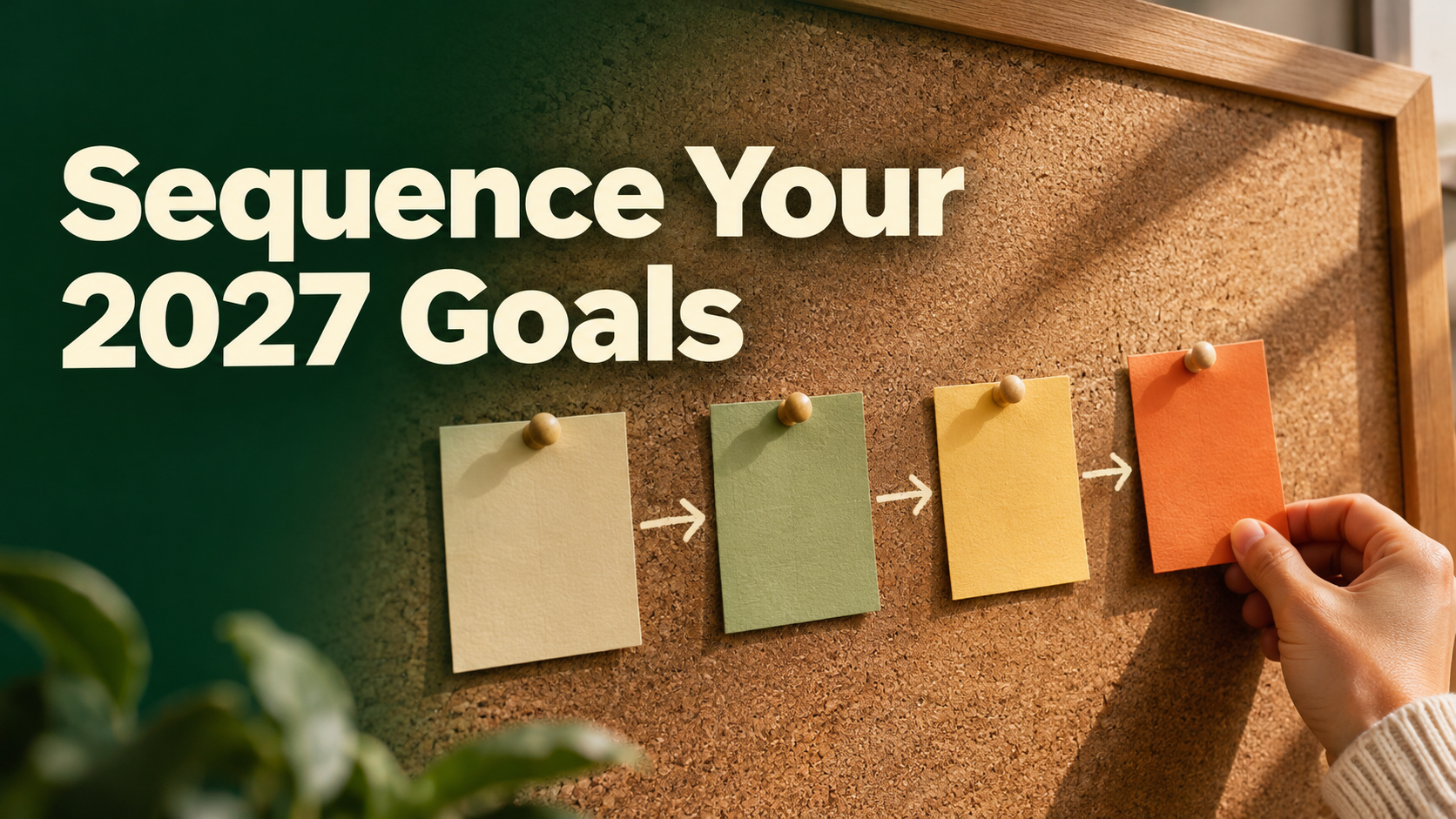
Several good goals can fail for the same reason: they all need your attention in the same month. A four-quarter plan helps you decide what needs to happen first, what can run alongside it, and what can wait until you know more.
Write a year map that answers three questions for each goal. What has to be true before it starts? When is the best window for the work? What decision will its first milestone let you make?
Separate real dependencies from preferences
A prerequisite is something the later work genuinely needs. A newsletter pilot needs a draft and a way to send it. A verdict about whether the pilot is worth continuing needs some response from readers. A redesigned website might help a wider launch, but Maya, a fictional freelancer, can email a small pilot to readers who've opted in while her existing site stays up.
Check for shared constraints too. Two projects can be independent on paper and still need the same two mornings or the same reviewer. Give the busier work the clearer window. If a goal can be maintained with a small repeating commitment, budget that time before adding project milestones.
Give each quarter a finish line and a decision
| Quarter | Example milestone | Decision at the end |
|---|---|---|
| Q1 | Interview readers and show them one sample issue | Proceed with the pilot if feedback reveals a clear audience and topic |
| Q2 | Send three pilot issues and record reader feedback | Continue, narrow the topic, or end the pilot |
| Q3 | Build a small data visualization project if client work permits | Decide whether the skill is worth applying to client reporting |
| Q4 | Package the year's useful work and agree on the next publishing schedule | Commit to a workable rhythm or free up the time |
Put firm dates on near-term commitments and mark distant dates as provisional when they depend on earlier decisions. Maya can reserve an autumn learning window without assuming the pilot will have ended on schedule. If the pilot needs another cycle, she can explicitly choose which project gets the time.
For each milestone, write a fallback. “If no reviewer is available by May 10, send the sample to the backup reviewer and confirm a new feedback date.” A reaction to a specific event is easier to use than a promise to stay adaptable.
Keep the year map and the next actions connected
In SelfManager.ai, keep the four-quarter map in a pinned table and record the condition for opening each next phase in its notes. Create dated tasks for the upcoming milestone and add the decisions from your checkpoint as comments. At each quarterly review, compare what actually happened with the condition you wrote before the work started. Dated tables, pinning and review.
If you use AI Plan, give it the approved part of the year map and draft the next block up to 31 days. Specify the hard dates and the work already taking the same time. A draft you can edit is useful when you know the constraint and still need help turning it into a workable sequence. AI Plan.
For milestones that already have a firm outside date, plan backward from the deadline.
Date-based AI Task Manager
Plan smarter, execute faster, achieve more
Create tasks in seconds, generate AI-powered plans, and review progress with intelligent summaries. Perfect for individuals and teams who want to stay organized without complexity.
Get started with your preferred account