
The Perfect Balance for Knowledge Workers in 2026
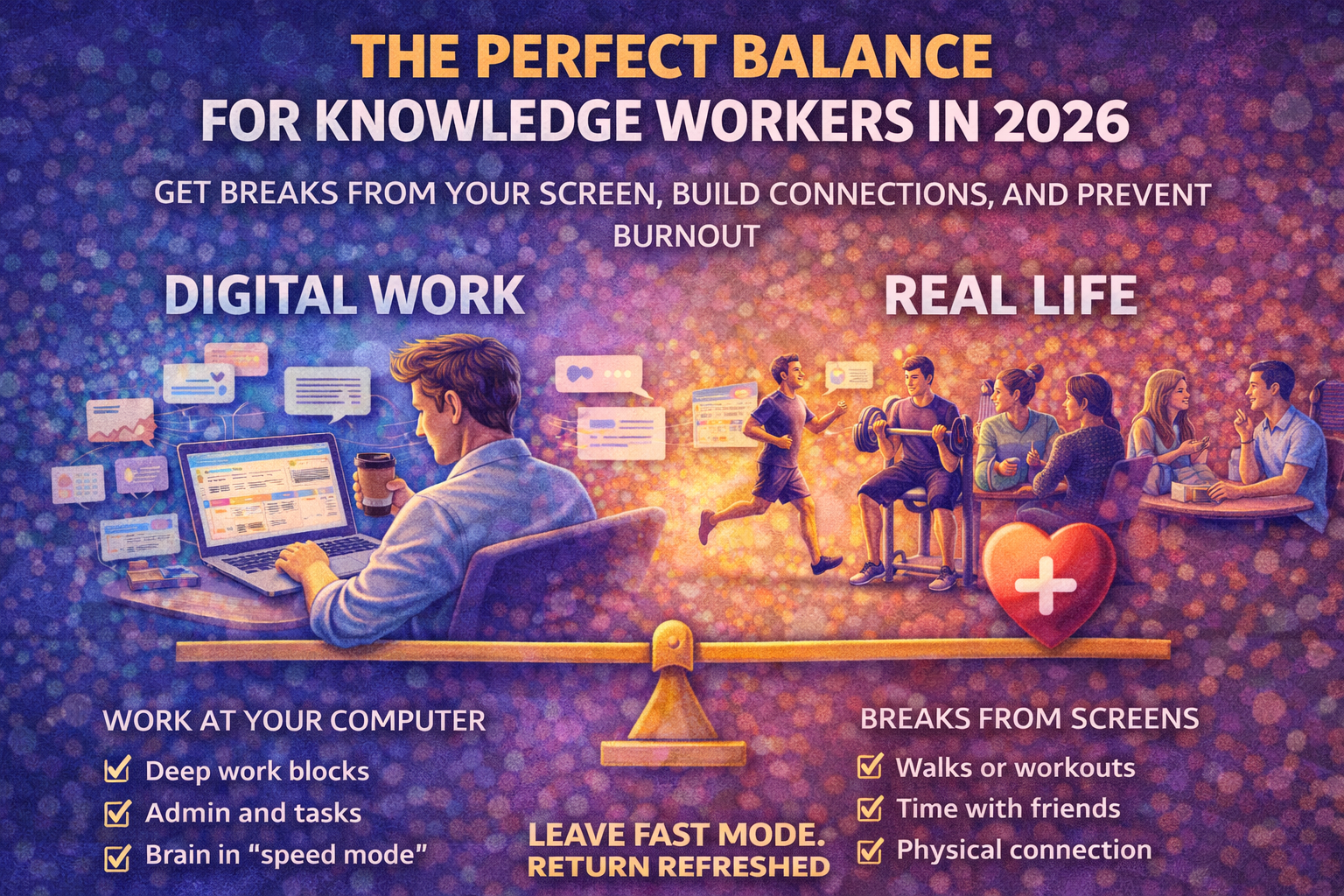
Why stepping away from your screen makes you *more* productive (not less)
If you're a knowledge worker in 2026, you spend most of your day in one place:
in front of a screen.
Your work happens in:
- tabs
- docs
- messages
- calendars
- dashboards
- tickets
- code
- AI tools
And the digital world has a specific "vibe":
- everything feels urgent
- everything updates instantly
- there's always something happening
- you can always do "one more thing"
- your brain stays in speed mode
The problem is: your body doesn't live in speed mode.
Your nervous system isn't built for 8–12 hours of continuous digital stimulation.
So if you want the perfect balance in 2026, you need a system that includes something most people forget:
regular breaks from devices to reconnect with the physical world.
Not as a luxury.
As a requirement for sustainable performance.
Digital speed creates a hidden trap: you never truly reset
When you stay in the digital environment too long, your brain gets stuck in:
- fast switching
- constant stimulation
- shallow attention
- "just check" behavior
- mental tension
You might still be working.
But your work quality drops over time:
- focus gets weaker
- decisions get worse
- creativity gets lower
- stress rises
- burnout becomes easier
This is why "working more" often produces less.
You're not a machine.
You need resets.
Physical world breaks are the reset button
When you step away from screens and do something physical, a few good things happen:
- your attention recovers
- your nervous system calms down
- your brain processes problems in the background
- you regain perspective
- you return with better focus
This is why many people get their best ideas:
- on a walk
- in the shower
- at the gym
- during a run
- while socializing
- during calm time with a partner
The physical world slows you down in a healthy way.
And paradoxically, slowing down creates better output.
What "physical world connection" looks like (simple options)
This doesn't have to be extreme.
Here are high-ROI ways to leave the digital mindset:
1) Walks (the simplest reset)
A 10–20 minute walk:
- reduces stress
- clears mental clutter
- helps you return to deep work faster
Bonus: walk without headphones sometimes. Let your brain breathe.
2) Gym / strength training (power reset)
Strength training is one of the best antidotes to "screen fatigue."
It forces:
- body awareness
- effort
- full attention
- long-term thinking
It also improves sleep, energy, and confidence — which makes work easier.
3) Jogging / cardio (mental flush)
Cardio is like clearing your cache.
If you feel mentally "stuck," a run or brisk walk often resets your mood and attention quickly.
4) Socializing with friends (reality grounding)
Screen life can make everything feel abstract and fast.
Friends bring you back to:
- emotion
- perspective
- humor
- reality
A good conversation is a nervous system reset.
5) Intimate relationships (deep human reset)
This is one of the most underrated productivity supports.
Not because it "makes you work more"…
…but because it makes you feel human again.
Connection reduces stress, improves mood, and breaks the isolation loop that many screen-heavy workers fall into.
The real goal: leave speed mode before you burn out
A knowledge worker's biggest danger isn't laziness.
It's staying in "speed mode" for too long.
Speed mode looks like:
- constant checking
- constant notifications
- always being "on"
- never finishing mentally
- feeling like the world is moving too fast
The physical world forces a different pace.
That pace is what prevents burnout.
The perfect balance system (practical, not motivational)
You don't need a "wellness lifestyle."
You need a rhythm.
Rule 1: Breaks are part of the plan
If you don't plan breaks, you won't take them.
You'll just "push through" until you crash.
Rule 2: Use a simple break schedule
Here are 3 schedules that work:
Option A (simple):
- 10 minutes outside midday
Option B (strong):
- 2 x 15-minute walks (midday + late afternoon)
Option C (high performer):
- one daily workout + one short walk
Pick the one you can repeat.
Rule 3: Protect at least one device-free block daily
Even 30 minutes helps.
No scrolling.
No notifications.
No "just checking."
This breaks the addiction loop.
Why this makes you more productive (not less)
Because productivity is not time spent.
It's:
- focus quality
- decision quality
- emotional stability
- creativity
- sustainable energy
Physical world breaks improve all of those.
So you're not "wasting time."
You're protecting your output engine.
How SelfManager.ai fits (planning work and breaks together)
One reason knowledge workers burn out is they plan only work tasks.
They don't plan recovery.
SelfManager.ai (formerly Self-Manager.net) helps because your day lives in one place — so you can plan:
- deep work blocks
- meetings/admin
- and physical world breaks
When breaks are on the schedule, they happen.
And when they happen, your work improves.
Copy/paste: "Digital Balance" daily template (2026)
Work (must-win):
- 1 deep work block (60–90 min)
Support tasks:
- 2 small tasks
Physical reset (non-negotiable):
- 20-minute walk OR gym OR run
Human connection (optional but powerful):
- message a friend / plan a meetup / quality time
If your work day is only digital, your brain never fully resets.
Final thought
The digital world is infinite.
There will always be:
- one more message
- one more thing to fix
- one more task to do
- one more tab to open
So the perfect balance in 2026 isn't "doing it all."
It's building a rhythm where you repeatedly leave the screen to reconnect with:
- your body
- your environment
- real people
- real pace
That's how you stay productive without burning out.
And that's how you stay human while working in a world that moves too fast.
Date-based AI Task Manager
Plan smarter, execute faster, achieve more
Create tasks in seconds, generate AI-powered plans, and review progress with intelligent summaries. Perfect for individuals and teams who want to stay organized without complexity.
Get started with your preferred account