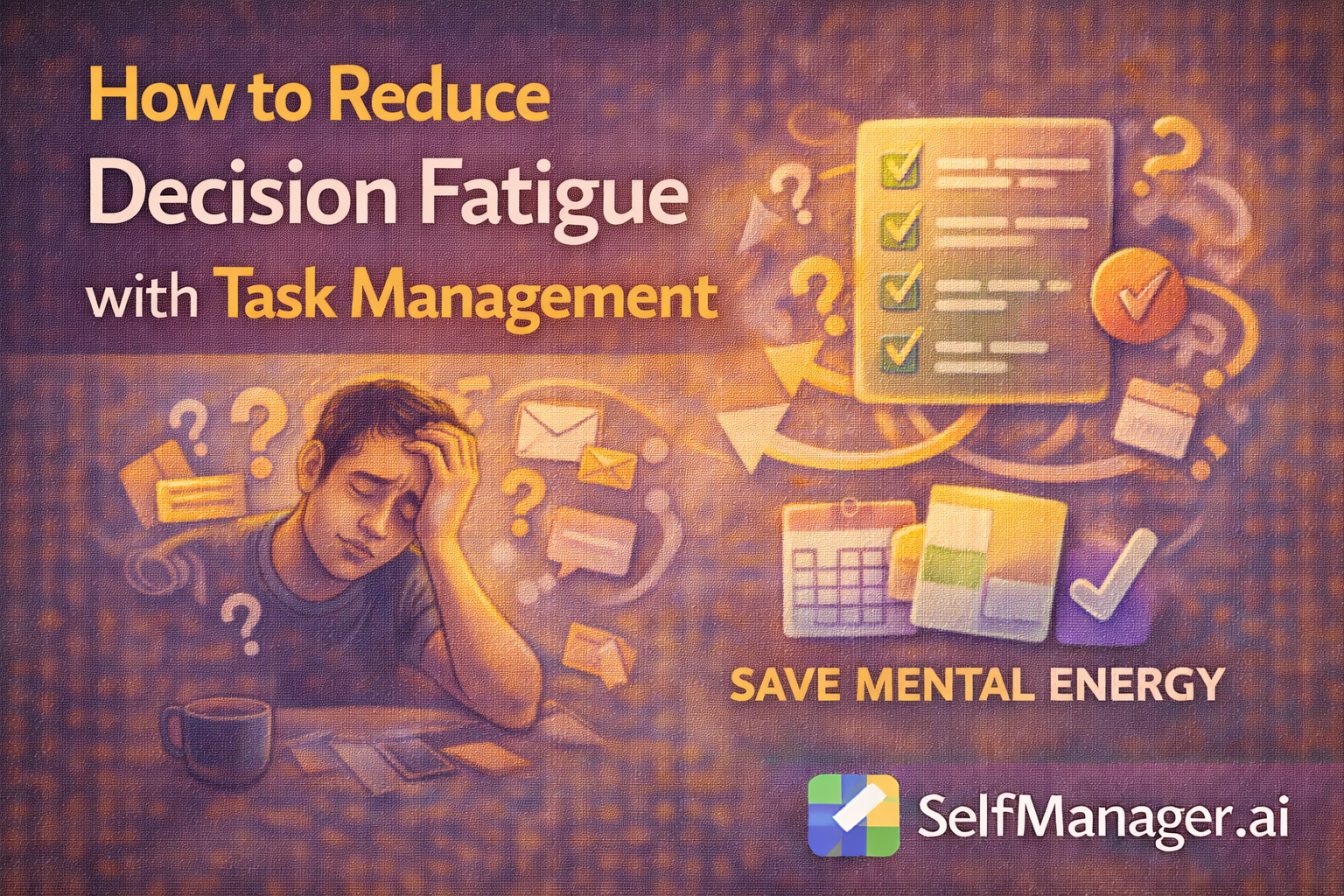
How to Reduce Decision Fatigue with Task Management
A lot of people think task management is mainly about remembering what to do.
That is part of it.
But one of its biggest benefits is something else:
It reduces decision fatigue.
That matters more than many people realize.
Because a lot of productivity problems do not come from laziness, lack of ambition, or lack of apps.
They come from making too many small decisions all day long.
What should I do first?
What matters most?
Should I respond now?
Can this wait?
Did I forget something?
Where did I put that?
What should I carry into tomorrow?
Is this even important?
By the middle of the day, that constant decision load starts to wear the mind down.
And when decision quality drops, everything gets harder:
- focus
- motivation
- prioritization
- follow-through
- emotional patience
- clarity
That is why task management matters.
A good task management system is not just a storage tool.
It is a way to reduce unnecessary decisions and preserve mental energy for work that actually matters.
What is decision fatigue?
Decision fatigue is what happens when the quality of your decisions gets worse after making too many of them.
Not only big decisions.
Small ones too.
That is what makes it dangerous.
Most people do not get exhausted because they made three giant life decisions before lunch.
They get exhausted because they made 80 tiny decisions:
- what to open
- what to answer
- what to delay
- what to prioritize
- what tool to use
- what meeting to prepare for
- what task to return to
- what reminder they forgot to capture
Each decision may feel small.
But together, they create cognitive drag.
That drag becomes mental fatigue.
Why decision fatigue is so common now
Decision fatigue is especially common today because work is so fragmented.
A normal day can involve:
- task apps
- chat
- calendar
- docs
- AI tools
- notes
- browser tabs
- calls
- personal errands
- random interruptions
That means many people are not only doing work.
They are constantly choosing between forms of work.
This is exhausting.
And the more fragmented the day becomes, the more decisions the brain has to make just to keep moving.
That is why a messy system creates more fatigue than people expect.
Why task management helps
A strong task management system reduces decision fatigue by removing uncertainty.
Instead of repeatedly asking:
- What should I do now?
- What did I forget?
- What matters most?
- Where is that item?
- What belongs today?
the system answers more of those questions for you.
That changes the whole feel of the day.
Task management helps because it can:
- clarify priorities
- reduce mental clutter
- give unfinished work a home
- keep context visible
- make next steps easier to see
- reduce repeated re-deciding
That is a much bigger benefit than simple organization.
1. Task management gets things out of your head
One of the biggest sources of decision fatigue is carrying too many open loops mentally.
You try to remember:
- calls to make
- follow-ups
- errands
- ideas
- deadlines
- things you promised
- things you meant to revisit
- things you are afraid to forget
That creates constant background pressure.
A task management system helps by giving those things a trusted place to live.
Once something is captured, your brain does not need to keep checking whether it might disappear.
That reduces mental tension immediately.
This is one of the simplest but most powerful ways task management reduces decision fatigue.
2. It reduces re-deciding
A lot of fatigue comes from deciding the same thing multiple times.
You look at a task.
You do not do it.
Later you see it again.
Then again.
Then again.
Each time, you spend fresh attention on the same unresolved question.
That is expensive.
A better task management system helps because it encourages decisions like:
- do now
- do later
- break down
- reschedule
- remove
- delegate
- attach context
That means tasks stop floating in an undefined state.
And undefined tasks are one of the biggest sources of repeated mental drain.
3. It makes priorities more visible
Decision fatigue gets worse when everything feels equally important.
That creates a heavy, noisy day.
Because if all tasks feel urgent, the brain has to keep evaluating all of them again and again.
A better task management system helps by making priority more visible.
That means you can separate:
- what matters most
- what matters later
- what is optional
- what is maintenance
- what is growth
- what should not be getting attention at all
This matters because the fewer competing “important” things you are holding at once, the easier it is to decide what to do next.
4. It gives the day a clearer shape
Many people do not get tired because they lack discipline.
They get tired because the day has no clear structure.
The workday becomes:
- react
- switch
- decide
- reopen
- reprioritize
- improvise
- repeat
That is mentally expensive.
Task management reduces this when it helps organize work by day, by sequence, or by meaningful categories.
A clearer day means fewer decisions in motion.
And fewer decisions in motion means less cognitive drain.
5. It lowers the cost of interruptions
Interruptions are bad enough.
But they are even worse when the system does not help you restart.
If you get interrupted and your work has no clear context, you have to decide:
- where was I?
- what was I doing?
- what matters now?
- what was the next step?
That restart tax adds up fast.
A strong task management system lowers this cost by keeping:
- the task
- the context
- the notes
- the next step
- the priority
closer together.
That means when you return, you do not have to rebuild the situation from scratch.
That is a huge reduction in decision fatigue.
6. It helps you close loops at the end of the day
A lot of decision fatigue carries into the evening.
Not because the day was hard in one dramatic way.
But because too many things remained unresolved.
Should I do that tomorrow?
Did I forget something?
What should I start with next?
What happened to that task?
Is this still important?
A good task management system helps close the day with decisions instead of uncertainty.
That might mean:
- moving unfinished work forward
- deleting what no longer matters
- leaving context for tomorrow
- noting the first next step
- capturing loose ends
This is powerful because tomorrow starts better when today ended cleanly.
7. It makes smaller routines possible
One hidden benefit of task management is that it makes routines easier to keep.
Not because routines are magical.
But because routines reduce decision load.
If you already know:
- how the day starts
- where priorities live
- how tasks are grouped
- how unfinished work is handled
- how the day gets reviewed
then you make fewer decisions from scratch.
That is why systems matter more than motivation.
And task management is one of the core tools that makes those systems real.
What bad task management looks like
Not every task system reduces decision fatigue.
Some make it worse.
A weak task system often looks like:
- too many lists
- too many apps
- unclear priorities
- giant backlogs
- tasks with no context
- no daily view
- no review process
- too many repeated reminders of vague work
That kind of system still creates mental clutter.
It just does it in a more organized-looking way.
The point is not to have more task management.
The point is to have task management that reduces ambiguity.
What good task management looks like
A stronger system usually includes:
- one trusted place for tasks
- visible priorities
- clear next steps
- notes or context near the work
- a daily view
- a weekly review rhythm
- a simple way to carry work forward
That kind of setup reduces decision fatigue because the system answers more questions before the brain has to.
And that is the whole game:
make fewer low-value decisions,
save more attention for meaningful ones.
Why this matters for knowledge workers
Knowledge workers are especially vulnerable to decision fatigue because their work depends on:
- reasoning
- planning
- context
- communication
- judgment
- mental quality
That means they are not only tired when they do too much.
They are tired when they decide too much.
A fragmented workday filled with small task decisions can destroy the best cognitive hours without producing much real progress.
That is why task management is not just organizational hygiene.
It is cognitive protection.
Why SelfManager.ai fits this especially well
SelfManager.ai is a strong fit for reducing decision fatigue because it organizes work around the day itself.
That matters because the day is where most decisions are happening.
A day-based system helps reduce fatigue by making it easier to see:
- what belongs today
- what matters now
- what is unfinished
- what has context
- what should move forward
- what can wait
Instead of forcing you to constantly rebuild the day from scattered tools, SelfManager.ai gives the day a clearer home.
That reduces:
- mental clutter
- restart friction
- repeated reprioritization
- open-loop pressure
And it helps tasks, notes, and decisions stay closer together.
That is exactly what lowers decision fatigue over time.
A better question to ask
Instead of asking:
“Why am I so tired by the middle of the day?”
try asking:
- How many decisions have I already made?
- How many tasks am I re-deciding?
- How much uncertainty is my system creating?
- How often am I rebuilding my priorities?
- How much of my fatigue is really decision fatigue?
That question often changes everything.
Because once you see the true source of the drain, the solution becomes much more practical.
Final thought
Decision fatigue quietly ruins a lot of good work.
It makes people slower, less clear, less patient, and less motivated.
And often the cause is not the big work.
It is the endless stream of small unresolved choices.
That is why task management matters so much.
A good task management system reduces the number of decisions your brain has to make over and over again.
It gives work a place.
It makes priorities clearer.
It lowers restart friction.
It helps close loops.
And it protects mental energy for things that actually deserve it.
That is a much stronger benefit than simply “staying organized.”
And that is exactly why a day-based system like SelfManager.ai can make such a difference.
It does not just help you track tasks.
It helps you think with less friction.
Date-based AI Task Manager
Plan smarter, execute faster, achieve more
Create tasks in seconds, generate AI-powered plans, and review progress with intelligent summaries. Perfect for individuals and teams who want to stay organized without complexity.
Get started with your preferred account