
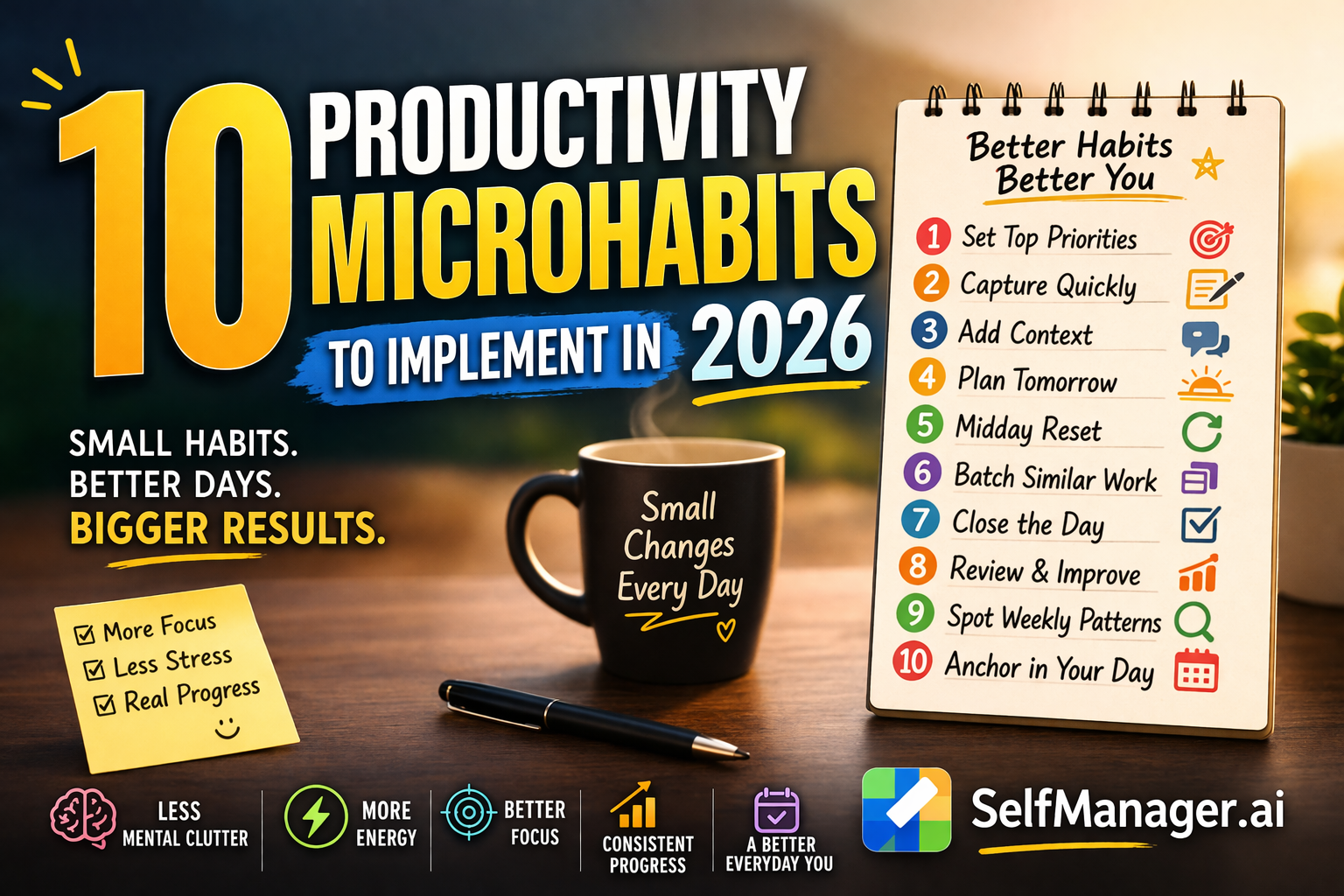
10 Productivity Microhabits to Implement in 2026
A lot of productivity advice is too heavy.
It asks people to rebuild their life overnight.
Adopt a perfect system.
Wake up earlier.
Track everything.
Change everything at once.
That usually does not last.
What lasts more often are smaller behaviors that are easy to repeat and useful enough to compound.
That is where microhabits matter.
A productivity microhabit is a small action that improves the quality of your day without demanding a huge amount of effort. It may look minor in the moment, but over time it reduces friction, protects focus, and makes progress easier to repeat.
And in 2026, that matters even more.
Because most people are not lacking productivity advice.
They are dealing with too much noise, too many tools, too many tabs, too many inputs, and too many small decisions.
So the best habits are often the ones that quietly stabilize the day.
Here are 10 productivity microhabits worth implementing in 2026.
1. Decide the top 1 to 3 priorities before checking messages
This is one of the highest-leverage microhabits you can build.
Before email, chat, notifications, and browser tabs start pulling your attention around, decide what actually matters most today.
Not everything.
Just the few things that define whether the day moved forward.
This helps because once the day gets noisy, priorities become easier to forget and easier to replace with urgency.
A small moment of clarity at the beginning of the day can save hours of drift later.
2. Capture ideas immediately instead of trusting memory
A lot of mental clutter comes from trying to remember things later.
A task comes to mind.
A follow-up matters.
A new idea appears.
A reminder shows up in the middle of something else.
And instead of capturing it, people try to keep it mentally active.
That is expensive.
A simple microhabit is:
capture it immediately in a trusted system.
This reduces background stress and stops your brain from acting like temporary storage.
3. Add one line of context to important tasks
A task title is often too thin to be useful later.
“Finish proposal.”
“Fix onboarding.”
“Review article.”
“Call client.”
That may feel clear now, but later it often creates restart friction.
A small but powerful microhabit is to add one line of context:
- what matters here
- what the blocker is
- what “done” means
- what changed
- what should happen first
This makes future work faster and lowers the cost of interruption.
4. Leave one sentence for tomorrow
At the end of the day, leave one short note for tomorrow-morning you.
Something like:
- “Start with pricing section - still unclear.”
- “Article intro first, then meta description.”
- “Follow up with client before opening email.”
This is a tiny habit, but it compounds because it reduces next-day restart cost.
You spend less energy trying to remember where the work left off.
5. Do a 2-minute midday reset
A lot of days start well and then slowly drift.
Meetings happen.
Messages appear.
Plans change.
Energy shifts.
That is why a tiny midday reset helps.
Ask:
- What still matters most today?
- What has changed?
- What can be dropped?
- What is the actual next step?
This helps prevent the second half of the day from becoming purely reactive.
6. Group similar tasks together
One of the biggest hidden drains on productivity is constant context switching.
Reply.
Write.
Plan.
Check.
Message.
Analyze.
Call.
Return.
A better microhabit is to group similar work together:
- admin together
- follow-ups together
- planning together
- deep work together
This reduces switching cost and protects mental energy.
It does not need to be perfect.
It just needs to be more intentional than random fragmentation.
7. End the day by deciding what happens to unfinished tasks
A lot of fatigue comes from unresolved work.
Tasks stay open.
They keep floating.
They silently move into tomorrow without a real decision.
A powerful microhabit is to end the day by asking:
- move forward?
- reschedule?
- break down?
- remove?
- leave a note?
This helps because unfinished work is much less stressful when it has a clear status.
8. Ask one ROI question about the day
A good microhabit is not only about doing tasks.
It is also about learning from the day.
Ask one simple question:
- What created the most value today?
or - Was today mostly growth work or maintenance work?
This matters because productivity improves faster when you stop measuring only busyness and start noticing return.
Small reflection habits like this change decision-making over time.
9. Review one repeating pattern each week
A weekly review does not need to be huge.
A strong microhabit is to notice just one pattern:
- what kept getting postponed?
- what took too long?
- what worked well?
- what drained energy?
- what gave the best payoff?
This makes self-awareness much easier to maintain.
And self-awareness is one of the biggest hidden productivity advantages.
10. Use the day itself as your planning anchor
A lot of people work from giant master lists that make everything feel equally heavy.
A better microhabit is to return to the day itself.
Ask:
- What belongs today?
- What fits today?
- What supports today?
- What should wait?
This matters because the day is a more realistic planning unit than a giant backlog.
When productivity is anchored in the actual day, it becomes easier to act, easier to review, and easier to sustain.
Why microhabits work so well
The reason these habits matter is simple.
They are small enough to repeat.
That is the whole advantage.
Big productivity overhauls often fail because they ask for too much at once.
Microhabits work better because they:
- survive imperfect days
- reduce friction immediately
- stack naturally
- improve clarity without drama
- help the system get better over time
That is real compounding.
Why this matters in 2026
In 2026, most people do not need more hype about productivity.
They need better ways to stay steady inside a noisy work environment.
That means:
- fewer open loops
- less context switching
- clearer priorities
- easier restarts
- better review
- lower decision fatigue
Microhabits are strong because they meet real life where it actually is.
Not in a fantasy perfect routine.
But in normal days that still need to work.
Why SelfManager.ai fits this especially well
SelfManager.ai is a strong fit for microhabit-based productivity because it organizes work around the day itself.
That matters because microhabits become easier to maintain when they live inside a visible daily structure.
A day-based system helps with:
- daily priorities
- quick idea capture
- task context
- unfinished work carry-forward
- review by date
- visible progress over time
That makes small habits more useful because they do not disappear into scattered apps or vague intention.
They become part of a working system.
And that is where their compounding effect gets stronger.
Final thought
The best productivity habits are not always the biggest or most impressive ones.
Often, the ones that matter most are the small behaviors that quietly improve the quality of your days:
- deciding priorities early
- capturing ideas quickly
- leaving context
- resetting midday
- grouping work better
- reviewing small patterns
- closing loops at the end of the day
That is what real productivity often looks like.
Not dramatic reinvention.
But useful small actions repeated inside a system that helps them stick.
And that is exactly why a day-based system like SelfManager.ai can be so effective.
It gives these habits a place to live, a day to belong to, and a structure that helps them actually compound.
Date-based AI Task Manager
Plan smarter, execute faster, achieve more
Create tasks in seconds, generate AI-powered plans, and review progress with intelligent summaries. Perfect for individuals and teams who want to stay organized without complexity.
Get started with your preferred account