
Habits and To-Dos Belong on the Same Day
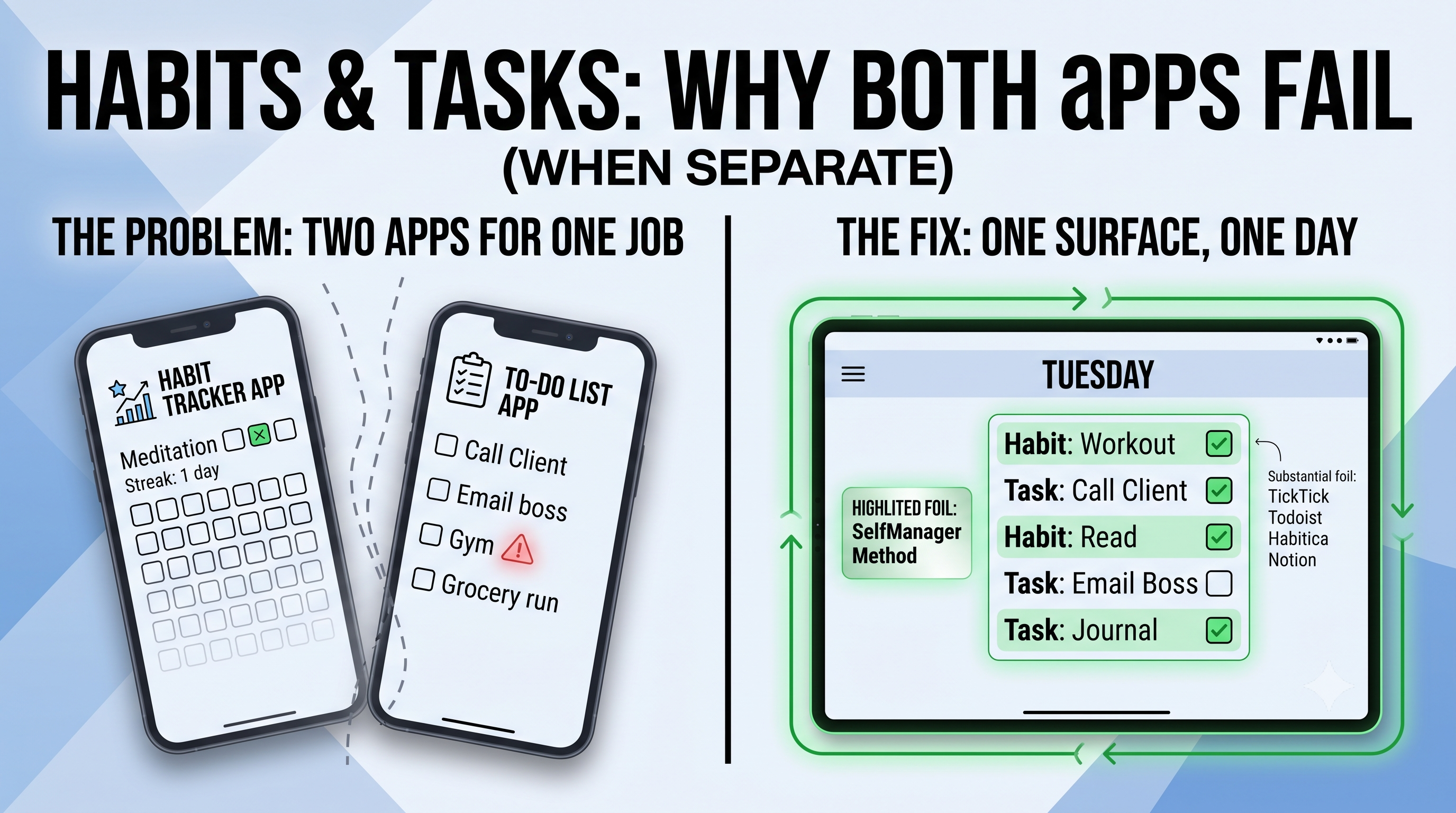
Most people run their life out of two apps that never talk to each other. The to-do list holds the work: the calls, the deadlines, the errands. The habit tracker holds the intentions: the workout, the reading, the water, the journaling. One app for what you have to do, another for who you are trying to become.
It feels organized. It is actually the reason both keep failing.
The habit you tracked in a separate app gets forgotten, because you never open it while you are actually running your day. The to-do list overflows, because it plans your hours as if your recurring commitments do not exist. The category sold you two apps for one job, then told you the problem was your discipline. It is not. It is the split.
The short answer
Habits and tasks should live on the same surface, anchored to the same day.
A habit is not a separate species of activity that needs its own home. It is just a task you have decided to repeat. When your habits and your to-dos sit together on a single day, three things happen that fix the core problem: the habit is visible at the exact moment you plan and execute, you schedule your real workload instead of half of it, and one review shows you both what you did and what you skipped. Separate the two into different apps and you lose all three, which is why the typical setup quietly collapses within a few weeks.
The rest of this is why that is true, what the habit research says about it, how the popular tools handle it, and how to actually run your day on one surface.
Why we ended up with two apps for one job
The split is not something you chose. It is something the software market did to you.
To-do apps grew up solving one problem: capture and complete discrete tasks. Habit apps grew up solving a different one: maintain streaks of repeated behavior, usually with a calendar of green checkmarks and a number that goes up. Two product categories, two business models, two sets of design decisions. So the natural thing happened. You ended up with a task manager for your work and a separate habit tracker for your routines, and you started copying intentions back and forth between them in your head.
The trouble is that your day does not come in two categories. At 7am, a workout and a work call are the same kind of thing: something that needs to happen today, that competes for the same finite hours, that you either do or you do not. Splitting them across two apps does not match how a day is actually lived. It just creates two incomplete pictures and asks you to reconcile them yourself, every single day, forever.
That reconciliation is exactly the work nobody keeps up.
What the science actually says about habits
Here is the part that reframes the whole problem. Habits are not powered by willpower. They are powered by cues. And a cue only works if it is present where you act.
Psychologist Wendy Wood has spent decades on this, and her central finding is blunt: about 43 percent of what people do every day is repeated in the same context, usually while they are thinking about something else. Nearly half your behavior is automatic and context-driven, not the result of conscious choice. That is why willpower feels so unreliable. You are trying to use the conscious part of your brain to run behavior that the automatic part is built to handle.
What makes that automatic system fire is a cue. Context cues are the environmental triggers that prompt a habit: the location, an object, the time of day, the people present, or the action that came right before. Crucially, the research shows it is the cue, not the goal, that does the triggering. In studies by Wood and colleagues, strong habits were set off by the context associated with past performance, such as a location, and were relatively unaffected by what the person currently wanted to achieve. You can want the outcome badly and still not act, because wanting is not what pulls the trigger. The cue is.
This is also why habits break for reasons that have nothing to do with motivation. When people experience changes in their everyday context, such as moving house or starting a new job, their old behaviors are no longer automatically cued. Remove the cue and the habit stops, even if the desire is unchanged. Keep the cue present and the habit fires, even when you are barely paying attention.
The famous timing study points the same way. When Phillippa Lally and her team tracked people forming new habits, each person attached their new behavior to a consistent daily cue, like doing it after breakfast, and repeated it in the same context for twelve weeks. The average time to reach automaticity was 66 days, but the range ran from 18 to 254, so the real lesson was that habit formation is highly variable and usually slower than the 21-day myth suggests. Two details from that study matter here. Missing a single opportunity to perform the behavior did not significantly hurt habit formation, and more complex behaviors like exercise took roughly one and a half times longer to become automatic than simple ones like drinking water. A more recent systematic review reached a similar place, putting median formation times in the 59 to 66 day region with enormous individual variation, and finding that self-selected habits and morning routines tended to be stronger.
There is one more piece, and it is the bridge to the practical fix. Decades of research on what psychologists call implementation intentions show that the simple act of specifying when and where you will do something dramatically improves follow-through. Across 94 independent tests, spelling out the when, where, and how of an action in an if-then form produced a medium-to-large improvement in goal attainment, with an effect size of 0.65. These plans work by making the situational cue more accessible, so that when the moment arrives, the behavior comes more automatically.
Put those threads together and the conclusion is hard to avoid. Habits run on visible, present cues. The single most reliable cue you have is the day in front of you, the one you actually look at to decide what to do next. So the question is not whether to track habits. It is whether your habits live where your day lives, or somewhere you have to remember to go.
Why a separate habit tracker quietly dies
Now apply that to the two-app setup.
You run your day off your task list. That is the surface you open in the morning, glance at between meetings, and check before you log off. It is your operating context. Your habit tracker is a different app, a different tab, a different icon you have to consciously decide to open.
So the cue for your workout lives in a place you are not looking when it is time to work out. The behavioral science says this is close to fatal. The habit needs a cue in the context where you act, and you have filed the cue somewhere else. The streak does not break because your discipline failed. It breaks because the trigger was absent at the moment of action, which the research says is exactly when habits do not fire.
This is the slow, predictable death of every habit app on your phone. The first week is great, because the novelty itself is a cue and you are opening the app on purpose. By week three the novelty is gone, you forget to open it for two days, the streak resets, the streak was the only thing motivating you, and the whole thing is uninstalled by week five. You blame yourself. You should blame the architecture. A cue you have to remember to look at is not really a cue at all.
Why a to-do list that ignores your habits overloads the day
The failure runs in the other direction too.
If your recurring commitments are not sitting on today's list, you plan as if they do not exist. You look at a day that already contains a workout, twenty minutes of reading, and a journaling session, and you see an empty day. So you fill it with six work tasks, commit to all of them, and then at 6pm you have done the work, skipped every habit, and you cannot understand why your routines never stick.
The problem is capacity blindness. A day has a fixed number of hours and a fixed amount of attention. If half your real load is invisible because it is parked in another app, every plan you make is built on a fantasy version of your day with more room than it has. You are not failing to keep your habits. You are scheduling over them, because the tool you plan in does not show them to you.
Honest capacity planning is impossible when you can only see half of what you have committed to. The habits and the tasks have to compete for the same hours on the same surface, or you will keep promising hours you already spent.
How the major tools handle habits and tasks
This is where most people feel the split without naming it, so it is worth being specific about how the popular tools draw the line. The pattern is consistent: nearly all of them keep habits and tasks in separate compartments, and the separation is the weakness.
TickTick
TickTick is the closest mainstream example, and it is the one people search for most when they hit this wall. It has a genuine, well-built Habit Tracker. The catch is that it lives as its own section, separate from your tasks and your calendar. Your habit for today and your to-dos for today exist in different views inside the same app. So you still have to switch contexts to see your full day, and the habit still is not sitting in front of you while you plan your tasks. It is two surfaces wearing one logo. That gap is precisely why so many people end up searching for how to get TickTick's habits and tasks to actually live together.
Todoist
Todoist has no real habit tracker at all. The common workaround is to model habits as recurring tasks, which sounds right but loses what a habit needs. A recurring task clutters your task list with low-stakes repeats, buries your actual priorities, and gives you none of the at-a-glance consistency view that makes a habit feel worth maintaining. A habit and a task are not identical: a habit is about the streak of showing up, a task is about the thing getting done. Flattening one into the other costs you the visibility that keeps the habit alive.
Habitica, Streaks, and Habitify
These are habit-only tools, and several are very good at the narrow job. Habitica gamifies it, Streaks and Habitify keep it minimal and clean. But by definition they only hold half your life. Use one and you are right back to running two apps: a habit app for your routines and a separate task manager for your work, with the same reconciliation problem you started with. A focused habit tracker can be excellent and still leave you fragmented.
Notion
Notion can technically do everything, which is its blessing and its trap. You can build a habit database and a task database and try to wire them into a single dashboard. But now you are maintaining two databases and the connections between them, and the upkeep becomes its own chore. The flexibility is real, and so is the friction, and friction is exactly what the habit research warns against, because anything that makes the behavior harder to reach makes it less likely to stick.
SelfManager
SelfManager takes the opposite stance: everything belongs to a date. There is no separate habits module, because a habit is just a recurring row that lives in the same day as that day's tasks. Your workout, your reading, and your three work tasks sit in one column for today, in the one place you already look. Nothing to sync, nothing to reconcile, no second app to remember. When you open the day, the habit is simply there, cued by the day itself, competing for the same visible hours as everything else. That is the entire point of a date-based system, and it happens to be exactly what the behavioral science asks for.
What this looks like on an actual day
Make it concrete. It is Tuesday.
On a single surface, today holds: a 7am workout, two work tasks due, a client call at 2pm, twenty minutes of reading, and journaling before bed. They are not sorted into habits over here and tasks over there. They are just today, in one list, in the order the day will unfold.
Because the workout is sitting at the top of today, not hidden in another app, you see it when you plan and you protect the time. Because the reading and journaling are visible alongside the work, you do not over-commit your afternoon, you can already see the day is fairly full. When you finish something, you check it off in the same place, habit or task, no app-switching. And on Sunday, when you review the week, the missed journaling session and the missed work task show up in the same view, so you get an honest picture of the week instead of two partial ones you never bother to combine.
That is the whole argument in one day. The habit got its cue. The schedule reflected reality. The review was complete. None of that required more discipline. It required one surface.
But what about streaks and gamification?
The obvious objection: streaks and points are motivating, and dedicated habit apps do them well. Are you giving that up?
Two things. First, the streak is doing less than you think. The research is clear that missing a single day does not meaningfully damage habit formation, which means the all-or-nothing streak that resets to zero after one miss is not just unnecessary, it is actively discouraging. It punishes a normal, harmless lapse and often ends the habit entirely out of guilt. A simple record of how consistent you have been, visible on the same surface as the rest of your day, gives you the useful signal without the brittleness.
Second, if gamification genuinely works for you, keep a habit app for the handful of habits where points and badges are the thing keeping you going. The argument here is not that habit trackers are useless. It is that the default for your everyday routines should be the day you already live in, because that is where the cue is. Reach for the separate, gamified tool as the exception, for the specific habits that need it, not as the home for all of them. Most of what you are trying to build does not need a game. It needs to be in front of you.
How to actually do it
If you want to collapse the two apps into one surface, the move is straightforward.
Put every recurring commitment on the day itself, next to your tasks, instead of in a separate tracker. Treat a habit as a repeating item that belongs to each day, so it shows up automatically and you never have to remember to go look for it.
Anchor each habit to something already in your day. The research on cues and on implementation intentions both point the same way: attach the new behavior to a fixed point you already hit, like after the morning coffee or before the first meeting, and specify the when. Lally's participants did exactly this with cues like after breakfast, and naming the moment is what made the behavior automatic over time.
Plan your tasks around your habits, not on top of them. Once the recurring items are visible on today, you can see your true capacity and stop scheduling over the routines you care about.
Review on one surface. Once a week, look at the day-by-day record of what you did and skipped, habits and tasks together, in the same place. One honest picture beats two partial ones, and it is the picture that actually tells you whether your week worked.
Give it the time the science says it takes. Sixty-six days on average, longer for anything physically demanding, and highly individual. The point of putting habits on your daily surface is not a fast win. It is to make sure the cue is present every one of those days, so the habit has the chance to form at all.
Where this leaves you
The two-app setup is not a discipline tool. It is a discipline tax. It asks you to manually reconcile your routines and your work every day, hides half your workload while you plan, and parks your habits' cues in a place you are not looking when it matters. Then, when it falls apart, it lets you conclude that you are the problem.
You are not. Habits run on present, visible cues, and the most reliable cue you own is the day in front of you. Put your habits and your to-dos on the same day, on one surface, and you stop fighting your own architecture. The workout stops being something you forgot in another app and becomes a line in today, right where the science says it needs to be.
One job. One day. One surface.
Takeaways
- A habit is just a task you have decided to repeat, so it does not need a separate app. It needs to live where your day lives.
- Habits are triggered by present context cues, not by willpower or goals, and the time of day is one of the strongest cues you have.
- A separate habit tracker fails because its cue sits in a place you are not looking while you run your day, so the behavior never fires.
- A to-do list that hides your recurring commitments causes capacity blindness, so you over-schedule and skip your routines without noticing.
- Most popular tools keep habits and tasks in separate compartments. TickTick has a habit tracker but in its own section, Todoist makes you fake it with recurring tasks, habit-only apps leave you running two tools, and Notion makes you build and maintain two databases.
- A date-based system puts habits and tasks on the same day by default, which is both simpler and aligned with how habits actually form.
- Streaks are more brittle than useful, since missing one day does no real harm. Track consistency without the all-or-nothing reset.
- Expect formation to take around 66 days on average, longer for demanding habits, and highly variable from person to person.
FAQ
Should habits and tasks be in the same app?
Yes. A habit is a repeated task, and keeping it on the same surface as your to-dos means it is visible when you plan and execute, it counts toward your real daily capacity, and you can review everything in one place. Splitting them across two apps forces a daily reconciliation that most people stop doing within weeks, which is why both the habit and the planning tend to fail.
Does TickTick combine habits and tasks?
TickTick includes a habit tracker, but it sits in its own section, separate from your tasks and calendar. So while both live inside the same app, they are not on the same surface, and you still switch views to see your full day. That separation is the exact gap many people run into when they want their habits and tasks genuinely together.
Is a recurring task the same as a habit?
Not quite. A recurring task is about getting a specific thing done on a schedule, while a habit is about the consistency of showing up, often for something small. You can model a habit as a recurring task, but you lose the at-a-glance record of consistency that makes a habit feel worth maintaining, and you clutter your task list in the process.
How long does it take to build a habit?
On average about 66 days, according to research by Phillippa Lally and colleagues, but the range in that study ran from 18 to 254 days. More complex behaviors like exercise take longer than simple ones, and timing varies a lot between people. The 21-day figure is a myth.
Where should habits live in a daily planner?
On the day itself, alongside that day's tasks, ideally anchored to something you already do at a fixed time. Habit research shows behaviors become automatic when they are tied to a consistent cue in the context where you act, and your daily plan is the context you actually look at, which makes it the right home for a habit.
Date-based AI Task Manager
Plan smarter, execute faster, achieve more
Create tasks in seconds, generate AI-powered plans, and review progress with intelligent summaries. Perfect for individuals and teams who want to stay organized without complexity.
Get started with your preferred account