Do Knowledge Workers Need a Task + Project Manager in 2026?
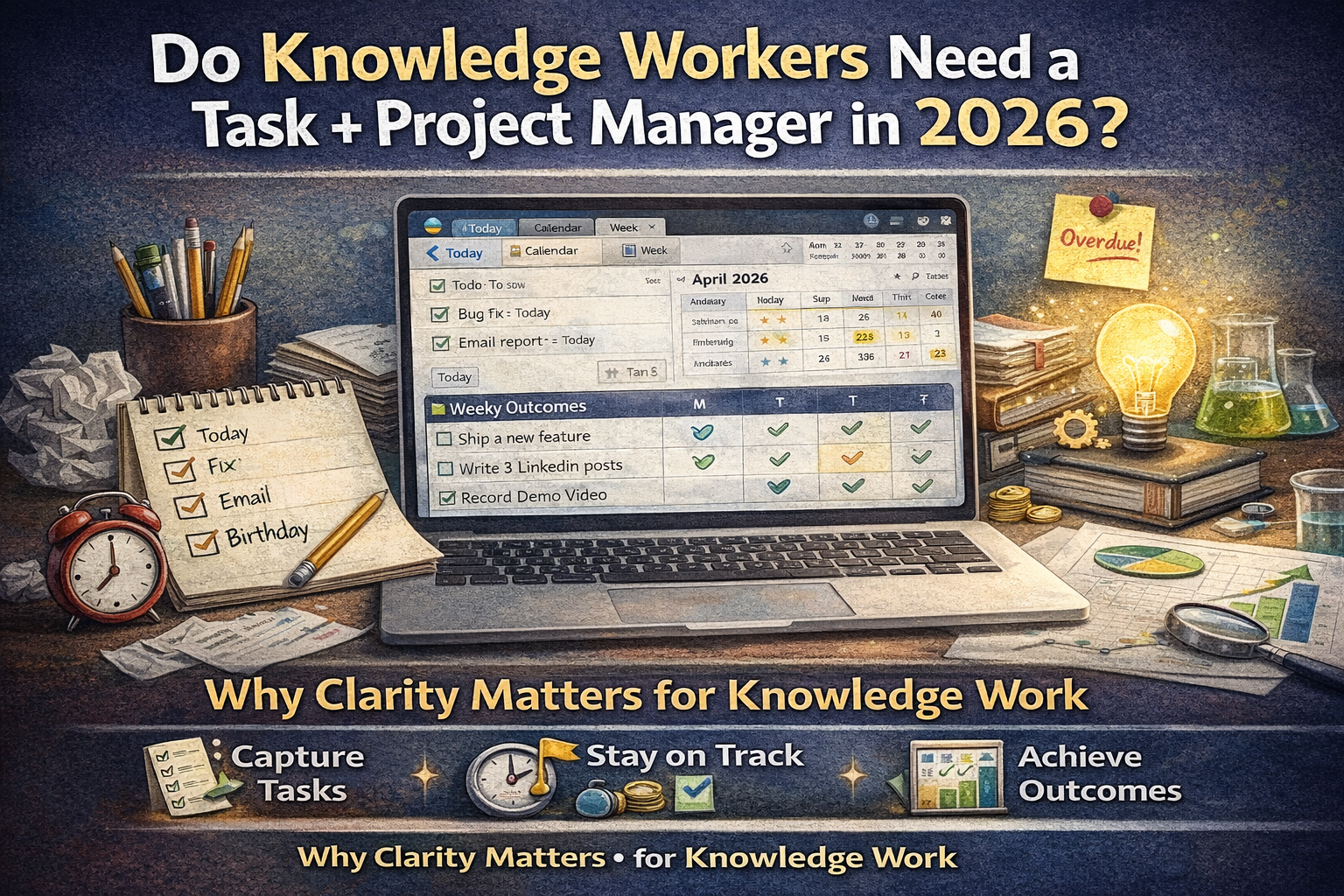
If you work from a computer, your biggest risk isn't laziness — it's invisible chaos
If you're a knowledge worker, your job is mostly:
- thinking
- writing
- designing
- planning
- coding
- communicating
- deciding
And ironically, that kind of work creates a special problem:
your work is invisible until it ships.
That's why it's so easy to feel "busy" while your important projects don't move.
So do you need a task/project manager app in 2026?
Not always.
But if you want consistent output (and less mental noise), the answer is usually: yes — because your brain isn't designed to manage modern work alone.
What "knowledge work" breaks (and why it feels different)
Knowledge work has three hidden costs:
1) You carry too many open loops
Unfinished tasks sit in your head like background tabs.
Even when you're "working," part of your attention is trying to remember:
- follow-ups
- ideas
- deadlines
- commitments
- what's next
2) You get pulled into reaction all day
Messages, Slack, email, meetings, quick fixes…
Reaction feels productive because it's constant motion.
But it often kills deep work.
3) Your "real work" has delayed reward
Writing, building, designing, strategy — these pay off later.
Small tasks pay off now.
So your brain chooses small tasks unless you build structure.
When you DO need a task/project manager app (signs)
If any of these are true, a task/project manager becomes leverage:
- you reschedule the same tasks repeatedly
- you forget follow-ups or "drop" commitments
- you have multiple projects running at once
- your weeks blur together and you can't explain what you achieved
- you feel busy but outcomes are inconsistent
- you plan daily but still feel reactive
- you want to build assets (content, product, skills) that compound
In short: when your work has complexity and time horizons, you need a system.
When you might NOT need one
If your work is mostly:
- a single clear pipeline (same tasks daily)
- few moving parts
- low number of concurrent projects
- minimal meetings/interruptions
…you can sometimes survive with a calendar + a short daily list.
But most knowledge workers in 2026 don't have that kind of simplicity.
To-Do List vs Task Manager vs Project Manager (quick clarity)
This matters because people "try a to-do list" and assume that's the category.
- To-do list: capture and remember
- Task manager: prioritize, track, execute
- Project manager: connect tasks to projects + time periods + reviews
Knowledge workers don't just need "tasks."
They need progress, across weeks and months.
That's why project structure + reviews matter.
The real value: a task manager gives you a feedback loop
A good system creates this loop:
Plan → Execute → Review → Adjust
Without the loop, you're guessing.
With the loop, you improve every week:
- better estimates
- better prioritization
- fewer carryovers
- less chaos
- more deep work
- more shipping
That's how professionals operate.
A simple setup that works (even if you hate complexity)
If you're allergic to complicated systems, do this:
1) One Inbox
Capture everything that pops up.
No organizing while capturing.
2) Three outcomes per week
Every week, choose 3 outcomes that matter.
Not 12. Three.
3) Deep work blocks
Schedule 2–4 blocks of 60–90 minutes for real work.
4) Daily "must-win"
Each day: 1 must-win + 2 support tasks.
5) Weekly review (15 minutes)
What shipped? What didn't? Why? What changes next week?
This alone will put you ahead of most people.
Why SelfManager.ai fits knowledge work especially well
Many task apps focus on lists.
SelfManager.ai is built around something knowledge workers actually need:
- planning by day/week/month (time periods)
- tasks and work grouped in a way that supports review loops
- a structure that helps you move from "busy mode" to "progress mode"
- AI features that help summarize and reflect when your weeks get dense
In other words, it's designed for the work reality of 2026:
lots of information, lots of context, lots of projects, not enough attention.
It helps you keep everything "outside your head" while still staying oriented around outcomes.
The biggest misconception: "Task managers are extra work"
A good system is not more work.
It replaces:
- mental reminders
- re-planning
- forgetting
- task anxiety
- context switching
- "what was I doing again?" moments
The goal isn't to manage tasks.
The goal is to reduce friction and ship outcomes.
FAQ
"Can't I just use my calendar?"
Calendars show time. They don't show progress, priorities, or next actions well — and they don't create review loops by default.
Calendar + task/project system is usually the winning combo.
"I tried a task app and it didn't stick."
Most people fail because they used it like storage.
Make it a loop:
- weekly outcomes
- deep work blocks
- weekly review
Now it sticks.
"What if I'm already overwhelmed?"
That's exactly when you should start small:
- one inbox
- one must-win task
- one weekly review
Build trust gradually.
Final thought
If you work from a computer in 2026, your biggest challenge isn't effort.
It's clarity.
A task/project manager app gives you a system to turn:
- thoughts into tasks
- tasks into projects
- projects into weekly outcomes
- weeks into real progress
And if you want a tool that naturally supports planning + reviews (not just endless lists), SelfManager.ai is a strong fit for knowledge workers.
Date-based AI Task Manager
Plan smarter, execute faster, achieve more
Create tasks in seconds, generate AI-powered plans, and review progress with intelligent summaries. Perfect for individuals and teams who want to stay organized without complexity.
Get started with your preferred account