
Why Daily Planning Is Essential for Digital Workers
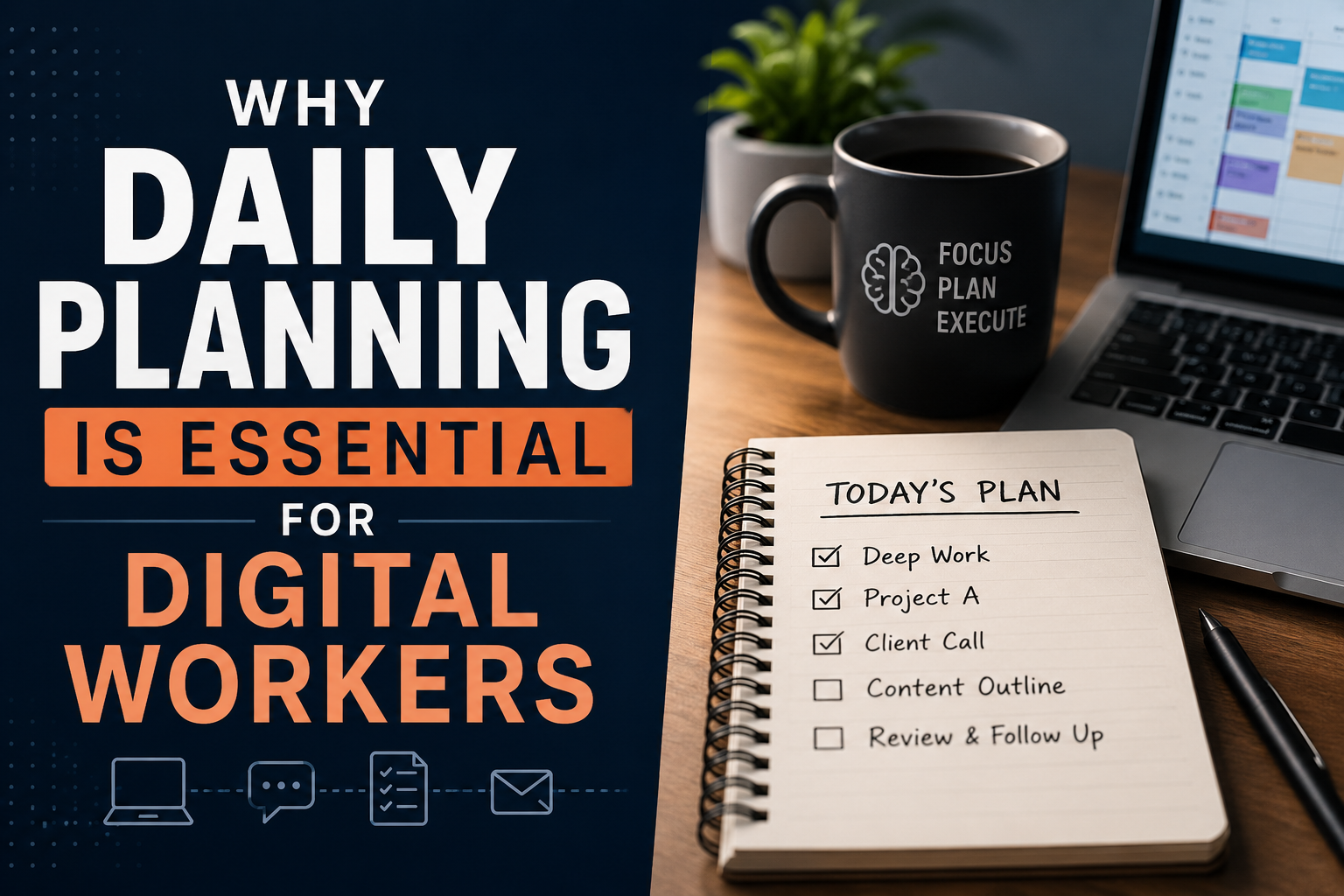
Daily planning has been taught for so long, in so many forms, that most people have stopped listening to the case for it. It sounds like generic productivity advice. Make a list. Pick your top three. Wake up early. The recommendations blur together into a mood that says: be more organized.
That framing has done daily planning a disservice. Because for one specific category of worker - the digital worker, the knowledge worker, anyone whose job happens behind a screen - daily planning is not generic advice. It is closer to survival equipment.
The cognitive demands of modern digital work are not a normal level of difficulty experienced by humans throughout history. They are unprecedented in scale, pace, and intangibility. The biology that worked fine for the blacksmith, the farmer, and the factory operator does not work fine for the knowledge worker. The gap between what the job demands and what the brain can natively handle is real, and it is growing wider as the work gets more abstract, more parallel, and more boundless.
Daily planning is what closes that gap. Not as a habit, not as a system, but as the foundational practice that makes the work possible at all.
This article makes the full case. What daily planning actually does. Why daily, not weekly. What it means to do it well. And why most attempts fail despite the underlying need being real.
The contrast that makes the case
To see why daily planning is essential for digital workers, you have to see why it was optional for everyone else.
Physical work, for most of human history, came with structure built in. The shape of the work itself organized the day. A farmer's day was bounded by sunrise and sunset. A factory worker's day was bounded by the shift bell. A shopkeeper's day was bounded by the opening and closing of the store. There was no question about when the work began, when it ended, or what counted as part of it.
Physical work also produced visible progress. The pile of harvested wheat. The shipped goods. The bricks laid. The patients seen. The output told the story of the day. You didn't have to remember what you did - you could see it.
And physical work tended to organize itself into episodes. The morning delivery. The afternoon repair. The evening inventory. Each was a discrete piece of work with a beginning, a middle, and an end. The day was a series of completed events, and memory could file them.
In this world, daily planning was a luxury. You didn't need it. The work planned itself. You arrived, you did what was in front of you, you went home. The day held its shape because the work held its shape.
Digital work has none of these features. None of them.
The day has no built-in start or end - your laptop opens whenever, closes whenever. Output is invisible - there is rarely anything physical to point at. The work is parallel - you are touching four projects, six conversations, and a dozen documents simultaneously, all day. Tasks blur into each other - you finish a thought without ever finishing a thing. There are no episodes. There is just one continuous, undifferentiated stream of small actions across a screen.
A knowledge worker without a daily plan is in the position a factory worker would be in if the bell never rang, the shift never ended, the inventory never settled, and the workplace was identical from one moment to the next. That worker would lose their grip on the day. So does the digital worker.
The work that used to come with structure now has to be given structure. The structure used to be free. Now it has to be made. Daily planning is how you make it.
The four jobs daily planning does
Daily planning isn't one practice. It's four jobs braided into one ritual. Each job addresses a specific way that digital work breaks the brain's normal operating conditions.
1. It compresses the silent decisions
The average knowledge worker makes between 30 and 50 small decisions per hour. What to answer first. Whether to engage with this Slack thread now or later. Whether to push back on a request or absorb it. When to take a break. Whether to start the deep work block or postpone it. Whether to interrupt focus for an unexpected meeting.
Each of these decisions is real. Each of them costs willpower. None of them announce themselves as decisions. They feel like the work, when they are actually the meta-work of choosing what to work on.
Across an eight-hour day, this comes to roughly 250 to 400 small acts of choosing. The cognitive cost is enormous and almost completely invisible. People who feel exhausted at the end of the day often haven't done that much actual work - they've done several hundred small decisions, each draining a small amount of will, and arrived at evening with nothing left.
Daily planning compresses most of those decisions into one. The morning plan is the decision. After it, the day becomes execution. You're not choosing all day. You're doing what you already chose.
This compression is invisible from the outside. It looks like the same person doing the same work. But the internal experience is different. The person without a plan is choosing 400 times. The person with a plan is choosing once. The difference is not a matter of efficiency. It is a matter of how depleted you arrive at 5pm.
2. It creates the boundaries digital work doesn't have
Physical work had natural endings. The light failed. The store closed. The shift bell rang. The brain received clear signals that one chunk of effort was over and consolidation could begin.
Digital work supplies no such signals. The laptop closes whenever you decide. The inbox is always open. The day blurs into the night blurs into the next day.
This isn't only a wellbeing problem - it's a memory problem and a focus problem. Without clear day boundaries, the brain can't file the day. Tasks don't settle. Yesterday and today bleed into one continuous, low-grade present that never stores as a discrete unit. You don't have a "yesterday" anymore. You have a fading sense of recent activity.
A daily plan installs the boundaries that biology used to supply. The act of writing down what's in today creates an implicit edge: this fits, that doesn't. The end of the day's plan creates a moment when the work has finished, even if the laptop is still open. The mental signal "this day is over" can be issued by the closing of the plan, the way it used to be issued by the closing of the shop.
This is not theater. The brain genuinely uses these signals. A worker who consistently closes their day with a quick review and a fresh plan for tomorrow sleeps better, recovers faster, and starts the next morning with more clarity than a worker who lets the day dissolve. The signal is the structure.
3. It provides episodic structure that memory can use
The brain's primary memory system for life events is episodic memory - the storage of specific, time-anchored experiences. Episodic memory was built to record events that had beginnings, middles, and ends. A hunt. A meal. A conversation. A trip.
Digital work doesn't produce episodes. It produces ongoing involvement. You don't finish thinking about the project. You think about it less for a while, then more, then less again. There is no decisive moment that marks "I worked on this." There is just a smear of partial attention across days and weeks.
Without episodes, episodic memory has nothing to file. You can spend three solid hours on a project, do excellent work, and a week later have almost no memory of those hours. The brain literally didn't have the right kind of event to store.
Daily planning fixes this not by changing the work but by changing the day around the work. Each day becomes an episode. It has a beginning - the morning plan. It has a middle - the execution. It has an end - the closing review. The episode has shape. The brain can grab it. The day, even one that consisted of "writing for four hours and meetings for two," becomes a unit that can be filed and recalled.
The work itself remains digital. The container becomes physical, in a cognitive sense - it has the shape memory was built for.
4. It builds the external record that survives the day
Memory loses most of what you do, especially in digital work. The four mechanisms - sensory anchoring, episodic structure, day boundaries, encoding pace - all fail at once. The brain isn't malfunctioning. It's doing its best with conditions it wasn't designed for.
A daily plan, especially one that includes both what you intended to do and what you actually did, builds an external record that survives the day. The plan and its update become the trace of the work.
That record matters in a way most people don't fully appreciate until they have it for a few months. With the record:
You can review the week honestly because you can read what you actually did instead of relying on selective memory.
You can plan next week against real data instead of imagined capacity.
You can notice patterns - which work consistently goes long, which collaborators consume disproportionate time, which kinds of days drain you and which energize you - that are invisible without a written history.
You can tell yourself a true story about the last quarter, year, decade. The story that you're "doing okay" or "falling behind" stops being a feeling and becomes something you can check.
The record is the most underrated benefit of daily planning. It's also the slowest to appear. The first week's record looks like nothing. By month six, it has changed how the worker sees their own work and life. It compounds.
Why daily, not weekly
There is a common objection to all of this: isn't weekly planning enough?
For most knowledge workers, it isn't. And the reason is worth understanding.
Weekly planning was the right cadence for an earlier era of work. When most output was longer-arc - shipping a product, writing a report, completing a project - a weekly cadence matched the work. You could plan on Monday, execute through the week, and review on Friday with reasonable fidelity.
Modern digital work doesn't follow that arc. The cognitive load is daily and intra-daily. Decisions, distractions, micro-priorities, and interruptions arrive in real time, all day, every day. A weekly plan made on Sunday is irrelevant by Wednesday because Wednesday's reality bears no resemblance to Sunday's prediction. Things have shifted, urgencies have surfaced, plans have crumbled.
Weekly planning catches drift too late. By the time you notice you're off track, you've lost two or three days. Daily planning catches drift the same day. You see the plan failing by 2pm and you can adjust by 3pm.
Hourly planning, on the other hand, is too fast. The cognitive overhead of replanning every hour would exceed the benefit. You'd spend more time on the plan than on the work.
Daily is the natural unit. Slow enough that you can plan once and execute. Fast enough that the plan stays connected to reality. It matches the rhythm at which the brain genuinely needs to reset, refocus, and reorient.
This is why the most experienced knowledge workers, often without quite being able to explain why, gravitate to daily planning over time. They've tried weekly. They've tried hourly. Daily is what works.
What daily planning actually means
The term "daily planning" gets used loosely. Sometimes it means writing a to-do list. Sometimes it means time-blocking the entire day. Sometimes it means a 30-minute morning ritual involving journaling, meditation, and intention-setting. These are not the same thing.
For the purposes of doing the four jobs above, daily planning has three required elements.
First, an explicit statement of intent for the day. Not a list of every task that exists. A statement of what this specific day is for. Three to five priorities, in order of importance, with rough sizing or time blocks. This is what makes the plan a decision instead of a wish.
Second, an implicit boundary. The plan declares what's in. By implication, everything else is not in - and that's the gift. Most people fail at daily planning by listing 15 things and treating the list as a menu. A real daily plan is shorter than your appetite and that's the point. The boundary is the structure.
Third, a closing ritual. At end of day, the plan gets a quick update: what got done, what didn't, what surprised you, what carries forward. This is what creates the episode. Without it, the day has a beginning and a middle but no end. The closing ritual is short - five minutes at most - but it does the work the shift bell used to do for free.
A daily plan that has all three of these features is doing the four jobs above. A plan that's missing one - especially the closing ritual - is doing less than half the work.
This is why most "I tried daily planning and it didn't work for me" reports turn out, on inspection, to describe a practice that was missing one or more of these elements. The person wrote a list, called it a plan, did some of the tasks, and never closed the day. The structure never formed. The benefits never compounded.
Why most attempts at daily planning fail
If the case is this strong, why don't more people sustain the practice?
The answer is friction, not motivation.
Manual daily planning, done well, takes about 30 minutes per day. Five minutes to brief tomorrow at end of day. Five minutes to review and adjust in the morning. Twenty minutes scattered through the day to update the plan as reality shifts. Times five working days, that's 2.5 hours a week. Times a year, that's 125 hours.
Most people will not allocate 125 hours to a meta-activity, no matter how persuaded they are of the benefits. The practice collapses not because it doesn't work but because it costs too much in the only currency that matters: time.
There's a deeper layer too. Manual daily planning requires you to be the engine of the system. Every morning, you must do the work of pulling forward unfinished items, prioritizing them, sizing them, deciding what fits. That work is itself cognitively expensive. You're using one of your scarcest resources - morning focus - to do prep work, not real work. Over weeks, this depletes the very thing the planning was supposed to protect.
This is why the productivity literature is littered with abandoned planning systems. People discover the value, install the habit, run it for two or three weeks, and quit. They blame themselves. They shouldn't. The system was too expensive to maintain.
The only sustainable form of daily planning is one where the time cost is under five minutes per day total. Anything heavier collapses under the weight of life.
Achieving that compression is its own subject. It requires a structure that pre-exists, so you're not creating it from scratch. It requires a way to draft the day faster than you could write it manually. It requires the closing ritual to be near-zero effort. It requires the plan to be reviewable in chunks - daily, weekly, monthly - without rebuilding anything.
These conditions are difficult to set up with general-purpose tools. They require something built for the shape of the work. Whether that's a deliberately designed analog system, a specialized app, or a custom-built workflow, the principle is the same: if daily planning costs more than five minutes a day, it won't survive.
What changes after 30, 90, and 365 days
The early stages of daily planning are uncomfortable. You see how often you overcommit. You watch yourself defer to "tomorrow" the same tasks every day. You confront the gap between what you say you'll do and what fits in a real day.
The discomfort is the work. By the end of month one, the plans start getting realistic. By the end of month three, the realism feels like calm. By the end of the first year, you have a quality you didn't have before: a coherent sense of where your time goes and what your weeks actually contain.
The downstream effects of that coherence are large.
Sleep improves, because the unfinished work isn't living in your head at 11pm.
Conversations with managers, clients, and collaborators get sharper, because you can speak truthfully about your capacity and your commitments.
Confidence shifts, because you can see your own progress in the record instead of guessing at it.
Anxiety drops, because the uncertainty of "am I doing enough?" gets replaced by the evidence of what you actually did.
Decisions get easier, because the work of choosing has been done in advance, in calm, with a clear head. The day becomes execution against a known plan, not improvisation against pressure.
None of these are claims about output. They are claims about the quality of attention and the texture of work life. They are also the things people most miss when they don't have them.
The deeper reason this matters
There is a final argument, which most productivity writing skips because it sounds soft, but which is actually the strongest case.
Daily planning is the practice that makes knowledge work compatible with being a person.
The knowledge worker has been asked to do something humans weren't built to do: hold dozens of priorities in working memory, make hundreds of micro-decisions per day, navigate parallel projects with no clear ends, and produce output that's mostly invisible to themselves and others. The cognitive load is enormous. The natural cost is a mind that is always slightly overrun, always slightly behind, always slightly anxious.
That state is so common in modern knowledge work that it has become invisible - the default. People accept it as "what work feels like."
It isn't what work has to feel like. It's what work feels like when the brain has been asked to operate beyond its design parameters without external support.
Daily planning is the external support. It absorbs the cognitive load that the brain would otherwise carry alone. It supplies the structure the work doesn't supply. It creates the boundaries the schedule doesn't create. It generates the record memory can't generate.
A knowledge worker with a working daily planning practice feels different - not because they're more productive, but because their brain has been given room to do its actual job. Thinking. Connecting. Creating. Solving.
Without the practice, the brain spends most of its capacity on overhead - holding lists, juggling priorities, suppressing the anxiety of forgotten commitments. The thinking that the worker was hired to do becomes one of the things their brain can't quite fit in.
Daily planning isn't about productivity. It's about getting your brain back from the job that has been borrowing it without paying interest.
Closing
For most of history, daily planning was a luxury practice for the unusually disciplined. For knowledge workers in the era of unbounded, parallel, invisible digital work, it is foundational.
The case is no longer "this would help you do more." The case is "without this, you cannot fully be a person doing knowledge work over time." The cognitive load of the modern job exceeds what one brain can carry, and the four jobs daily planning does - compressing decisions, creating boundaries, providing episodes, building the record - are the only known way to close the gap.
The reason most people don't sustain the practice is not lack of belief. It's that the manual version is too expensive in time. A daily planning ritual that costs more than five minutes a day cannot survive contact with a real life. The only way to make daily planning persistent is to make the cost low enough that the benefit dominates.
What you choose to use - whether a specialized tool, a paper system, a custom workflow, or anything else - matters less than this: you choose something that turns daily planning into a five-minute act, not a thirty-minute one. The benefit was never in dispute. The cost is what determines whether the benefit ever reaches you.
Daily planning is essential for digital workers. The question is no longer whether you'll do it. The question is whether the form you choose is cheap enough to last.
Date-based AI Task Manager
Plan smarter, execute faster, achieve more
Create tasks in seconds, generate AI-powered plans, and review progress with intelligent summaries. Perfect for individuals and teams who want to stay organized without complexity.
Get started with your preferred account