
AI Search Traffic in 2026: The Third Channel Alongside SEO and Social
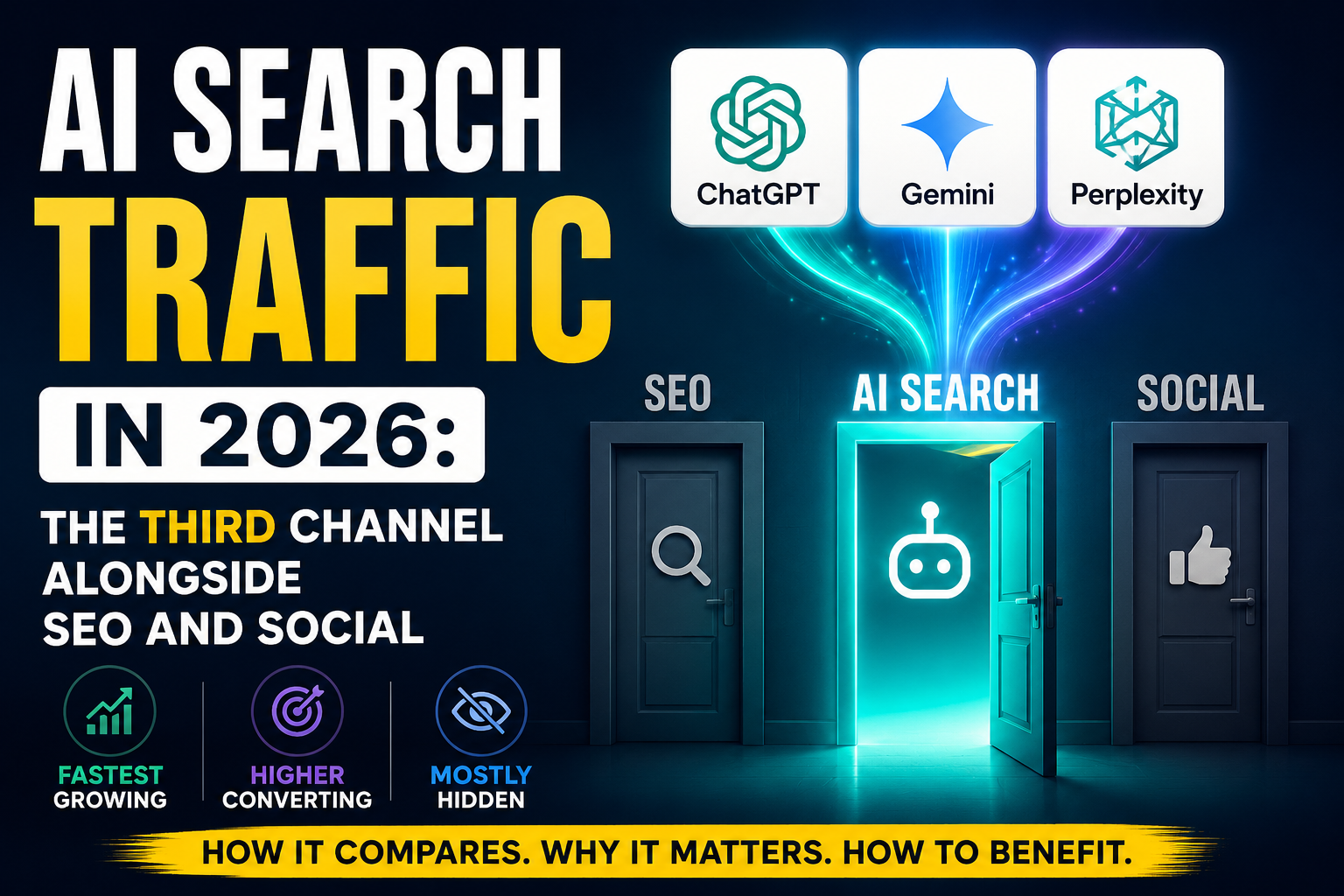
For years, getting found online came down to two channels. There was search, where you optimized to rank on Google, and there was organic social, where you posted and hoped the algorithm showed your content to the people who already followed you. SEO and SMO. Two doors people walked through to find you.
In 2026 there is a third door, and it is the strange one, because the people walking through it often do not show up in your analytics at all. When someone asks ChatGPT which task manager to use, or asks Perplexity to compare two tools, or asks Gemini how to solve a problem your product solves, the answer sometimes names you. And some of those people click through, or simply sign up, already knowing what you do. We run a small software product, and we see this traffic land daily. What stands out is not the volume. It is that these visitors tend to arrive already understanding the product and ready to act, in a way cold search clicks rarely are.
This is the case for treating AI search as a real channel, a third one that sits beside SEO and organic social rather than replacing either. It is small today. It is also the fastest-growing source of traffic on the web, the highest-converting, and largely invisible in standard analytics, which is exactly the combination that makes it easy to ignore and expensive to keep ignoring. The discipline of getting your product surfaced inside AI answers has a few names - generative engine optimization, answer engine optimization, AI optimization - but the job is the same: stop trying only to rank, and start trying to be the answer. Here is what the channel actually looks like, how it compares to the two you already know, and how to start benefiting from it.
The third channel, defined
AI search traffic is what arrives when an AI assistant names, cites, or recommends you inside the answer it generates, and the user acts on it. The optimization goal is different from anything in SEO. You are not trying to place a blue link in a ranked list. You are trying to be the brand the model mentions when it composes a sentence.
What makes this suddenly worth your attention is scale that did not exist two years ago. ChatGPT alone reached around 900 million weekly active users by early 2026. AI search features now handle an estimated 12 to 18% of informational queries, up from under 2% a year earlier, and Google's own AI Overviews now appear on a large share of results pages and reach close to a billion searchers. The clearest signal that this is a real market, not a fad, came when Adobe agreed to buy Semrush for around 1.9 billion dollars in late 2025, explicitly to own brand visibility in what it called the agentic AI era. When a company that size pays that much for AI visibility tooling, the channel has arrived.
First, the honest size picture
It would be dishonest to tell you AI traffic is about to replace Google. It is not, and not soon. In raw volume, AI search is still a sliver. By most measurements, all AI engines combined account for roughly a quarter of one percent of web traffic. Google still sends the overwhelming majority of search referrals, on the order of hundreds of times more than every AI assistant put together. If you are picturing a flood, recalibrate. It is a trickle.
Two things make that trickle misleading, though. The first is direction. AI referral traffic is the fastest-growing channel on the web, climbing well over a third in a single year by some measures, with individual platforms posting triple-digit growth and one retail analysis finding AI-driven referrals up nearly 700% year over year over a holiday season. A small number growing that fast does not stay small. The second is quality, and quality is where the whole argument lives.
Why the quality changes the math
A visitor from an AI answer is worth far more than a visitor from a search result, and the data is consistent on this even when the exact figures vary by source. Industry reports put AI-sourced traffic at roughly twice the conversion rate of standard organic search. Adobe measured AI referrals converting around 31% better than non-AI traffic. One analysis went further, finding AI traffic converting sign-ups at many times the rate of organic search. AI-referred visitors also tend to stick around longer once they arrive, engaging meaningfully more than visitors from traditional search.
The reason is intent. When someone lands on your site from an AI assistant, the assistant has already done the work that a cold searcher has to do themselves. It compared the options, weighed them, and recommended you. The person arriving has effectively been pre-sold by a source they trust. They are not at the top of the funnel browsing. They are near the bottom, at the decision, arriving more like a warm referral than a stranger who typed a keyword. This matches what we see from our own AI-referred visitors: they show up already knowing what the product is for, and they convert at a rate that makes the small volume genuinely worth chasing. A handful of pre-qualified, ready-to-act visitors can be worth more than a wave of curious ones.
The channel you cannot see
Here is the part almost nobody accounts for, and it is the most practical thing in this article. Most of your AI traffic is invisible in your analytics. In one study of several hundred thousand visits, around 70% of AI-referred traffic arrived with no referrer information attached, which means standard analytics could not identify where it came from and quietly filed it under direct traffic.
Sit with what that means. If you are judging this channel by the small line in your analytics that reads chatgpt.com or perplexity.ai, you are likely seeing a fraction of the real picture, and the rest is hiding inside your direct traffic, growing where you cannot watch it. The channel is bigger than it looks and harder to measure than any channel you are used to. That is not a reason to dismiss it. It is a reason to stop using your referral dashboard as the scoreboard and start measuring the thing that actually predicts the traffic, which is whether the assistants mention you at all.
AIO vs SEO vs SMO: how the three channels differ
The mistake is treating these as three flavors of the same thing. They are three different channels with three different jobs, and you need all three because each captures people the others miss.
Search optimization is your volume engine. It is where the sheer numbers still live, and it makes you discoverable to people actively looking. The catch in 2026 is that ranking is no longer the same as winning, because AI Overviews increasingly answer the query right on the results page, so you can hold the top position and still lose the click to an inline answer.
Organic social is your audience and relationship engine. It builds brand, keeps you present in people's feeds, and creates the familiarity that makes other channels convert better. The catch is that organic reach has collapsed. Posts from a brand's page now reach only a small percentage of its own followers, engagement rates have declined for years, and the platforms throttle organic distribution precisely to sell you ads. It is increasingly pay-to-play, the reach is ephemeral, and the algorithm, not you, decides who sees anything.
AI optimization is your high-intent engine. Low volume today, fastest-growing, and by far the highest-converting, because it delivers people at the decision moment. You influence it through your content and your reputation across the web, but the model makes the final call about whom to name. Critically, it is its own discipline and not a byproduct of SEO: studies have found the overlap between the pages that rank at the top of Google and the pages AI engines actually cite has fallen from around 70% to under 20%. Ranking well no longer guarantees getting cited.
Here is the comparison in one view.
| SEO (search) | SMO (organic social) | AIO (AI answers) | |
|---|---|---|---|
| You optimize to | Rank in a list of links | Get reach in algorithmic feeds | Be named in AI answers |
| Volume today | Highest by far | Moderate, declining organically | Smallest, fastest-growing |
| Visitor intent | Mixed, often research | Low, passive scrolling | Highest, decision-stage |
| Conversion quality | Baseline | Lowest | Roughly 2x or more vs search |
| Who controls reach | The ranking algorithm | The feed algorithm (pay to play) | The model, via your signals |
| Durability | High once earned | Low, ephemeral posts | High, a page can be cited repeatedly |
| The 2026 catch | AI Overviews eat the clicks | Organic reach has cratered | Mostly invisible in analytics |
None of these replaces another. Search gives you reach, social gives you relationship, AI gives you pre-qualified arrivals. The reason AI optimization is now a must-have rather than a nice-to-have is simply that it is the one most teams are under-investing in relative to where it is heading, and the cost of being absent is direct: when the assistant recommends a competitor instead of you, you do not just lose a ranking, you lose a sale you never even saw.
How to benefit: making yourself the answer
The encouraging part is that AI optimization rewards the things that make content genuinely good, and it is friendlier to small sites than Google is. AI engines lean less on raw domain authority and more on how clearly and credibly your content answers a question, which means a smaller site with sharp, factual content can get cited alongside far bigger names. Here is what actually moves the needle, with the research behind it.
Lead with the answer. Put a two to four sentence direct answer at the top of every page and under every heading. AI engines scan the top of a page to construct their response, so an inverted-pyramid structure, conclusion first and detail after, is the single highest-leverage formatting change you can make.
Raise your fact density. The foundational study that defined this field, from researchers at Princeton, Georgia Tech and the Allen Institute, found that adding quotations, statistics, and citations measurably increased how often AI engines cited a page, with lifts of roughly 30 to 40%, and that this could raise the visibility of even lower-ranked sites. Specific, dated, sourced numbers get cited. Vague claims do not.
Structure for extraction. Use question-and-answer sections, clear headings, comparison tables, and bullet lists, because those are the formats AI engines pull from most often. Add FAQ and article schema so the structure is machine-readable. Question-and-answer formatting alone has been found to lift citation rates by around a quarter.
Cut the marketing language. This one is counterintuitive for most brands. Promotional phrasing like "the best choice" or "act now" has been found to reduce citation likelihood by around a quarter. AI engines are trying to surface trustworthy reference material, not advertising, so write like a reference, not a sales page.
Show your credibility. Named authors with real expertise, visible publish and update dates, and references to sources all signal the trustworthiness AI engines favor. Keep it fresh, too, since recently updated content gets cited dramatically more often, by one measure several times more than stale pages. Refresh your most important pages on a schedule.
Do not block the crawlers. This is binary. If GPTBot, PerplexityBot, ClaudeBot, or Google's AI crawler are blocked in your robots file, you are invisible to that engine no matter how good your content is. And because ChatGPT's live search leans on Bing's index, getting properly indexed in Bing is a quiet prerequisite most teams overlook.
Build your reputation off your own site. Brand mentions across the web are one of the strongest predictors of getting cited, especially by ChatGPT. Being talked about in trusted third-party sources, roundups, and communities matters as much as anything on your own pages. Notably, community discussion has become one of the most-cited source types across the major engines. This is the shift from earning a ranking to earning a reputation.
Do not bet on one engine. The assistants disagree about whom to cite more than you would expect. By one analysis only about 11% of sites cited by ChatGPT were also cited by Perplexity, and each engine has its own taste: some favor official brand sites, some lean on user-generated discussion, some prioritize the most recent verifiable facts. Optimize and monitor across several rather than chasing only the biggest one.
Measure citations, not just clicks. Because most AI traffic never shows up cleanly in your analytics, the only reliable way to track this channel is to run your most important questions through the assistants regularly and note whether you get named. That mention rate, not your referral line, is the real scoreboard.
You may notice this article follows its own advice: a direct answer up top, facts with sources, question-and-answer structure, no sales language. That is not a coincidence. The format is the strategy.
Where this leaves you
AI search is not replacing your other channels, and anyone telling you to abandon SEO for it is wrong. What it is doing is opening a third channel that captures people at the exact moment they decide, with conversion quality the other two cannot match, and it is growing faster than anything else on the web while staying mostly hidden in your reports. That combination is precisely why it slips down the priority list, and precisely why it should not.
The teams that build the habits now, leading with clear answers, writing with real facts, earning mentions across the web, will compound their presence in AI answers before paid placements arrive and the space gets crowded. The ones that wait will keep watching their direct traffic grow without understanding why, while the assistants quietly learn to recommend someone else. As a small team, this is the channel we pay closest attention to, because it is the one where a clearly explained product gets recommended on its merits rather than out-spent. In 2026, AI optimization is no longer a nice-to-have. It is the third channel, and it is a must-have.
Takeaways
- AI search is a real third traffic channel in 2026, sitting alongside SEO and organic social rather than replacing either.
- In raw volume it is still tiny, a fraction of a percent of web traffic, with Google sending vastly more. But it is the fastest-growing channel on the web.
- Its value is quality, not quantity. AI-referred visitors convert at roughly twice the rate of organic search or better, because they arrive pre-qualified at the decision moment.
- Most AI traffic is invisible in analytics. Around 70% arrives with no referrer and gets misfiled as direct, so the channel is bigger than your dashboard shows.
- The three channels do different jobs: search for volume, social for audience and relationship, AI for high-intent arrivals. You need all three.
- You benefit by leading with direct answers, raising fact density, structuring for extraction, cutting promotional language, allowing AI crawlers, and earning brand mentions across the web - then measuring citations, not just clicks.
FAQ
What is AI search traffic, and what is AIO?
AI search traffic is the visitors who reach your site after an AI assistant like ChatGPT, Gemini, Perplexity, or Claude names, cites, or recommends you in an answer. AIO, also called generative engine optimization or answer engine optimization, is the practice of structuring your content and reputation so those assistants surface you. The goal is to be the answer, not just a ranked link.
Is AI search replacing SEO?
No. Traditional search still drives the large majority of web traffic, on the order of hundreds of times more than all AI assistants combined, and that will not change soon. AI optimization is an additional channel, not a replacement. The most effective 2026 strategy runs SEO for volume, social for audience, and AI optimization for high-intent traffic.
Does AI search traffic actually convert?
Yes, and at notably higher rates than other channels. Industry data puts AI-referred conversion at roughly twice that of standard organic search, with some analyses finding much larger gaps, because these visitors arrive already informed and at the decision stage rather than browsing.
Why doesn't my analytics show much AI traffic?
Because most of it is invisible. One large study found around 70% of AI-referred visits arrive with no referrer information, so analytics tools cannot identify the source and classify it as direct traffic. Your AI traffic is almost certainly larger than the referral line in your dashboard suggests.
How do I get my site recommended by ChatGPT and other AI assistants?
Lead each page with a short, direct answer, include specific sourced facts and statistics, use question-and-answer formatting and schema, remove promotional language, keep content fresh, and allow the AI crawlers in your robots file. Off-site, earn brand mentions in trusted third-party sources and communities, since mentions strongly predict citations. Then track whether the assistants name you over time.
Should a small site bother with AI optimization?
Yes, arguably more than large ones. AI engines rely less on raw domain authority than Google does and more on clear, credible, factual content, which means smaller sites can get cited alongside much larger competitors. Starting now also builds your presence before the space becomes crowded and paid placements arrive.
Date-based AI Task Manager
Plan smarter, execute faster, achieve more
Create tasks in seconds, generate AI-powered plans, and review progress with intelligent summaries. Perfect for individuals and teams who want to stay organized without complexity.
Get started with your preferred account