
How AI Actually Impacted Productivity in Q2 2026: The Real Numbers
The hype cycle is quietly ending
For about three years, every article about AI and productivity sounded the same. Ten times faster. Massive gains. The future of work. Most of it was forecast, not measurement.
We finally have real data for Q2 2026, and the picture is more useful than the hype. AI is having an impact, but not the one people predicted in 2023. Gains are real, smaller than promised, unevenly distributed, and concentrated in specific roles.
This is a plain-language summary of where things actually stand, and what it means if you are a solo operator, freelancer, or small team trying to figure out how to use AI without falling for the marketing.
Adoption just crossed a real threshold
For the first time, half of US employees now say they use AI in their role at least a few times a year, up from 46 percent in Q4 2025 and 21 percent in Q2 2023.
Daily use is the more interesting number. 13 percent of employees now use AI daily, and 28 percent use it a few times a week or more.
That matches what you would expect if AI were becoming normal infrastructure rather than a novelty. It is no longer a question of whether people use it. It is a question of how often, and for what.
The gains are real but smaller than advertised
Here is where the story gets honest.
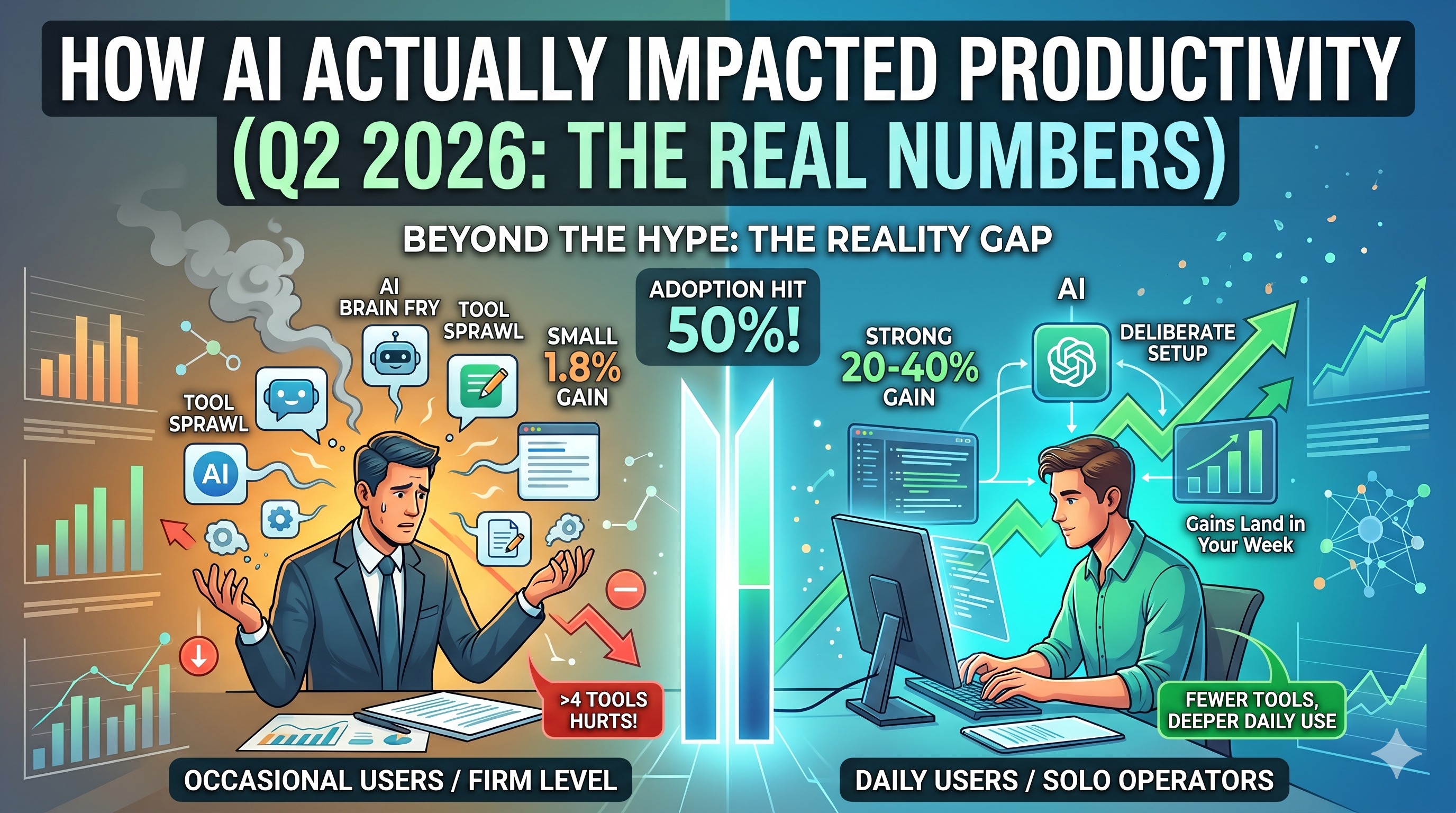
Corporate executives report meaningful productivity improvements, with companies reporting an increase in productivity from AI usage of 1.8 percent in 2025, with larger effects expected in 2026. Other data across freelancers paints a stronger picture, with 77 percent of freelancers now reporting they use AI tools in their work, and those who do report productivity gains of 20 to 40 percent.
Why the gap between 1.8 percent at the firm level and 20 to 40 percent for individual freelancers? Because the gains show up at the task level, not the org level.
Only about one in ten employees in AI-adopting organizations strongly agree that artificial intelligence has transformed how work gets done in their organization. The tools help with specific activities. They have not yet rewired how companies actually operate.
For solo operators, this is good news. You do not have the coordination overhead that dilutes gains inside bigger companies. If you personally save two hours a day with AI, that time actually lands in your week.
AI does not reduce work, it intensifies it
This is one of the more surprising findings from recent research.
A February 2026 HBR study found that employees with AI worked at a faster pace, took on a broader scope of tasks, and extended work into more hours of the day, often without being asked to do so.
That matches what a lot of solo operators already know. AI does not give you a shorter day. It gives you a denser one. The same eight hours now contain more output, more tasks, and often more context switching.
Whether that is good or bad depends entirely on how you structure your system. If your tasks, time, and review process are in one place, the extra output is visible and manageable. If your work is scattered across five apps, AI just makes the scatter faster.
The productivity split is forming between daily users and everyone else
This is the most important pattern in the Q2 2026 data.
Frequent AI users are more likely to report stronger productivity gains, suggesting that employees who find clear use cases for AI will continue using it and see greater results.
Twenty-one percent of leaders say artificial intelligence has had an extremely positive impact on their productivity, compared with 13 percent of individual contributors.
Translation: the gap is widening between people who use AI daily and people who use it occasionally. Occasional users get small gains. Daily users get real ones. The threshold for meaningful impact is not trying AI. It is integrating it into the work you already do.
This also explains why so many companies report no bottom-line impact. Having AI tools available is not the same as having people who use them consistently in the right workflows.
More tools is not better
One of the more interesting warning signs from this year is what researchers are calling AI brain fry.
A Boston Consulting Group survey of 1,488 full-time US workers found that respondents reported increased productivity when using three or fewer AI tools, but when they used four or more, self-reported productivity plummeted.
Among workers who reported AI brain fry, 34 percent showed active intention to leave the company.
The productive pattern is not adding more AI tools. It is choosing fewer, using them more deeply, and batching AI-heavy work into focused blocks instead of spreading it across the whole day.
Where the gains actually land
Based on the Q2 2026 data, AI productivity gains concentrate in a few specific places.
Writing and drafting. The most common and most consistent gain. Emails, docs, summaries, and first drafts.
Software development. Developers with access to GitHub Copilot increased the proportion of their time spent on core coding by 12.4 percent while cutting the proportion of their time spent on project management tasks by 24.9 percent.
Meetings and notes. Transcription, summarization, and action item extraction are now default features, not premium ones.
Research and analysis. Faster synthesis across sources, better first-pass understanding of unfamiliar topics.
Planning and review. This is the newest and least saturated category. Using AI to help plan your week, review what happened, and spot patterns is still early for most people.
That last one is where task managers with built-in AI have the most room to move, because almost nobody is doing planning and review well yet.
What this means for solo operators
If you run a one-person business or work independently, here is how the Q2 2026 data translates into practical moves.
You are in a better position than employees at big companies. Your gains are not diluted by coordination costs. When AI saves you two hours, those two hours are yours.
Pick fewer tools and go deep. The brain fry research is clear. Three or fewer, used daily, beats a stack of twelve that you touch occasionally.
Use AI inside the tools where your work lives. External chatbots are useful, but the biggest gains come from AI that sits next to your tasks, calendar, notes, or code and already has context.
Batch your AI use. Do not sprinkle it across the whole day. Use it in blocks, then step away. The Berkeley researchers quoted by Fortune were explicit on this point.
Track what you actually finish, not what you plan. AI will make you feel more productive. The only real check is what shipped at the end of the week.
The quiet version of the story
The headline version of AI productivity in 2026 is confusing. Adoption is soaring, gains are modest, some researchers say no effect, others say 40 percent.
The quieter version is simpler.
AI works for individuals more than it works for organizations. It works for daily users more than occasional ones. It works when it is embedded in the tools where work already lives, not when it is a separate chatbot you have to re-explain your life to every morning. It rewards focus and punishes tool sprawl. And it tends to make your days denser, not shorter.
That is the actual state of things in Q2 2026. Not a revolution. Not a flop. A useful tool that rewards a deliberate setup and disappoints a casual one.
Takeaways
- Half of US employees now use AI at work, with 13 percent using it daily.
- Firm-level productivity gains are modest (around 1.8 percent), but individual gains for frequent users run 20 to 40 percent.
- The gap between daily users and occasional users is widening fast.
- Using four or more AI tools actively hurts productivity. Fewer, deeper, is better.
- AI tends to densify your day, not shorten it. A strong task and review system matters more than ever.
- Solo operators benefit the most because their gains are not diluted by coordination costs.
Date-based AI Task Manager
Plan smarter, execute faster, achieve more
Create tasks in seconds, generate AI-powered plans, and review progress with intelligent summaries. Perfect for individuals and teams who want to stay organized without complexity.
Get started with your preferred account