
Why Weekly Reviews Matter More Than Motivation
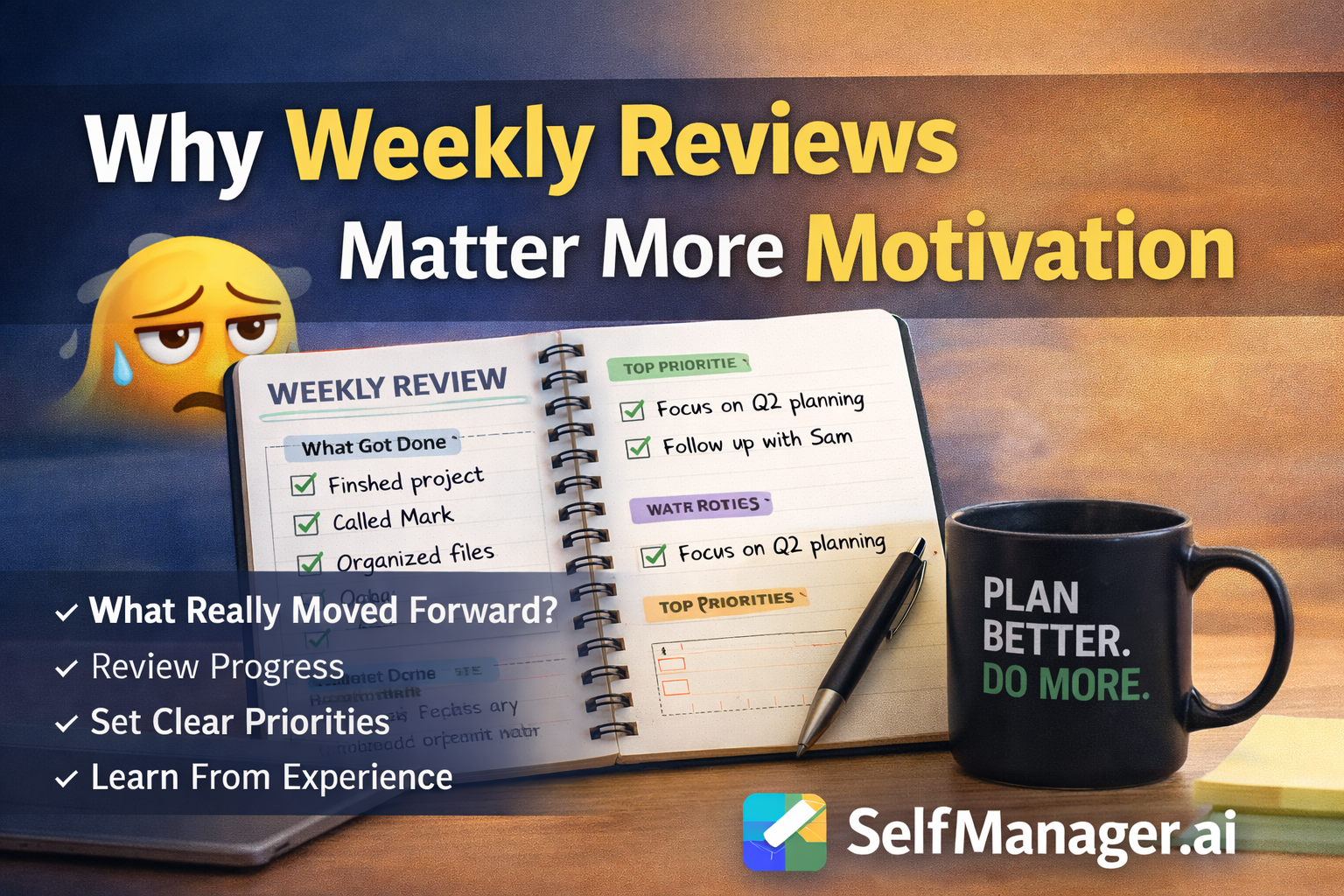
A lot of people think productivity depends mostly on motivation.
If they feel energized, focused, and ready, they expect themselves to do good work. If they do not feel motivated, they assume the week is already harder than it should be.
That sounds normal.
But it also creates a fragile system.
Because motivation is unstable.
Some days it is high.
Some days it is low.
Some weeks feel full of momentum.
Other weeks feel mentally scattered, heavy, or unclear.
If productivity depends too much on motivation, consistency becomes difficult.
That is why weekly reviews matter so much.
A weekly review does something motivation cannot do reliably.
It creates structure, awareness, and adjustment.
And over time, that usually matters much more.
The problem with relying on motivation
Motivation is useful.
It can help people begin.
It can create momentum.
It can make hard things feel easier for a while.
But motivation has limits.
It changes based on:
- sleep
- stress
- mood
- health
- outside events
- workload
- uncertainty
- emotional state
- how many unfinished things are already in your head
That makes it unreliable as the main foundation of productivity.
A person can be very capable and still have an unproductive week if they are waiting to feel ready before they act.
This is one of the biggest hidden traps in personal productivity.
People think the answer is to become more motivated.
Often the better answer is to become more aware.
That is where weekly reviews come in.
What is a weekly review?
A weekly review is a regular process of stepping back and looking at what happened over the past week, what matters now, and what should happen next.
It is not just about checking completed tasks.
A good weekly review usually helps you see:
- what got done
- what did not get done
- what still matters
- what became less important
- what distracted you
- what patterns are showing up
- what needs to carry into the next week
- whether your actions are aligned with bigger goals
In simple terms, a weekly review helps you reset your direction.
That matters because most people do not need more pressure.
They need more clarity.
Why weekly reviews are more important than motivation
1. Weekly reviews create clarity when motivation is missing
Motivation often disappears when things feel unclear.
Too many open loops.
Too many tasks.
Too much uncertainty.
Too much mental clutter.
In those moments, trying to force motivation usually does not work very well.
A weekly review helps because it reduces confusion.
Instead of staring at a vague cloud of pressure, you begin to see:
- what is actually important
- what can wait
- what is still unfinished
- what deserves attention next
Clarity often creates movement faster than raw motivation does.
2. Weekly reviews help you make better decisions
A lot of poor productivity comes from poor decision-making, not lack of effort.
People spend too much time on the wrong things.
They carry old priorities forward without questioning them.
They keep reacting to urgency.
They do not stop to notice whether their work is still aligned with what matters.
A weekly review improves decision quality.
It gives you a moment to ask:
- Is this still important?
- What should I stop carrying?
- What really moved the week forward?
- What deserves space next week?
These questions are more valuable than waiting to feel inspired.
3. Weekly reviews help you learn from reality
Motivation is emotional.
A weekly review is informational.
That difference is important.
Motivation may tell you how you feel.
A weekly review shows you what actually happened.
Maybe you thought you were focused, but the week was full of interruptions.
Maybe you thought you were behind, but you actually completed meaningful progress.
Maybe you kept delaying something that clearly needs a different approach.
Maybe your schedule looked fine on paper but was overloaded in practice.
A weekly review turns the week into feedback.
That feedback helps you improve.
4. Weekly reviews reduce repetition of the same mistakes
Without review, many people repeat the same unhelpful patterns again and again.
They overload the week.
They underestimate how long things take.
They forget small but important follow-ups.
They let reactive work dominate.
They keep carrying too many half-finished items.
They end the week tired but unclear.
Then the next week starts the same way.
A weekly review interrupts that cycle.
It gives you a structured pause where you can notice the pattern before repeating it.
That is one of the biggest reasons reviews matter more than motivation.
Motivation may help you push harder.
Review helps you work smarter.
5. Weekly reviews create continuity
One of the hardest parts of productivity is not working hard for one day.
It is maintaining continuity across time.
That means connecting:
- last week’s unfinished work
- this week’s priorities
- longer-term goals
- lessons from recent progress
- patterns that need adjustment
Motivation usually works in short bursts.
Weekly reviews help create continuity.
They connect one week to the next so your progress becomes more intentional instead of random.
This is how real momentum is built.
Why people skip weekly reviews
Even when people know weekly reviews are useful, many still avoid them.
Common reasons include:
- they feel too busy
- they do not know what to review
- they think they already know what happened
- they assume review is less important than action
- they worry about facing unfinished tasks
- they do not have a system that makes review easy
But skipping review often creates more friction later.
Because without review:
- priorities stay vague
- clutter builds up
- tasks carry forward without thought
- mistakes stay invisible
- motivation drops faster
- the next week starts less clear
In other words, avoiding review often makes the week feel heavier, not lighter.
What a good weekly review should include
A weekly review does not need to be complicated.
It just needs to be useful.
A simple review can include questions like:
- What did I complete this week?
- What important things did I not complete?
- What should carry forward?
- What caused friction or delay?
- What felt effective?
- What no longer deserves attention?
- What are the most important priorities for next week?
That is enough to create direction.
The point is not to build a perfect ritual.
The point is to make the next week clearer than the last one.
Weekly reviews help reduce overwhelm
Overwhelm often grows when too many things remain mentally unresolved.
A weekly review helps reduce that by giving you a place to process the week.
Instead of carrying vague stress, you can sort things into clearer categories:
- done
- still important
- reschedule
- remove
- rethink
- defer
This matters because overwhelm often comes less from the number of tasks and more from the lack of structure around them.
A weekly review gives the week edges.
It makes things easier to understand.
That alone can reduce pressure significantly.
Weekly reviews make progress more visible
A lot of people underestimate how important this is.
When progress stays invisible, motivation weakens.
People start feeling like nothing is moving, even when meaningful work is happening.
A weekly review helps surface:
- what got finished
- what improved
- what moved closer to completion
- what was learned
- what is building over time
This visibility is powerful.
It helps people feel grounded in actual progress rather than vague emotional impressions.
And once again, that usually matters more than motivation by itself.
Weekly reviews support better planning for the next week
A weekly review is not only about looking backward.
It is also one of the best ways to plan forward.
When you review the week properly, the next week becomes easier to shape.
You are no longer starting from chaos.
You are starting from understanding.
That helps you:
- choose better priorities
- avoid repeating the same overload
- carry forward only what matters
- begin the week with more confidence
- align daily plans with bigger goals
This is one of the strongest practical benefits of weekly reviews.
They make future planning smarter.
Why this matters especially for knowledge workers
Knowledge work is rarely simple or fully visible.
A lot of the work happens in thinking, planning, writing, problem-solving, communication, and decision-making.
That makes it easier to lose track of progress or drift into reactive work.
Weekly reviews are especially useful here because they help knowledge workers:
- reconnect with meaningful priorities
- measure progress that is not always obvious
- see where attention really went
- reduce cognitive clutter
- improve the quality of future weeks
For people whose work depends on mental clarity, weekly reviews are not optional fluff.
They are part of maintaining a high-quality operating system.
Why SelfManager.ai fits this especially well
SelfManager.ai is especially strong here because it is built around structured daily use and review flow, not just task storage.
That matters because weekly reviews work best when the system already contains the real story of the week:
- what tasks were active
- what notes were captured
- what got completed
- what was carried forward
- what patterns can be seen across days
Instead of forcing people to reconstruct their week manually from scattered apps, SelfManager.ai gives them a more connected view of their actual work and planning history.
And this becomes even more valuable with AI-assisted weekly reviews.
That is where SelfManager.ai can offer something much stronger than a simple task list.
An AI weekly review can help users:
- summarize what happened
- surface patterns
- highlight important unfinished work
- identify where time and energy went
- turn a messy week into a clearer next step
That is a major advantage.
Because the harder life gets, the more valuable it becomes to have a system that helps you reflect clearly without needing to do all the mental sorting yourself.
A simple weekly review mindset
If you want a simple way to think about weekly reviews, it is this:
Do not ask,
“Am I motivated enough for next week?”
Ask,
“What did this week teach me, and how should that change next week?”
That is a much more useful question.
It shifts productivity away from emotion alone and toward awareness, adaptation, and better structure.
Final thought
Motivation is helpful, but it is too unstable to build a full productivity system around.
Weekly reviews matter more because they create clarity when motivation is low, make progress visible, reduce repeated mistakes, and help shape the next week with better decisions.
That is what long-term productivity actually needs.
Not constant inspiration.
But regular reflection.
And that is exactly why weekly reviews are so powerful.
They help turn scattered effort into clearer progress.
And with a system like SelfManager.ai, especially with AI-powered weekly review support, that process becomes much easier, more practical, and more useful over time.
Date-based AI Task Manager
Plan smarter, execute faster, achieve more
Create tasks in seconds, generate AI-powered plans, and review progress with intelligent summaries. Perfect for individuals and teams who want to stay organized without complexity.
Get started with your preferred account