
Why People Quit Their Task Manager After a Few Days (And How Date-Based Planning Solves It)
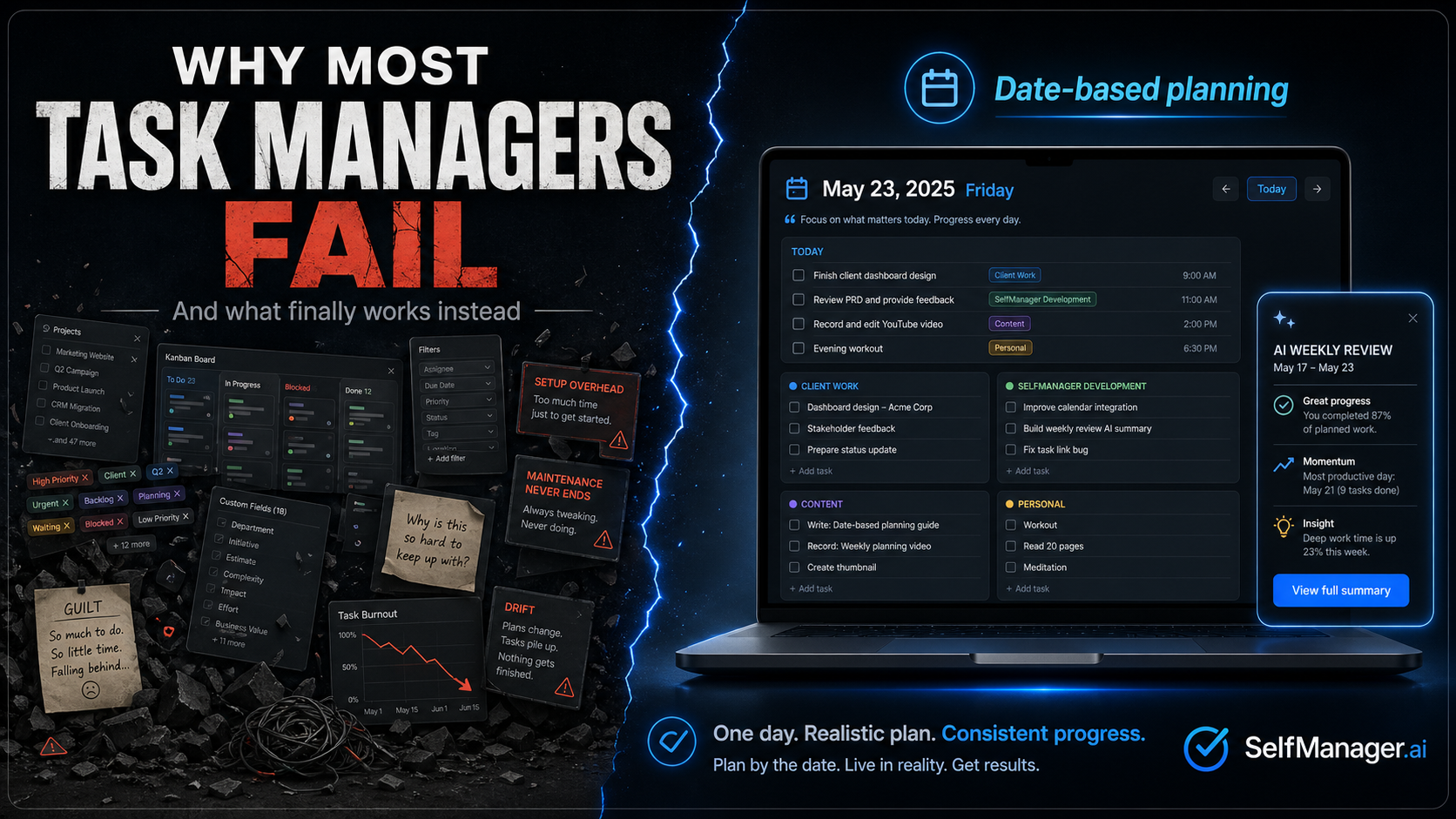
You download a new task manager. You spend a Saturday setting it up. Projects, tags, categories, priority levels, custom views. Sunday you import everything. Monday you use it religiously. Tuesday too. Wednesday you skip a few entries. By Friday, you've stopped opening the app.
Two weeks later, you read a Reddit thread about productivity and download a different one. Same cycle. Same outcome.
If this sounds familiar, you're not the problem. The model most task managers are built on is the problem. And after 12 years of using and building task managers (2 years on paper, 9 years building my own digital version), I've seen exactly why people quit and what it takes to make a system that actually sticks.
This is what I learned, and how I designed SelfManager.ai around it.
The five real reasons people quit
It's not laziness. It's not lack of discipline. It's friction. And the friction is built into the design of most popular tools.
Setup overhead. Most task managers ask you to define your entire work universe before you can do any work. Projects, categories, tags, priorities, custom fields, integrations, automations. By the time you finish setting up, you've spent more energy on the system than on actual tasks. The tool starts feeling like a job in itself before you've completed a single task.
Maintenance tax. Once it's set up, you have to keep maintaining it. Move tasks between projects. Update statuses across boards. Re-prioritize when things shift. Archive completed projects. Manage tags. Every day you owe the tool a few minutes of housekeeping just to keep the structure honest. Those minutes add up fast.
Empty-state guilt. You miss a day. The streak breaks. The Sunday review you promised yourself didn't happen. Now opening the app feels like opening a guilt machine. So you stop opening it. Many tools accidentally punish inconsistency, which is the worst thing a productivity system can do because life is inherently inconsistent.
Disconnected from reality. Your tool's structure assumes your work is predictable. But Tuesday brought a client emergency, Wednesday a sick kid, Thursday a deep work block that ran 4 hours instead of 2. Your tool doesn't reflect any of that. The "Marketing Project" board still says you're 30% done, even though you haven't touched it in a week. The plan and the reality drift apart, and the tool keeps showing you the plan.
No feedback loop. You log tasks but never look back. There's no moment where the system shows you what you did, what shifted, what's repeating. Without that loop, the tool feels like a graveyard for tasks. You add to it, you check off some items, but you never get any insight back. It's a one-way relationship, and one-way relationships don't last.
Five points of friction. Each one alone is survivable. Stacked together, they're why you quit by Friday.
Why date-based planning solves all five
I built SelfManager.ai around a different model: every task, every note, every comment, every image belongs to a date. Not a project. Not a category. Not a tag. A real day on the calendar.
This sounds simple. The implications aren't.
No setup required. Today already exists. Just open today's page in SelfManager and start writing what you're doing. There are no projects to define, no categories to set up, no priority systems to configure. The structure is the calendar, and the calendar already exists. You can be productive within 30 seconds of signing up.
Almost no maintenance. You don't move tasks between projects because there are no projects to move them between. You don't update statuses across boards because everything for today lives on today's page in one place. SelfManager lets you create unlimited tables per day, so you can group your work however you want (client A, client B, personal, content) without forcing yourself into a fixed project structure. The tool gets out of the way.
Missing a day doesn't break anything. There's no streak to maintain. If you don't open SelfManager on Wednesday, Thursday is just Thursday. You can pick up where you left off without a guilt screen, no broken streaks, no judgment. The system is built around the assumption that real life happens, and that's fine.
It always matches reality. Whatever happened on Tuesday, that's what's on Tuesday's page in SelfManager. Client emergency? It's logged with timestamps. Deep work that ran long? It's tracked. Sick day with no tasks done? Empty page. The tool reflects your actual life, not a planned version of it. And because everything is anchored to dates, you can scroll back through any week, any month, any year and see exactly what happened.
Built-in feedback loop. This is the big one. Reviews aren't an add-on feature in SelfManager. They're the natural use case. Scrolling back through last week shows you exactly what happened, day by day. SelfManager has a dedicated Week Page, Month Page, and Overview view that pull together everything you did across that period. Patterns become obvious without effort.
Why SelfManager.ai is built around this model from the ground up
Most productivity apps started as project management tools and added features over time. SelfManager started as a paper system in 2014, with three physical tools: a calendar for future events, an agenda for daily tasks, and a notebook for everything else. After 2 years on paper, I started building the digital version in 2016, and I've been refining it ever since.
The result is a tool where the date-centric model isn't a feature. It's the foundation. Here's what that actually looks like in practice:
Each day is a real workspace. Open any date and you see a full page with whatever you put there. Tasks. Tables. Notes. Images. Comments. Time tracking. Everything that happened or will happen on that day, in one place. No switching between tabs. No drilling into projects.
Unlimited tables per day. A table is essentially a flexible container. You can use it as a project, a checklist, a meeting agenda, a journal entry, a content calendar. You decide. Each table holds rows, and each row can be a task with completion status, priority, time tracked, and notes. SelfManager doesn't force a structure on you. You shape the structure to fit how you actually work.
Time tracking built in. Every task in SelfManager can be timed without switching to a separate timer app. You start the task, the timer runs, you stop when you're done. The time is logged on that date. Over a week, you have a real picture of where your hours actually went, not where you thought they went.
Real-time collaboration without per-seat pricing. If you work with a team or a freelance client, you can share specific tables and collaborate in real time. SelfManager's pricing is flat at $30/month for teams with unlimited collaborators, instead of charging per user like every other tool in the space. This matters because per-seat pricing punishes growth, and SelfManager doesn't.
Works across devices in real time. The app syncs instantly across web, mobile, and desktop. Open today's page on your phone in the morning, on your laptop during the day, on your tablet at night. Everything is the same, everywhere.
Where AI reviews change everything
Here's the honest part: most people don't review their work, even when the tool makes it easy.
I noticed this with my own users. The data was right there. The Week Page was one click away. People still didn't do it. Reviewing felt like homework, like another task on the list.
So early in 2025 I added AI reviews to SelfManager.ai. Now you open a week, hit AI Period Summary, and within seconds you get a real summary of what you did, what slipped, what shifted, and what's repeating. Then you can ask follow-up questions in a chat interface, with all your real data as context.
"What did I work on for Client X this week?"
"Which days did I have the least progress, and what was happening?"
"What's been sitting on my plate for over a month without progress?"
"Compare last week to this week. What changed?"
The AI has access to your actual tasks, notes, comments, time tracking, and history. It's not generic productivity advice. It's grounded in what you actually did.
This changed something I didn't expect. Reviews stopped feeling like homework. They started feeling like a conversation about my own work. I actually wanted to do them.
I've been doing AI reviews weekly for over a year now. They're the reason I stay accountable to my own goals. Without that feedback loop, even the best date-based system slowly drifts. With it, the system teaches you about yourself every single week.
SelfManager includes 7 AI features in total, with no token limits and no usage caps. The pricing stays flat: $8/month for individuals, $30/month for unlimited team collaboration. No tiered AI plans, no extra costs for using the AI more.
How this keeps you on top of your goals
Most goal-tracking apps treat goals as separate entities. You set a quarterly goal in some "Goals" tab, then go work in a different tab on tasks that supposedly relate to it. Two weeks later, the goal feels disconnected from your daily work because it literally is.
In SelfManager, your goal lives inside time. A quarterly goal becomes monthly milestones, which become weekly priorities, which become tasks on real days. You can create a dedicated table for the goal that you reference each week, with rows for milestones, tasks, and notes. When you scroll back, you can see the actual days you worked on it. When you do an AI review, the AI sees the goal in context with everything else you did.
The goal stops being a wish. It becomes a thread that runs through your actual days.
This is the difference between "I have goals" and "I can prove what I did on Tuesday to move toward them." That difference is what keeps you accountable. Not motivation. Not willpower. Visibility.
When to switch
If you've quit 3 task managers in the last year, the issue isn't you. It's the model. Project-based and list-based tools work for some people, but they break down when life is unpredictable, when you juggle multiple roles, or when you want to actually learn from your past instead of just managing your present.
Date-based planning is worth trying. You can do it on paper (I did, for 2 years before I built anything digital). You can do it in any app that lets you organize by dates.
Or you can try SelfManager.ai. It's built around this model from the ground up. Date-centric structure. Unlimited tables and tasks per day. Built-in time tracking. AI reviews that make accountability fun instead of forced. Real-time collaboration without per-seat pricing. Free 7-day trial, no payment info needed.
I built it because I quit every other task manager too. Nine years later, I'm still using the same system I designed in 2014. That's the longest I've ever stuck with anything.
Date-based AI Task Manager
Plan smarter, execute faster, achieve more
Create tasks in seconds, generate AI-powered plans, and review progress with intelligent summaries. Perfect for individuals and teams who want to stay organized without complexity.
Get started with your preferred account