
What Is Procrastination? How to Overcome It Without Waiting to "Feel Motivated"
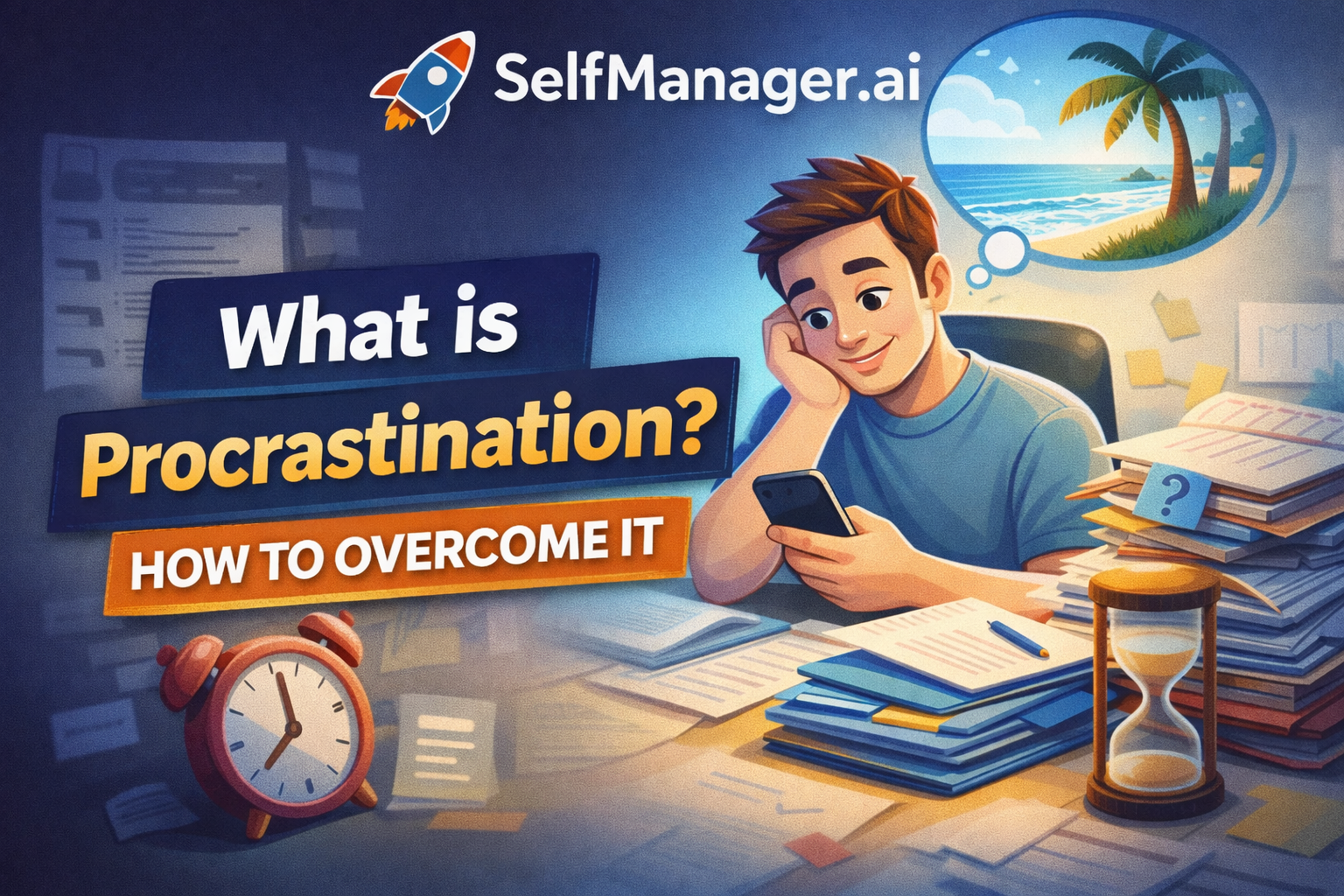
Procrastination is one of the most common productivity problems people face, yet it is also one of the most misunderstood.
A lot of people describe procrastination as laziness. But that is usually not accurate.
Most of the time, procrastination is not about doing nothing because you do not care. It is about delaying something you know matters, even when that delay creates stress, guilt, or bigger problems later.
That is why procrastination can feel so frustrating.
You know what you should do.
You often even want to do it.
But somehow, you still avoid starting.
The good news is that procrastination is not a fixed personality trait. It is a pattern. And patterns can be changed.
What is procrastination?
Procrastination is the habit of postponing important or necessary tasks, usually in favor of something easier, more comfortable, or more immediately rewarding.
That does not always mean wasting time completely.
Sometimes procrastination looks obvious:
- scrolling social media instead of working
- watching videos instead of studying
- cleaning your desk instead of writing the report
But sometimes it looks productive on the surface:
- organizing folders instead of doing the hard task
- answering easy emails instead of making the important decision
- planning the work in detail instead of actually starting it
- researching endlessly instead of shipping
That is why procrastination can hide inside busy days.
You may feel active while still avoiding the thing that matters most.
Why do people procrastinate?
Procrastination usually happens because a task creates some kind of mental resistance.
That resistance can come from many places:
1. The task feels too big
When something feels large, unclear, or mentally heavy, the brain often treats it like a threat.
It becomes easier to delay it than to face the uncertainty.
Examples:
- "Build the presentation"
- "Start the business"
- "Fix my life"
- "Write the article"
These are not really tasks. They are big, vague areas of work. The brain often resists what it cannot clearly picture.
2. The task feels uncomfortable
A lot of procrastination is emotional, not logical.
You may delay a task because it brings up:
- fear of failure
- fear of judgment
- perfectionism
- boredom
- confusion
- pressure
- self-doubt
In that sense, procrastination is often an attempt to avoid discomfort in the short term.
3. The reward feels too far away
The brain tends to prefer immediate relief over delayed benefit.
That is why checking your phone or doing something easy can feel more attractive than working on something important that may only pay off days, weeks, or months later.
4. You do not know the next step
Sometimes procrastination is not about lack of discipline.
It is about lack of clarity.
When the next step is not obvious, people often stall. They keep thinking about the task without entering the task.
5. Your energy is too low
Not every delay is a mindset problem.
Sometimes you are tired, overloaded, distracted, or mentally depleted. In those moments, even simple tasks can feel heavier than they really are.
That is why solving procrastination is not only about "trying harder." It is often about reducing friction and working with your real energy, not against it.
Why procrastination feels bad
Procrastination often creates a painful loop:
- you delay the task
- the task stays in your mind
- guilt and anxiety grow
- the task now feels even heavier
- you avoid it again
- the cycle repeats
This is why procrastination is so draining.
It is not only the unfinished work that hurts. It is the mental load of carrying it around.
A task that should have taken 30 minutes can sit in your head for five days.
The truth: you do not need more motivation first
One of the biggest myths about procrastination is this:
"I will do it when I feel more motivated."
That sounds reasonable, but in real life motivation often comes after starting, not before.
Action creates momentum.
Momentum creates motivation.
Waiting to feel ready is one of the easiest ways to stay stuck.
How to overcome procrastination
There is no magic trick, but there are practical methods that work very well when used consistently.
1. Make the task smaller
This is one of the most effective ways to reduce resistance.
Do not write:
- "Work on website"
- "Write blog post"
- "Study marketing"
Write:
- open homepage draft
- rewrite headline
- outline 5 blog sections
- read 3 pages of notes
- write first paragraph only
A vague task creates avoidance.
A small concrete task creates movement.
The goal is to make the starting point so clear that your brain does not have to negotiate with it.
2. Focus on starting, not finishing
A lot of procrastination comes from mentally carrying the full weight of the task before even beginning.
Instead of asking:
"How do I finish this?"
Ask:
"What is the easiest way to begin?"
Examples:
- open the file
- write one sentence
- set a timer for 10 minutes
- make a rough draft
- create the first version badly
Starting matters more than starting perfectly.
3. Use time blocks
Many people procrastinate because tasks float around all day with no clear place.
If a task lives only in your head, it competes with everything else.
Putting it into a specific time block helps a lot:
- 10:00 - 10:25 outline article
- 14:00 - 14:30 fix landing page copy
- 17:00 - 17:15 reply to hard email
This shifts the question from "Will I do it?" to "Can I protect this time?"
4. Reduce the emotional pressure
Some tasks become hard because we attach too much pressure to them.
Examples:
- "This has to be amazing"
- "I cannot mess this up"
- "If this goes badly, it means I am not good enough"
That kind of thinking makes starting harder.
Try replacing it with:
- "I only need a draft"
- "This version does not need to be perfect"
- "The goal is progress, not performance"
- "I can improve it after it exists"
Perfectionism is one of the most socially accepted forms of procrastination.
5. Remove easy distractions before you begin
Do not rely only on willpower.
Make the task easier and the distractions harder.
For example:
- put your phone in another room
- close unnecessary tabs
- work in full screen
- clear your desk
- prepare the files you need in advance
- use a short timer to create urgency
A lot of procrastination disappears when friction is removed.
6. Decide the next step the day before
One of the best ways to reduce procrastination is to avoid beginning your day with uncertainty.
At the end of the day, define:
- the top task for tomorrow
- the first small step
- the time block when you will do it
That way, tomorrow starts with direction instead of mental fog.
7. Track what you avoid repeatedly
If you keep procrastinating the same type of task, pay attention.
That usually means something deeper is going on.
Ask yourself:
- Is the task unclear?
- Is it too big?
- Am I afraid of doing it badly?
- Do I actually need help?
- Does this task belong to me at all?
- Am I overloaded?
Sometimes procrastination is useful feedback. It can reveal a broken process, not just weak discipline.
8. Use review loops
Many people procrastinate because they live only in reaction mode.
They do not pause to see patterns.
A weekly review helps you notice:
- what you kept delaying
- what drained your energy
- which tasks moved forward
- what should be broken down better
- where your system is creating friction
That is one reason review matters so much. It turns procrastination from a vague feeling into something you can observe and improve.
9. Accept imperfect action
This is one of the biggest breakthroughs for many people.
You do not need the perfect mood, perfect energy, or perfect plan.
You often just need one imperfect work session.
A rough start is still a start.
A messy draft is still progress.
Ten useful minutes still count.
The people who move forward consistently are often not the people who feel ready all the time. They are the people who are willing to begin before they feel ready.
A practical anti-procrastination method
If you want something simple, use this:
Step 1
Write the task in one line.
Step 2
Break it into the smallest possible first step.
Step 3
Put it on a specific date and time.
Step 4
Work on it for 10 to 25 minutes only.
Step 5
At the end, decide the next step before stopping.
This approach works because it reduces vagueness, lowers emotional resistance, and creates continuity.
How SelfManager.ai can help with procrastination
Procrastination gets worse when tasks are vague, scattered, and disconnected from your real day.
That is why a date-based structure can help so much.
Instead of keeping everything in abstract project buckets, SelfManager.ai helps you place work into actual days, break it into smaller pieces, and review how things are progressing over time.
That matters because procrastination often improves when you can:
- see what belongs to today
- separate big goals into smaller tasks
- keep notes and context next to the work
- review what got delayed and why
- use AI to turn messy thoughts into more structured action
A system like that does not magically remove procrastination, but it can reduce the friction that causes it.
And that is often what people need most.
Final thought
Procrastination is not proof that you are lazy or broken.
In many cases, it is a signal.
It may be telling you that the task is too vague, too heavy, too emotionally loaded, or too disconnected from your real schedule.
The answer is usually not to shame yourself more.
The answer is to make the work clearer, smaller, and easier to enter.
Because once you start, things usually feel lighter than they did in your head.
And that is often the moment progress begins.
Date-based AI Task Manager
Plan smarter, execute faster, achieve more
Create tasks in seconds, generate AI-powered plans, and review progress with intelligent summaries. Perfect for individuals and teams who want to stay organized without complexity.
Get started with your preferred account