Top Productivity Lessons You Can Learn From Jensen Huang (NVIDIA's Execution Playbook)
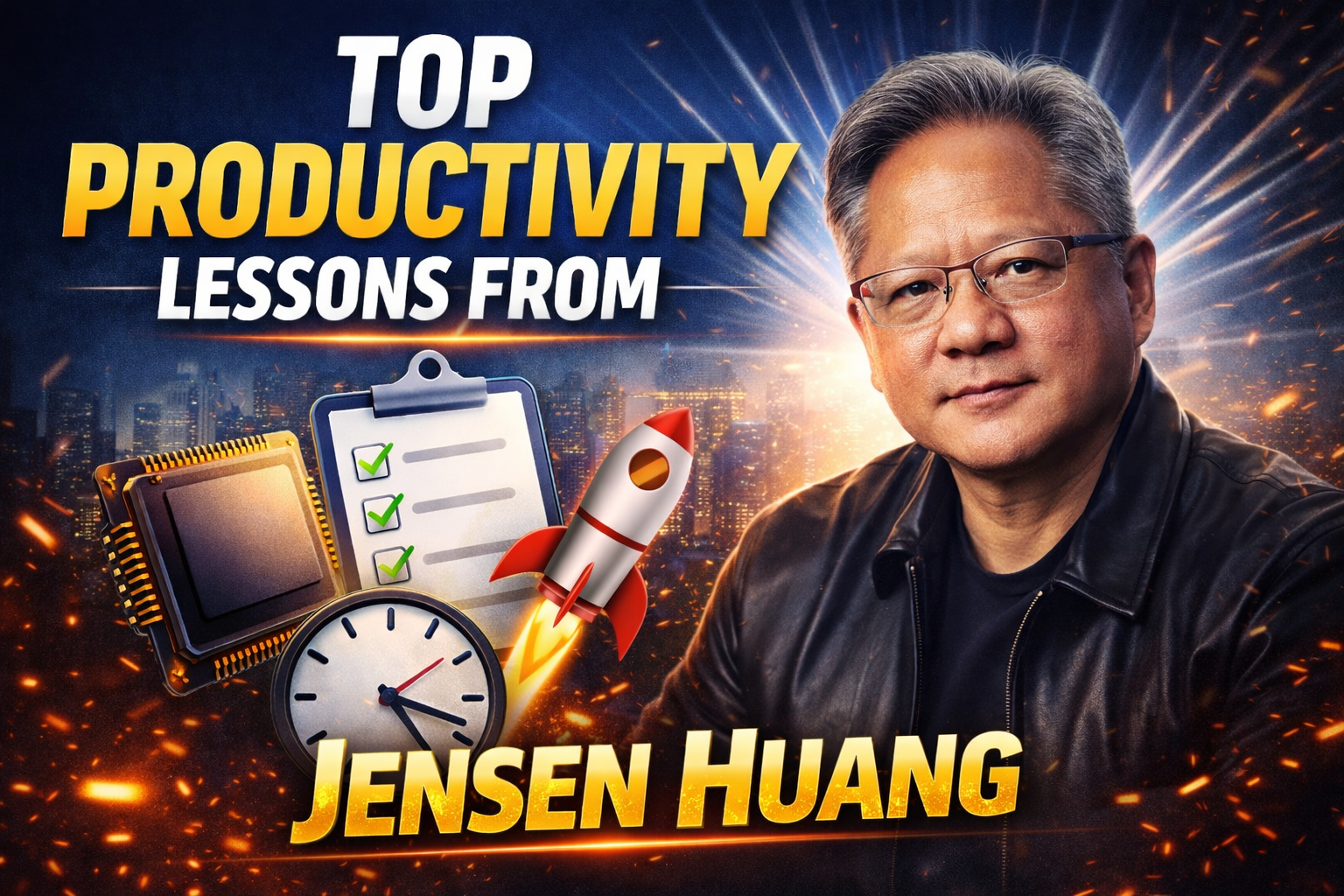
Jensen Huang's productivity style is less about "habits" and more about operating systems: fast information flow, clear ownership, first-principles decisions, and relentless iteration. He's the founder/CEO of NVIDIA (since 1993), and a lot of what people call his "productivity" is really how he designs communication and decision-making at scale.
Below are the most transferable lessons - written so you can apply them as a solo builder, freelancer, or founder.
1. Build a high-bandwidth "truth pipeline" (so reality reaches you fast)
One of the most interesting reported habits is his "Top-5 things" email system: employees send the top items on their mind, giving leadership a live feed of risks, progress, and opportunities.
Productivity takeaway: Most teams don't have a work problem - they have an information latency problem. Bad news arrives late, so fixes arrive late.
Try this (solo or team):
- Weekly: write "Top 5 things I'm thinking about" (projects, blockers, risks, opportunities).
- Keep it brutally short.
- Review it every Monday and Friday.
2. Use first-principles thinking to avoid "industry autopilot"
Huang has spoken publicly about using first-principles reasoning to drive decisions.
Productivity takeaway: First principles is a speed tool. It helps you stop copying other people's playbooks and focus on what's actually true for your situation.
A simple first-principles prompt:
- What must be true for this to work?
- What assumptions am I borrowing?
- What would I do if I had to cut this plan by 50%?
3. Optimize for speed of iteration, not perfection
NVIDIA's culture is widely described as execution-heavy and engineering-driven, and Huang is often portrayed as intense about delivery and learning loops.
Productivity takeaway: The fastest teams don't "get it right." They close feedback loops quickly.
Try this:
- Replace "finish" with "v1 shipped."
- After shipping: measure + learn + v2.
4. Keep the org (or your workflow) flat to reduce coordination tax
Reporting on his management style often highlights a flat structure and unusually wide visibility across the business.
Productivity takeaway: Every extra layer adds meetings, approvals, and waiting. Flat workflows move faster.
Try this in your projects:
- One owner per outcome (no shared ownership).
- One place where decisions live (short notes).
- Fewer handoffs, more "finish what you start."
5. Treat communication as infrastructure, not chatter
The "Top-5" system is a good example of this: communication isn't ad hoc; it's structured.
Productivity takeaway: If your communication system is weak, your execution will always feel chaotic.
Try this:
- Daily: 1 short update ("what I did / what's next / what's blocked").
- Weekly: Top 5 list.
- Monthly: one "what we learned" summary.
6. Make hard bets early, then commit (and out-execute)
Profiles of Huang emphasize engineering-led conviction and strategic risk-taking (early bets that compound).
Productivity takeaway: Indecision is the slowest workflow. Great execution often starts with a clear bet.
Try this decision rule:
- If a decision is reversible → decide fast.
- If it's irreversible → decide with a written rationale, then commit.
7. Invest where returns compound (tools, skills, platform)
Huang's "CEO math" line ("the more you buy, the more you save") is usually framed as a joke, but the underlying idea is compounding value from the right investments.
Productivity takeaway: The best productivity upgrades are not hacks - they're compounding assets:
- automation
- reusable templates
- distribution channels
- systems that reduce repeated thinking
8. Run with intensity - but channel it into priorities
He's frequently described as having a demanding, hands-on style and long working hours.
Productivity takeaway: Intensity without priority becomes burnout. Intensity with priority becomes output.
Try this constraint:
- Only 3 outcomes per week.
- Everything else is support work (limited timebox).
9. Keep a tight "signal-to-noise" filter
The point of a Top-5 list is not detail - it's signal.
Productivity takeaway: High performers don't consume more information - they filter better.
Try this:
- Before adding a task, ask: does this directly move a weekly outcome?
- If not, park it (don't delete it - park it).
10. Design your week around feedback loops
A practical way to copy the "Huang style" without being a CEO:
The loop:
- Monday: decide the week's 3 outcomes
- Midweek: check progress + remove one blocker
- Friday: Top-5 review + lessons learned
This prevents the classic productivity failure: doing a lot, learning little.
The "Jensen-style" weekly template (copy/paste)
3 Outcomes (this week):
- ---
- ---
- ---
Top 5 things on my mind:
- ---
- ---
- ---
- ---
- ---
Biggest blocker: __________________
Decision I'm avoiding: __________________
One experiment to get feedback in 7 days: __________________
How to implement this inside SelfManager.ai (simple setup)
- Create a pinned table: "Top 5 (This Week)"
Keep it as the single source of truth for priorities + risks. - Create a weekly table: "Scoreboard"
Add your 3 outcomes + one metric (shipping, revenue, outreach, deep work hours). - Create a daily table: "Today's Focus"
Pull only 1–3 tasks from the weekly outcomes. - End of week: generate a short weekly summary (AI or manual) and compare it to outcomes:
- Did you do what mattered?
- What was noise?
- What's the new bottleneck?
Date-based AI Task Manager
Plan smarter, execute faster, achieve more
Create tasks in seconds, generate AI-powered plans, and review progress with intelligent summaries. Perfect for individuals and teams who want to stay organized without complexity.
Get started with your preferred account