
Top Productivity Lessons Learned From Jamie Dimon: Discipline, Risk, and Operating Through the Cycle
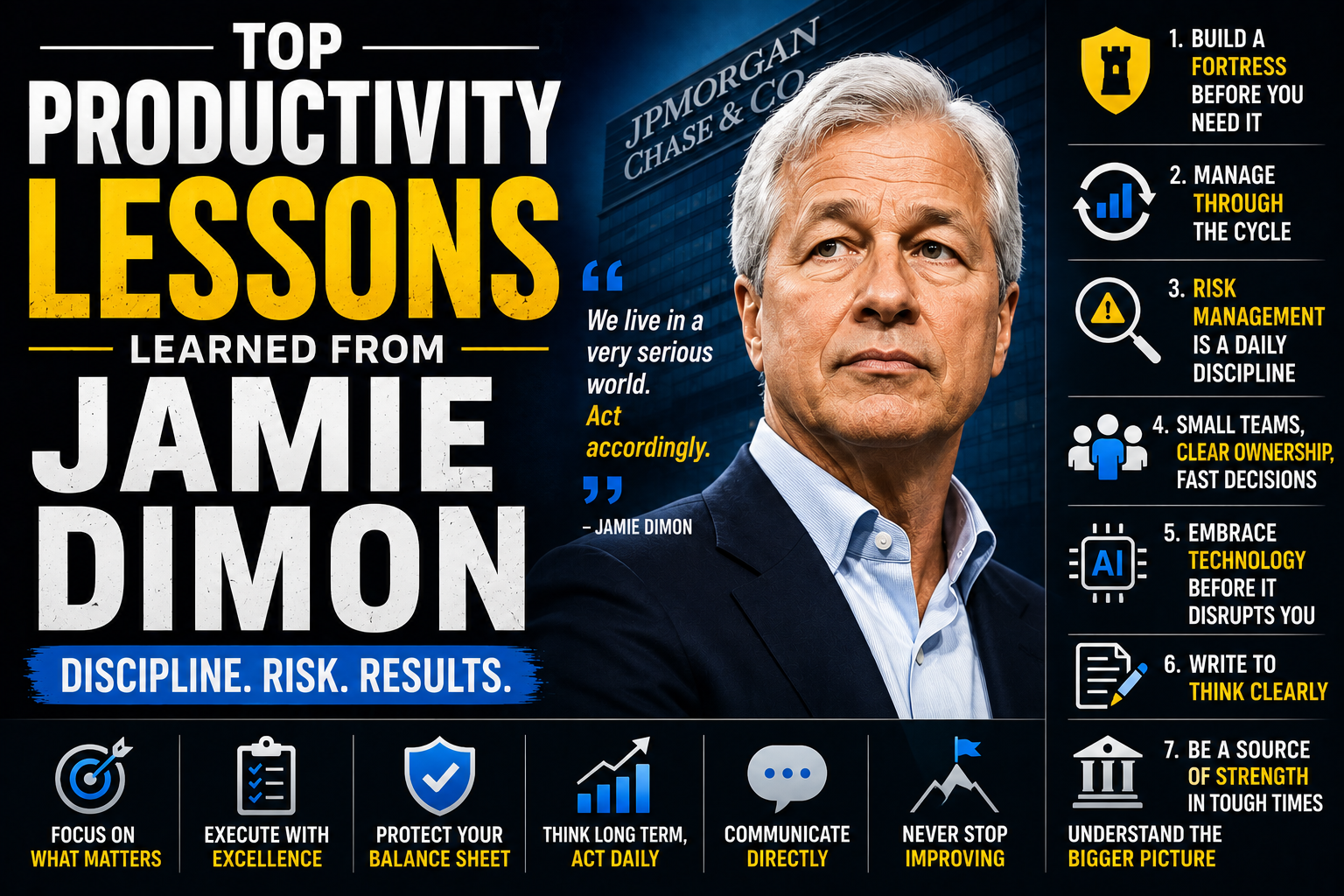
Jamie Dimon is usually discussed as one of the most powerful people in global banking.
That makes sense.
He is the Chairman and Chief Executive Officer of JPMorganChase, one of the largest financial institutions in the world. JPMorganChase says Dimon became CEO on January 1, 2006, and became Chairman one year later. The company also describes itself as a global financial services firm with $3.2 trillion in assets and operations worldwide.
But Jamie Dimon is not only a banking story.
He is also a productivity story.
His career is about operating under pressure, managing risk, building resilient systems, thinking long term, writing clearly, and leading a massive organization through financial crises, regulatory changes, technology shifts, geopolitical uncertainty, and market cycles.
That makes him very useful to study.
Not because everyone should run a bank.
But because every serious builder eventually has to learn the same lesson:
Productivity is not only about doing more.
It is about building a system that survives pressure.
Below are the most useful productivity lessons learned from Jamie Dimon.
1) Deal with reality, not fantasy
One of the strongest Jamie Dimon lessons is realism.
He is known for speaking directly about risks, markets, politics, regulation, debt, technology, and business conditions. Whether someone agrees with him or not, his style is rarely vague.
That matters for productivity.
Many people waste time because they avoid reality.
- They avoid looking at numbers.
- They avoid bad feedback.
- They avoid declining performance.
- They avoid hard conversations.
- They avoid the fact that a project is not working.
- They avoid the fact that a strategy is outdated.
A productive person does not only ask:
"What do I want to be true?"
They ask:
"What is actually true?"
Practical habit:
Once per week, write down the uncomfortable facts.
- What is not working?
- What metric is worse than expected?
- What problem keeps repeating?
- What risk are you ignoring?
Reality is not always pleasant, but it is always useful.
2) Build a fortress before you need it
Dimon is strongly associated with the phrase "fortress balance sheet."
In JPMorganChase's 2025 annual report letter, he wrote about reinforcing the company's fortress balance sheet while continuing to invest in products, people, and technology with strict risk discipline.
That is a productivity lesson beyond banking.
A fortress is not built during the storm.
It is built before the storm.
For a company, that might mean capital, liquidity, compliance, cybersecurity, talent, and strong systems.
For an individual, that might mean savings, health, skills, reputation, clean processes, and reliable habits.
- For a freelancer, it might mean not depending on one client.
- For a SaaS founder, it might mean not depending on one acquisition channel.
- For a creator, it might mean not depending on one platform.
Practical habit:
Ask:
Where am I fragile?
Then build a buffer.
- A cash buffer.
- A time buffer.
- A health buffer.
- A skill buffer.
- A technical buffer.
- A reputation buffer.
Productivity without resilience is fragile productivity.
3) Manage through the cycle
Dimon's leadership style is deeply connected to the idea of managing through cycles.
Banking is cyclical by nature. Markets rise and fall. Credit conditions tighten and loosen. Interest rates change. Crises appear. Sentiment shifts quickly.
In the 2025 shareholder letter, JPMorganChase says it manages "through the cycle," and Dimon discusses how risks can build over time before a tipping point appears.
That is useful for anyone doing serious work.
Most people overreact to short-term changes.
- One bad week, and they want to quit.
- One slow month, and they change the strategy.
- One competitor launches something, and they panic.
- One post fails, and they stop publishing.
- One client rejects them, and they assume the market is dead.
Long-term productivity requires a cycle mindset.
Practical habit:
Separate temporary noise from structural change.
Ask:
- Is this a bad day, or a real trend?
- Is this a temporary dip, or a broken system?
- Is this feedback, or just market randomness?
Do not redesign your whole life based on one bad week.
4) Risk management is productivity
A lot of people think risk management is defensive.
But Dimon's career shows that risk management is productive.
- A company that manages risk well can keep moving when others freeze.
- A person who manages risk well can take smarter bets.
- A founder who manages risk well can survive longer.
- A team that manages risk well can execute with more confidence.
In the 2025 letter, Dimon criticized narrow risk models and wrote that JPMorganChase looks at far more scenarios and reviews risks every week, not just once a year.
That is a huge lesson.
You do not manage risk once.
You manage it continuously.
Practical habit:
Create a weekly risk review.
Ask:
- What could break this project?
- What are we depending on too much?
- What changed this week?
- What are we assuming?
- What would hurt us if it happened suddenly?
This does not make you pessimistic.
It makes you prepared.
5) Move fast with small, focused teams
Dimon's 2025 management lessons include a very practical idea: organize in small teams for speed.
He wrote that competitive battles happen at detailed segment levels, and that the teams working on these challenges should be small, dedicated, and able to move quickly. He also warned that if a new effort is only "1%" of many people's jobs, it usually will not get done.
That is one of the best productivity lessons in the whole letter.
Many projects fail because no one truly owns them.
- Everyone is involved.
- Everyone is copied.
- Everyone is "helping."
- But no one is 100% responsible.
A small dedicated team can beat a large unfocused group.
Practical habit:
For every important project, define:
- Who owns it?
- Who decides?
- Who executes?
- What is the mission?
- What is not part of the mission?
- What does success look like?
Small teams with clear ownership move faster than large teams with vague responsibility.
6) Build platforms, not bureaucracy
Dimon also makes an important distinction between platforms and bureaucracy.
In the 2025 letter, he wrote that teams need common tools, common language, interoperability, and companywide platforms for areas like data, AI, coding, financial systems, and CRM. But he also warned that the trick is to have great platforms without creating bureaucracy.
That is extremely relevant for modern work.
A good system makes work faster.
A bad system becomes another job.
- Good platforms reduce friction.
- Bureaucracy adds friction.
- Good platforms help teams move independently.
- Bureaucracy makes everyone ask permission.
- Good platforms create consistency.
- Bureaucracy creates meetings.
Practical habit:
Review your tools and processes.
Ask:
- Does this system make work faster?
- Or does it only make us feel organized?
A productivity system should reduce friction, not become another source of work.
7) Culture takes real effort
Dimon does not treat culture as a soft topic.
In the 2025 letter, he wrote that building a lasting, deeply rooted common culture is critical and takes extraordinary effort. He also said that, for a company with JPMorganChase's complexity and global reach, the company could not have survived and thrived without that effort.
That applies to any team.
Culture is not slogans.
Culture is what people do repeatedly.
- How decisions are made.
- How problems are discussed.
- How fast people move.
- How quality is defined.
- How people treat customers.
- How people handle pressure.
- How people communicate bad news.
- How people recover from mistakes.
Practical habit:
Instead of writing vague values, define behaviors.
Do not only say:
"We value ownership."
Say:
"When something is broken, the owner proposes the next step before the next meeting."
Culture becomes real when it becomes behavior.
8) Write to clarify thinking
Jamie Dimon's annual shareholder letters are not short status updates.
They are long, detailed documents about business performance, management lessons, risk, technology, policy, markets, and strategy.
In the 2025 letter, he wrote that the annual letter is clarifying not only for shareholders, but also for himself, the management team, employees, and communities. He said the writing process forces the company to analyze complex questions and explain what it is trying to accomplish clearly.
That is a powerful productivity lesson.
Writing is thinking.
A vague idea can survive in your head.
It has a harder time surviving on the page.
When you write, you notice gaps.
- You notice contradictions.
- You notice weak logic.
- You notice missing evidence.
- You notice what you do not actually understand.
Practical habit:
Before making a major decision, write a one-page memo.
Include:
- What is happening?
- What do we believe?
- What evidence supports it?
- What could go wrong?
- What are the options?
- What is the decision?
Writing slows you down just enough to think better.
9) Stay paranoid about competition
Dimon's annual letters often emphasize competition.
In the 2025 letter, he wrote that JPMorganChase faces extraordinary competition and recognizes both its strengths and vulnerabilities.
That is a healthy mindset.
Strong organizations do not assume they deserve to win.
- They know customers can leave.
- Talent can leave.
- Competitors can improve.
- Technology can change the rules.
- Markets can shift.
- Regulation can reshape incentives.
A productive person or company does not rely only on past success.
Past success is useful, but it can also make you slow.
Practical habit:
Ask every month:
- Who is improving faster than us?
- What would I do if I were competing against myself?
- Where are we too comfortable?
- What would make customers choose someone else?
Comfort is dangerous when the market is moving.
10) Adopt technology before it adopts you
Dimon is not treating AI as a side topic.
In JPMorganChase's 2025 letter, he wrote that the company must move quickly and incorporate AI into everything it does. He also wrote that AI will affect virtually every function, application, and process in the company and will have a major long-term productivity impact.
Reuters also reported in May 2026 that Dimon said JPMorgan would likely hire more AI specialists and fewer traditional bankers in some categories, while using retraining, redeployment, and other approaches to manage workforce changes over time.
That is a clear productivity lesson for 2026.
Do not wait until technology forces you to change.
Start learning while you still have time.
AI will not replace every worker in the same way.
But people and companies that understand AI workflows will have an advantage over those that ignore them.
Practical habit:
Pick one workflow every week and ask:
- Can AI make this faster?
- Can AI improve quality?
- Can AI help with analysis?
- Can AI reduce repetitive work?
- Can AI create a better first draft?
- Can AI help us make a better decision?
The goal is not to chase every tool.
The goal is to redesign work before the market forces you to.
11) Prepare for second-order effects
Dimon's AI comments are also useful because he does not frame AI as only simple automation.
In the 2025 letter, he wrote that major technological shifts create second- and third-order effects that can deeply affect society, similar to how earlier technologies reshaped cities, suburbs, phones, apps, and social media.
That is a deep productivity lesson.
Beginners ask:
"What does this tool do today?"
Strategic thinkers ask:
"What does this change make possible?"
For example:
AI does not only help you write faster.
- It may change how teams hire.
- It may change how agencies price work.
- It may change how software is built.
- It may change how customers expect support.
- It may change how content is produced.
- It may change which skills become valuable.
Practical habit:
When a major technology shift appears, ask:
- What becomes cheaper?
- What becomes faster?
- What becomes easier?
- What becomes unnecessary?
- What becomes newly possible?
That is where the real opportunity is.
12) Be a source of strength in hard times
In the 2025 letter, Dimon wrote that JPMorganChase must be a source of strength in tough times for clients and the countries where it operates, and that the firm takes seriously its role as one of the guardians of the financial system.
That is bigger than normal productivity advice.
But it is useful.
Anyone can look good when things are easy.
The real test is what happens under pressure.
- Do people trust you more during hard times?
- Or less?
- Do clients feel safer because you are involved?
- Or more anxious?
- Does your team become clearer during chaos?
- Or more confused?
Practical habit:
Ask:
When things get difficult, do I become more useful or less useful?
That question reveals a lot.
A strong operator becomes calmer, clearer, and more valuable when pressure rises.
A Simple Jamie Dimon-Inspired Productivity Framework
Daily
- Deal with reality.
- Look at the real numbers.
- Communicate clearly.
- Protect the most important work.
- Do not avoid hard facts.
Weekly
- Review risk.
- Review progress.
- Review what changed.
- Ask whether the team has clear ownership.
- Identify one friction point in your operating system.
Monthly
- Review competition.
- Review technology shifts.
- Review whether your systems create speed or bureaucracy.
- Strengthen one buffer.
- Write one memo that clarifies your thinking.
Quarterly
- Ask whether your strategy still fits reality.
- Review long-term risks.
- Review talent, tools, capital, and culture.
- Cut complexity.
- Invest in the systems that make you more resilient.
Final Thoughts
Jamie Dimon's productivity lessons are not about hacks.
They are about operating discipline.
- Deal with reality.
- Build buffers.
- Manage risk continuously.
- Think through cycles.
- Move fast with small teams.
- Build platforms without bureaucracy.
- Write to clarify thinking.
- Take culture seriously.
- Adopt technology early.
- Prepare for second-order effects.
- Be strong when conditions are difficult.
The deeper lesson is simple:
Real productivity is not just how much you can do when everything is easy.
Real productivity is how well your system performs when the world becomes uncertain.
Date-based AI Task Manager
Plan smarter, execute faster, achieve more
Create tasks in seconds, generate AI-powered plans, and review progress with intelligent summaries. Perfect for individuals and teams who want to stay organized without complexity.
Get started with your preferred account