
Top Productivity Lessons Learned From Cristiano Ronaldo: Discipline, Longevity, and Relentless Standards
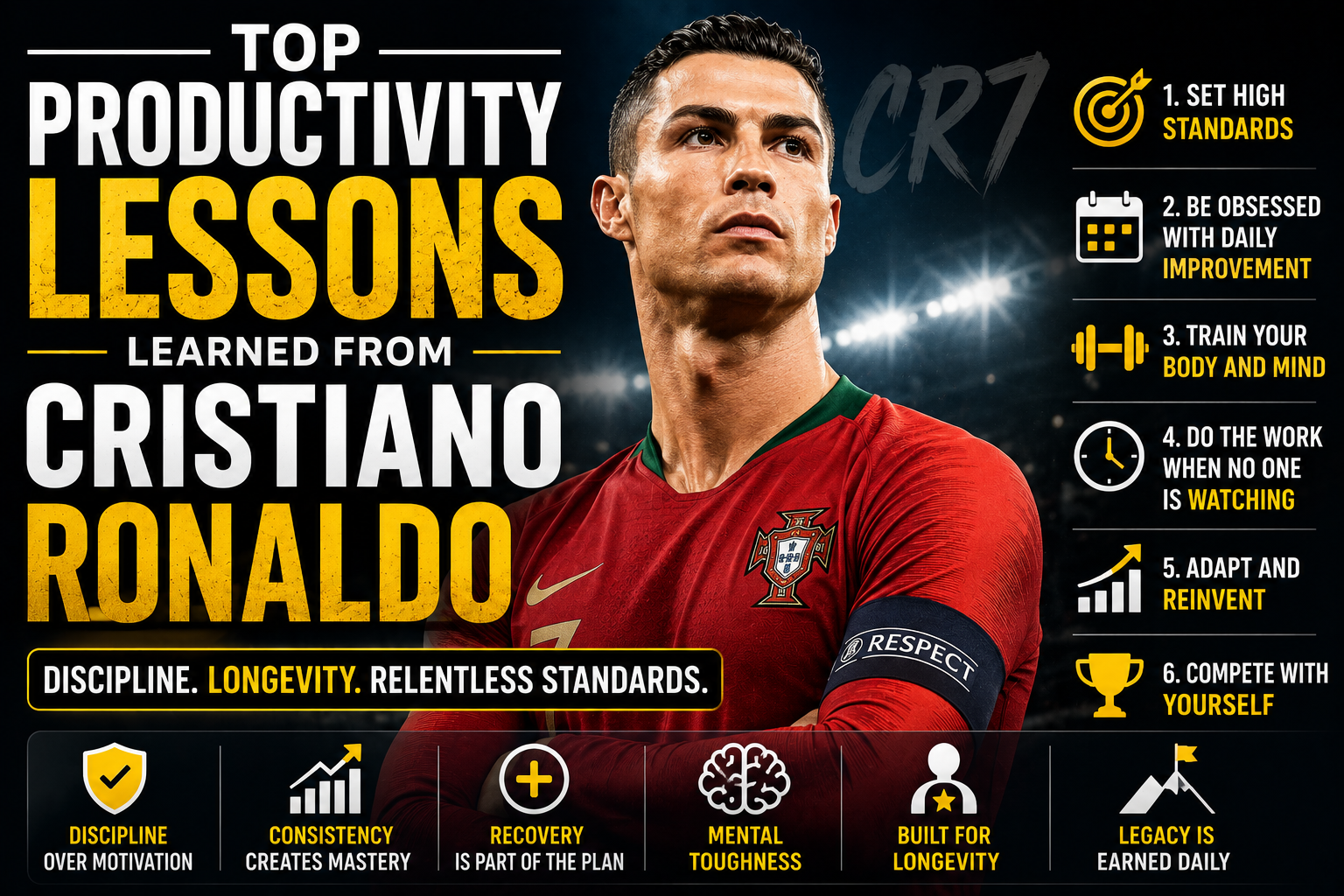
Cristiano Ronaldo is usually discussed as one of the greatest footballers of all time.
That makes sense.
He holds major records across international football and European club football. FIFA describes him as the record holder for most goals and caps in men's international football, while UEFA lists him as the all-time top scorer in the Champions League, UEFA club competition, and senior international football.
But Ronaldo is not only a football story.
He is also a productivity story.
His career is built around discipline, repetition, physical preparation, mental toughness, branding, longevity, and the ability to keep performing under pressure for more than two decades.
That is useful even if you never play football.
If you are building a business, freelancing, creating content, managing a team, growing a product, or trying to improve your own life, Ronaldo's career offers a very clear lesson:
Talent matters.
But talent without discipline fades.
Below are the most useful productivity lessons learned from Cristiano Ronaldo.
1) Talent is only the starting point
Cristiano Ronaldo is obviously talented.
But his career is not only a story of natural ability.
The reason Ronaldo became Ronaldo is not because he was good once. It is because he kept improving, training, adapting, and raising his standard year after year.
Many talented people disappear because they rely too much on the talent that made them visible.
- They stop improving.
- They stop listening.
- They stop learning.
- They stop doing the boring work.
Ronaldo's career shows the opposite.
Talent opens the door.
Discipline keeps you in the room.
Practical habit:
Ask yourself:
What advantage do I have that I am under-maintaining?
- A skill.
- A reputation.
- A client base.
- A product.
- A body.
- A relationship.
A talent that is not maintained eventually becomes wasted potential.
2) Build a body that can support the mission
Ronaldo's productivity is physical.
That is one of the biggest lessons.
You cannot separate his output from his body. His speed, strength, recovery, movement, and longevity are all part of the system.
For knowledge workers, founders, freelancers, and creators, this is easy to ignore.
Most of our work happens on laptops, in meetings, in documents, in code, in dashboards, and inside our heads.
But the body still matters.
- Bad sleep affects decisions.
- Bad energy affects discipline.
- Bad health affects consistency.
- Bad recovery affects patience.
- Bad physical condition affects mental performance.
Ronaldo's lesson is not that everyone should train like a professional athlete.
The lesson is that your body is part of your productivity system.
Practical habit:
Protect the basics:
- Sleep.
- Movement.
- Nutrition.
- Recovery.
- Energy.
You do not need an elite athlete routine. You need a body that can support the work you expect from yourself.
3) Repeat the boring fundamentals
Ronaldo's success is connected to repetition.
- Training.
- Finishing.
- Positioning.
- Strength work.
- Recovery.
- Matches.
- Review.
- Improvement.
Again and again.
Most people want the exciting part of success.
- They want the launch.
- The big result.
- The attention.
- The trophy.
- The viral post.
- The breakthrough.
But extraordinary success is usually built from boring fundamentals repeated for years.
That is true in football.
It is true in business.
It is true in content.
It is true in software.
It is true in freelancing.
Practical habit:
Choose the boring fundamentals in your field.
- For a founder, it may be talking to customers.
- For a writer, it may be publishing consistently.
- For a developer, it may be shipping clean work.
- For a freelancer, it may be improving proposals and follow-up.
- For an athlete, it may be training.
The question is:
What boring action would change my life if I repeated it for 5 years?
4) Set standards before the world sets them for you
Ronaldo is famous for high standards.
That matters because high achievers do not wait for external pressure to care.
They create internal pressure.
A normal player may train because the coach expects it.
A great player trains because their own standard demands it.
That is a major productivity lesson.
If your standard only rises when someone is watching, you will always be inconsistent.
The best people build an internal scoreboard.
- They know when the work is not good enough.
- They know when they are lying to themselves.
- They know when they are cutting corners.
Practical habit:
Before starting important work, define the standard.
- What does "good" mean?
- What does "excellent" mean?
- What would make this worth publishing, shipping, sending, or showing?
If you do not define the standard early, you will lower it when you get tired.
5) Longevity is a strategy
Ronaldo's career longevity is extraordinary. He has continued playing and scoring at the highest levels into his late 30s and early 40s, and Reuters reported in May 2026 that he scored twice as Al Nassr won the Saudi Pro League title.
This is not normal.
Most athletes peak earlier. Many fade because of injury, pressure, lifestyle, motivation, or competition.
Ronaldo's lesson is that longevity does not happen by accident.
Longevity is designed.
- You need recovery.
- You need adaptation.
- You need discipline.
- You need to change your game as your body, market, or industry changes.
That applies to work too.
- A founder cannot operate the same way forever.
- A freelancer cannot rely on the same platform forever.
- A creator cannot use the same content format forever.
- A developer cannot stop learning.
Practical habit:
Ask yourself every quarter:
- What used to work that no longer works?
- What do I need to change to stay in the game longer?
Productivity is not only about this week.
It is about staying effective for years.
6) Reinvent without losing your core identity
Ronaldo did not play the same way throughout his entire career.
He changed.
- The young Manchester United version was explosive, skillful, and wide.
- The Real Madrid version became a goal machine.
- The later version adapted around positioning, timing, finishing, and efficiency.
That is a powerful lesson.
Reinvention does not mean abandoning your identity.
It means adapting the expression of your strengths.
Your core may stay the same:
- Discipline.
- Ambition.
- Quality.
- Competitiveness.
But your method may need to change.
Practical habit:
Write down:
What is my core strength?
Then ask:
What is the modern version of that strength?
- A designer may become a product strategist.
- A freelancer may become an agency owner.
- A developer may become a SaaS founder.
- A writer may become a media business.
The strength remains.
The format evolves.
7) Use pressure as fuel, not as an excuse
Few athletes have lived under more pressure than Cristiano Ronaldo.
- Every match is judged.
- Every miss is replayed.
- Every facial expression becomes news.
- Every season is compared to previous seasons.
- Every trophy, failure, transfer, and goal becomes part of a global conversation.
That level of attention can break people.
Ronaldo has used pressure as part of the machine.
This is useful because pressure exists in every serious path.
- Clients create pressure.
- Audiences create pressure.
- Investors create pressure.
- Deadlines create pressure.
- Competition creates pressure.
- Your own ambition creates pressure.
The question is not whether pressure exists.
The question is whether you use it or collapse under it.
Practical habit:
When you feel pressure, ask:
What is this pressure asking me to prepare better for?
Pressure becomes useful when it improves preparation.
8) Build confidence through evidence
Ronaldo's confidence is obvious.
But the useful lesson is that confidence is stronger when it is backed by evidence.
- Training is evidence.
- Consistency is evidence.
- Past performance is evidence.
- Preparation is evidence.
- Sacrifice is evidence.
This matters because many people try to create confidence with motivation alone.
- They watch videos.
- They repeat affirmations.
- They imagine success.
That can help, but real confidence comes from proof.
You trust yourself more when you know you did the work.
Practical habit:
Create evidence for your confidence.
- Keep promises to yourself.
- Complete the work.
- Track progress.
- Review wins.
- Study improvement.
Confidence built on evidence lasts longer than confidence built on mood.
9) Protect your brand like an asset
Ronaldo is not only an athlete.
He is also a global brand.
That is part of his extraordinary success. Reuters reported that Forbes listed him as the highest-paid soccer player in 2025, with estimated earnings of $280 million.
This matters because modern productivity is not only about output.
It is also about reputation.
- Your name becomes an asset.
- Your work history becomes an asset.
- Your public presence becomes an asset.
- Your consistency becomes an asset.
- Your standards become an asset.
For freelancers, founders, creators, and business owners, this is extremely important.
- A strong brand makes future work easier.
- People trust you faster.
- Opportunities come to you.
- Your work has more leverage.
Practical habit:
Ask:
What does my work repeatedly signal about me?
- Reliable?
- High quality?
- Fast?
- Clear?
- Creative?
- Serious?
- Premium?
Your brand is not what you say once. It is what you repeat.
10) Compete with others, but measure yourself against your own standard
Ronaldo's career has been full of competition.
- With other players.
- With records.
- With clubs.
- With history.
- With age.
- With expectations.
Competition can be useful.
- It can push you.
- It can sharpen you.
- It can reveal your gaps.
But external competition can also become toxic if it becomes your only measurement.
The better model is to use competition as fuel while still measuring yourself against your own standard.
Practical habit:
Instead of asking only:
Am I better than them?
Ask:
- Am I better than my previous version?
- Did I improve the system?
- Did I raise the standard?
- Did I prepare better?
- Did I execute better?
The healthiest competition is the one that makes your own work better.
11) Obsession can be powerful, but it needs direction
Ronaldo's career shows the power of obsession.
But obsession is only useful when it is attached to a clear target.
Random obsession becomes chaos.
Focused obsession becomes mastery.
This applies to all high achievers.
They do not just "work hard."
They obsess over something specific:
- Finishing.
- Fitness.
- Scoring.
- Winning.
- Preparation.
- Improvement.
- Standards.
In business, your obsession might be:
- Customer experience.
- Product quality.
- Content output.
- Sales process.
- Design detail.
- Speed.
- Retention.
- Distribution.
Practical habit:
Choose your productive obsession.
What part of your work deserves unusually high attention?
Then make that part your edge.
12) Do the work when motivation disappears
Ronaldo's career is too long to be explained by motivation.
Nobody stays motivated every day for more than 20 years.
- There are injuries.
- Bad games.
- Criticism.
- Travel.
- Fatigue.
- Personal problems.
- Aging.
- Changing teams.
- New coaches.
- New leagues.
- New expectations.
Motivation is not enough for that.
Systems and standards are.
This may be the biggest productivity lesson.
Do not build a life that only works when you feel inspired.
Build a system that keeps you moving when inspiration is gone.
Practical habit:
Create a minimum version of your important habits.
- On a great day, do the full version.
- On a bad day, do the minimum version.
The minimum keeps the identity alive.
A Simple Cristiano Ronaldo-Inspired Productivity Framework
Daily
- Do the boring fundamentals.
- Protect your energy.
- Train the skill that matters most.
- Keep one promise to yourself.
- Prepare before pressure arrives.
Weekly
- Review your performance.
- Study what went wrong.
- Improve one part of your system.
- Remove one habit that hurts your energy.
- Track whether your actions match your standards.
Monthly
- Ask whether your current routine supports longevity.
- Look for signs of burnout or decline.
- Update your training, learning, or work system.
- Review your brand signals.
- Choose one area where your standard must rise.
Quarterly
- Reinvent one part of your approach.
- Ask what needs to change for the next stage.
- Study your competition without becoming obsessed with them.
- Set a standard that forces growth.
- Build for the long game.
Final Thoughts
Cristiano Ronaldo's productivity lessons are not complicated.
They are demanding.
- Discipline.
- Repetition.
- Recovery.
- Pressure.
- Standards.
- Reinvention.
- Longevity.
- Brand.
The deeper lesson is that extraordinary success is rarely built from one great moment.
It is built from thousands of ordinary moments handled with unusual seriousness.
Ronaldo's career shows what happens when talent is multiplied by discipline for decades.
That is the real lesson.
Not everyone can become Cristiano Ronaldo.
But everyone can raise their standard.
Everyone can repeat the fundamentals.
Everyone can protect their energy.
Everyone can build confidence through evidence.
Everyone can stay in the game longer by designing better systems.
And that is where real productivity begins.
Date-based AI Task Manager
Plan smarter, execute faster, achieve more
Create tasks in seconds, generate AI-powered plans, and review progress with intelligent summaries. Perfect for individuals and teams who want to stay organized without complexity.
Get started with your preferred account