
Top 10 Ways to Recharge as a Knowledge Worker After a Hard Working Period
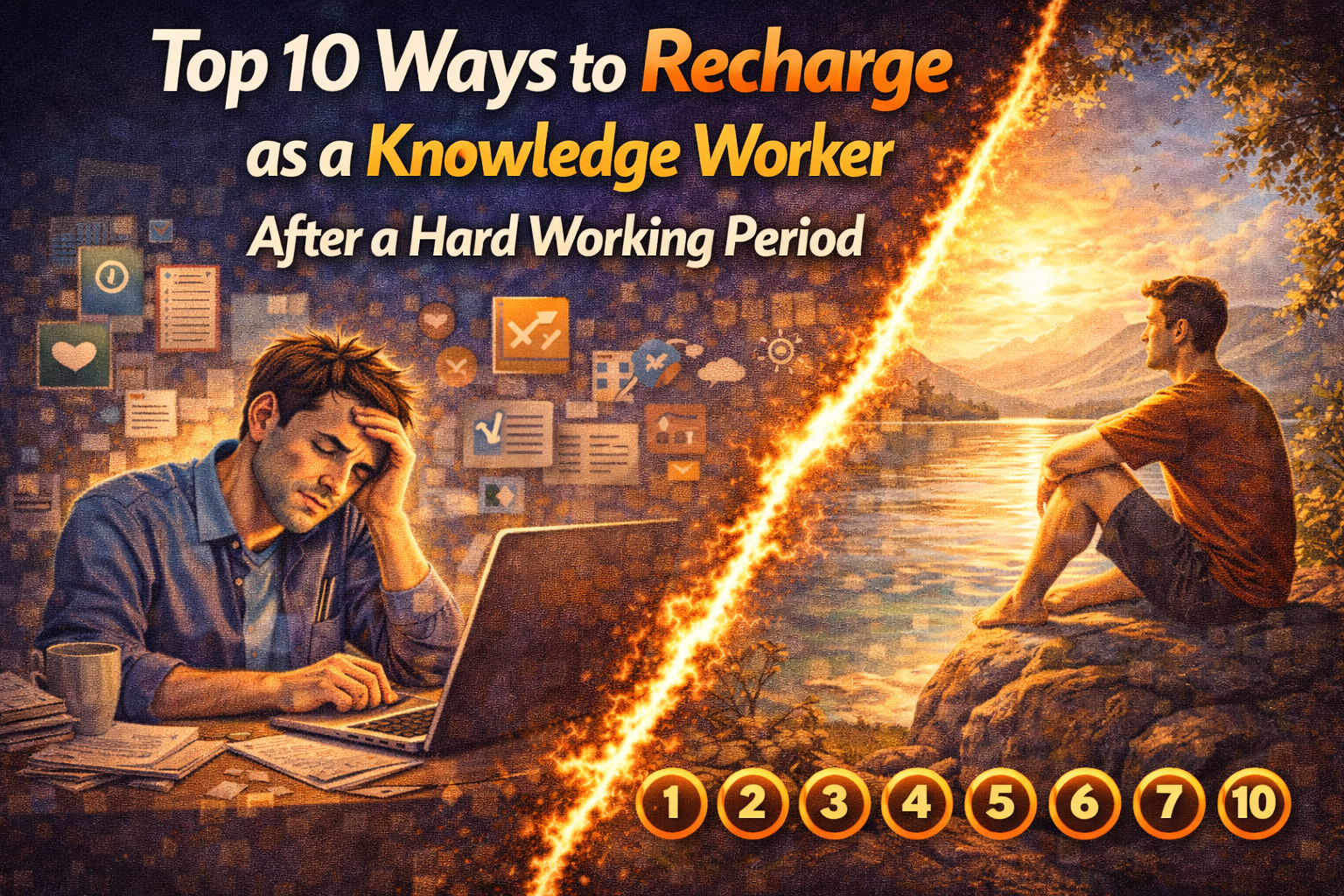
Knowledge work can be intense in a way that is not always visible.
You may not be lifting heavy things or running around all day, but your brain can still become deeply tired after a demanding period of work.
Long stretches of planning, writing, coding, problem-solving, meetings, decision-making, context switching, and screen time can slowly drain your mental energy.
And one of the biggest mistakes people make after a hard working period is assuming that a little extra sleep or one quiet evening will automatically fix everything.
Sometimes that helps.
But often, real recovery requires a more intentional reset.
If you have been pushing hard for a while, you do not only need rest.
You need recharging.
That means restoring focus, emotional steadiness, motivation, clarity, and your sense of being human outside of work.
Here are 10 useful ways to recharge as a knowledge worker after an intense period.
1) Take time away from screens on purpose
If your hard working period involved laptops, phones, meetings, messages, tabs, documents, and constant digital stimulation, then one of the best forms of recovery is reducing screen exposure for a while.
That does not mean you need to disappear completely.
But it does mean giving your brain a break from the same environment that drained it.
Time away from screens can reduce mental noise, overstimulation, and the feeling that you are always “on.”
Even a few hours of lower device use can help your nervous system settle.
And if you can take a full day with much less screen time, the reset is often even stronger.
2) Get outside and change your environment
After a mentally demanding stretch, staying in the same room or at the same desk too long can keep your brain in work mode.
A powerful way to recharge is to physically change environments.
Go outside.
Walk.
Sit in a park.
Spend time in fresh air.
Be somewhere that does not look or feel like work.
This matters because mental recovery is often easier when the body and senses receive a different signal.
A new environment helps interrupt the old pattern.
It tells your brain that it can stop bracing, reacting, and performing for a while.
3) Sleep more, but also protect sleep quality
Sleep is one of the foundations of recovery, but after a hard working period it is not only about getting more hours once.
It is about restoring sleep quality over several days.
That means trying to create better conditions for deeper, more stable sleep:
- less stimulation late at night
- fewer work thoughts before bed
- more consistency with bedtime
- less late-night screen overload
- more physical and mental winding down
If your system has been overstretched, good sleep can help bring back patience, clarity, attention, and emotional balance.
It is one of the most powerful forms of recovery you have.
4) Stop consuming constant input
A lot of people finish a hard work period and then “rest” by switching from work input to entertainment input.
That can help sometimes, but not always.
If your brain is overloaded, replacing email and tasks with endless scrolling, videos, news, and stimulation may not truly recharge you.
Real recovery often includes less input, not just different input.
That might mean:
- quiet time
- silence
- less social media
- less news
- less mental clutter
- more time without constant content entering your brain
This helps because overloaded minds often need space more than they need more material.
5) Do something enjoyable that has nothing to do with productivity
One of the best ways to recharge is to reconnect with experiences that are not about output.
After a hard working period, your brain may be stuck in performance mode.
Everything starts feeling like a task, a metric, a project, or a responsibility.
That is why it helps to do something that is enjoyable for its own sake.
Something simple.
Something human.
Something that is not about achievement.
This could be:
- meeting a friend
- going somewhere nice
- listening to music
- watching a good film
- having a slow meal
- spending time with family
- doing a hobby with no performance goal
Enjoyment matters because it helps your system remember that life is not only about producing.
6) Move your body
Long periods of hard knowledge work often mean too much sitting, too much tension, and too little physical reset.
Moving your body can help release some of that accumulated mental and physical pressure.
This does not need to mean intense exercise.
Sometimes a walk is enough.
Sometimes stretching helps.
Sometimes going to the gym helps.
Sometimes a longer walk in nature is exactly what your brain and body need.
Movement matters because it changes state.
It helps you get out of the frozen, mentally compressed feeling that often builds up after long work periods.
7) Let yourself be unproductive for a little while
This is difficult for many serious people.
After working hard, they try to recover efficiently.
They want optimized rest.
Fast recovery.
Maximum recharge in minimum time.
But real recharging often requires letting go of productivity thinking for a while.
Not everything has to be measured.
Not every hour has to justify itself.
Not every break needs to become a system.
Sometimes you need space where you are not trying to perform, improve, or make progress.
That mental permission can be deeply restorative.
Because one of the things you may actually need a break from is the constant pressure to be useful.
8) Reflect on what drained you
Recovery is not only about resting. It is also about learning.
After a hard working period, it helps to ask:
- What exactly drained me most?
- Was it too much context switching?
- Too many meetings?
- Too much screen time?
- Too little sleep?
- Too much pressure without enough recovery?
- Too many open loops?
This reflection matters because not all hard work drains you in the same way.
Understanding what actually exhausted you helps you recover more intelligently and adjust your future work rhythm.
Without reflection, people often recover a little and then repeat the same overload pattern again.
9) Reduce commitments briefly if you can
After a period of high output, it helps if the next stretch is not immediately overloaded again.
If possible, create a lighter recovery window.
That may mean:
- saying no to a few extra things
- not filling every free hour
- reducing optional meetings
- simplifying your days temporarily
- giving yourself more breathing room
This is useful because your system may need more than one evening to reset.
Sometimes the best recovery comes from a few days of lower pressure, not from one intense “rest session.”
A little more space can make a big difference.
10) Reconnect with the bigger picture of your life
When you have been working hard for a while, it is easy for life to shrink around work.
Your mind stays inside projects, responsibilities, deadlines, and digital tasks for too long.
One of the best ways to recharge is to reconnect with something larger.
That might be:
- your relationships
- your health
- your values
- your long-term vision
- nature
- gratitude
- faith
- the kind of life you want to build
This matters because deep fatigue is not always only about energy.
Sometimes it is also about disconnection.
Recharging often means remembering that your work is part of your life - not the whole thing.
Why recharging matters
A lot of people think recovery is optional until performance starts dropping.
But for knowledge workers, recovery is part of performance.
Your work depends on:
- attention
- memory
- clarity
- creativity
- patience
- emotional steadiness
- decision quality
- focus
When those get depleted, the quality of your work changes even if you are still technically showing up.
That is why recharging matters.
It helps restore the internal conditions that good work depends on.
And it makes your productivity more sustainable over time.
Final thought
If you have been working hard for a period, do not assume that pushing straight into the next demanding phase is always the smartest move.
Sometimes the highest-value thing you can do next is recover properly.
Reduce screen time.
Get outside.
Sleep better.
Move your body.
Lower the input.
Do something enjoyable.
Give yourself mental space.
Reflect on what drained you.
Simplify your next few days.
Reconnect with life beyond work.
That is not weakness.
That is how you come back clearer, calmer, and stronger.
And in the long run, that kind of recovery often helps you do much better work than constant pressure ever could.
Date-based AI Task Manager
Plan smarter, execute faster, achieve more
Create tasks in seconds, generate AI-powered plans, and review progress with intelligent summaries. Perfect for individuals and teams who want to stay organized without complexity.
Get started with your preferred account