
Top 10 Signs You Need a Break as a Knowledge Worker
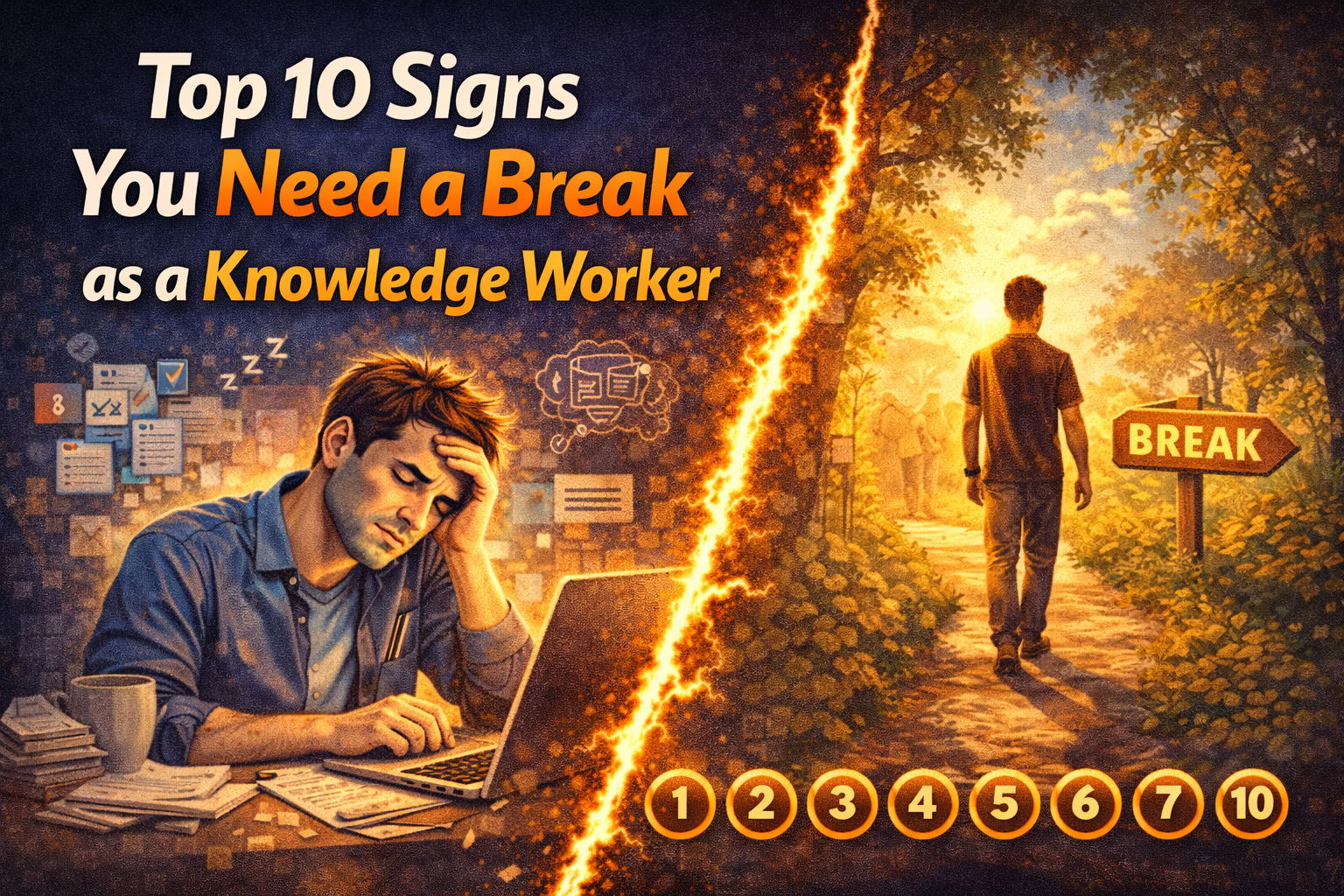
Knowledge work can be deceptive.
From the outside, it may not look as exhausting as physical labor. You are often sitting down, typing, thinking, reading, replying, planning, writing, designing, coding, or attending meetings.
But mental work drains you too.
And one of the biggest mistakes knowledge workers make is waiting too long before taking a real break.
Many people keep pushing because they are technically still working. They are still at the desk. Still answering messages. Still opening documents. Still trying to move things forward.
But being active is not the same as being effective.
Sometimes the problem is not laziness, lack of ambition, or poor discipline.
Sometimes the real problem is that your brain needs rest.
If you ignore that for too long, the quality of your work usually drops before you fully admit it to yourself.
Here are 10 common signs you probably need a break.
1) You are reading the same thing multiple times
One of the clearest signs of mental fatigue is when your attention stops holding properly.
You read a paragraph, reach the end, and realize you barely processed it.
So you read it again.
And sometimes again.
This often happens when your brain is overloaded.
It is not always a sign that the material is hard. Sometimes it is simply a sign that your mind is no longer fresh enough to engage with it properly.
If basic reading, thinking, or comprehension starts feeling strangely slippery, a break may help more than forcing another hour of effort.
2) Simple tasks start feeling unusually heavy
When you need a break, even small tasks can begin to feel bigger than they are.
Replying to one email feels annoying.
Organizing a file feels strangely difficult.
Writing a short message feels mentally expensive.
A simple decision feels like too much.
This matters because fatigue changes perception.
The task may not actually be harder.
You are just operating with less mental energy.
And when everything starts feeling heavier than normal, it is often a sign that your internal system needs recovery.
3) You keep switching between tabs, tasks, and apps without making real progress
Another sign you need a break is restless, fragmented work.
You open one task, then another.
Check email.
Open chat.
Look at your notes.
Return to the original task.
Get distracted again.
This constant switching can create the illusion of activity, but often very little meaningful work gets done.
Sometimes people think they need more discipline in that moment.
Sometimes that is true.
But sometimes the real issue is that the brain is tired and looking for easier stimulation instead of sustained thinking.
A break can help reset attention and reduce that mental scattering.
4) You feel more irritated than usual
Mental fatigue often shows up emotionally before people recognize it cognitively.
You may become:
- more impatient
- more sensitive to interruptions
- more annoyed by small things
- less tolerant in conversations
- more likely to feel mentally crowded
This matters because emotional friction affects productivity too.
A tired brain usually has less room.
So small problems feel bigger, and normal work annoyances become harder to handle calmly.
If you notice that your mood is getting sharper or more reactive, it may be less about the situation and more about your need for rest.
5) You are staring at the screen but not really thinking well
There is a form of fake work that many knowledge workers know well.
You are there.
You are looking at the screen.
You are technically “working.”
But your thinking has become weak, slow, dull, or unfocused.
You are not truly solving.
Not truly writing.
Not truly deciding well.
You are just staying present and hoping clarity returns.
This is often one of the biggest signs you need a break.
Because once the quality of thought drops enough, more screen time often stops helping.
At that point, stepping away may be more productive than staying seated.
6) You start making small mistakes more often
Fatigue increases error rate.
You forget simple things.
Miss details.
Send messages with mistakes.
Skip steps.
Misread information.
Need to double-check things you would normally handle easily.
This matters because tired work creates rework.
And rework quietly destroys productivity.
A break may feel like a delay, but continuing in a mentally tired state can cost more time overall if your output quality keeps slipping.
Sometimes the fastest move is to stop for a while and come back sharper.
7) Your motivation drops in a strange way
Not every loss of motivation is about purpose.
Sometimes motivation drops because your brain has reached a limit.
You may still care about the project.
Still want the result.
Still value the work.
But in the moment, you feel flat.
This can be confusing, because people often interpret it as personal weakness or loss of discipline.
But sometimes your brain is simply asking for recovery.
A break does not always mean you have become less serious.
It may mean you are serious enough to notice that pushing harder is no longer producing better work.
8) You feel mentally crowded and cannot think clearly
Sometimes the sign is not tiredness in the obvious sense.
It is mental overcrowding.
Too many tabs.
Too many conversations.
Too many tasks.
Too many unfinished thoughts.
Too much digital input.
When this builds up, it becomes harder to think in a clean, direct way.
Your brain starts feeling noisy.
And once that happens, decision-making often gets worse.
You may struggle to prioritize, to simplify, or to see what matters most.
A real break can help create enough mental space for clarity to return.
9) You are pushing through because you feel guilty stopping
This is an important one.
Sometimes the clearest sign you need a break is that you resist taking one even though part of you knows you should.
Why?
Because stopping feels unproductive.
Because you feel behind.
Because you think serious people should keep going.
Because you want to “just finish one more thing.”
But guilt-based overworking often produces poor-quality effort.
The longer you work from that state, the more likely it becomes that you are working from pressure rather than effectiveness.
If you feel guilty about pausing even though your brain is clearly tired, that may be exactly why a break is needed.
10) You do not feel restored after work anymore
A deeper sign is when work stops feeling recoverable.
You finish the day, but your brain still feels overloaded.
You rest a little, but it does not feel like enough.
You return the next day still carrying mental heaviness from the previous one.
This can happen when breaks are too weak, too rare, or too screen-based to actually restore you.
If your workdays keep blending into each other without real recovery, you may not just need a five-minute pause.
You may need stronger boundaries, better rest, or more intentional recovery time overall.
Why this matters
Knowledge workers are often paid for the quality of their thinking.
That means your mind is not just part of the job.
It is the core asset.
If that asset becomes tired, overloaded, or dull, your productivity is affected whether you admit it or not.
This is why breaks matter.
A break is not only about comfort.
It is about protecting performance.
It helps restore:
- focus
- patience
- emotional steadiness
- mental clarity
- judgment
- energy
- work quality
Without breaks, knowledge work often becomes slower, messier, and more frustrating.
What a real break can look like
Not every break needs to be long, but it should actually interrupt the mental pattern.
A real break might mean:
- standing up and walking
- stepping outside
- getting away from the screen
- stretching
- sitting in silence for a few minutes
- drinking water and resetting
- taking a proper lunch without multitasking
- ending the work block and returning later with a fresher mind
The key is that the break should reduce mental load, not just replace one kind of stimulation with another.
Final thought
As a knowledge worker, one of the smartest things you can learn is how to recognize when your brain is no longer producing at a high level.
Because more time at the desk is not always the answer.
Sometimes the most productive move is to stop before your work gets worse.
If you notice that you are rereading things, switching tasks constantly, feeling irritated, making more mistakes, losing clarity, or forcing yourself forward through guilt, take that seriously.
Those are not random signs.
They may be your brain telling you it needs a break.
And listening to that earlier can protect both your productivity and your long-term well-being.
Date-based AI Task Manager
Plan smarter, execute faster, achieve more
Create tasks in seconds, generate AI-powered plans, and review progress with intelligent summaries. Perfect for individuals and teams who want to stay organized without complexity.
Get started with your preferred account