
Student Group Project Plan Template: Tasks, Owners, Subtasks, and a Shared Deadline
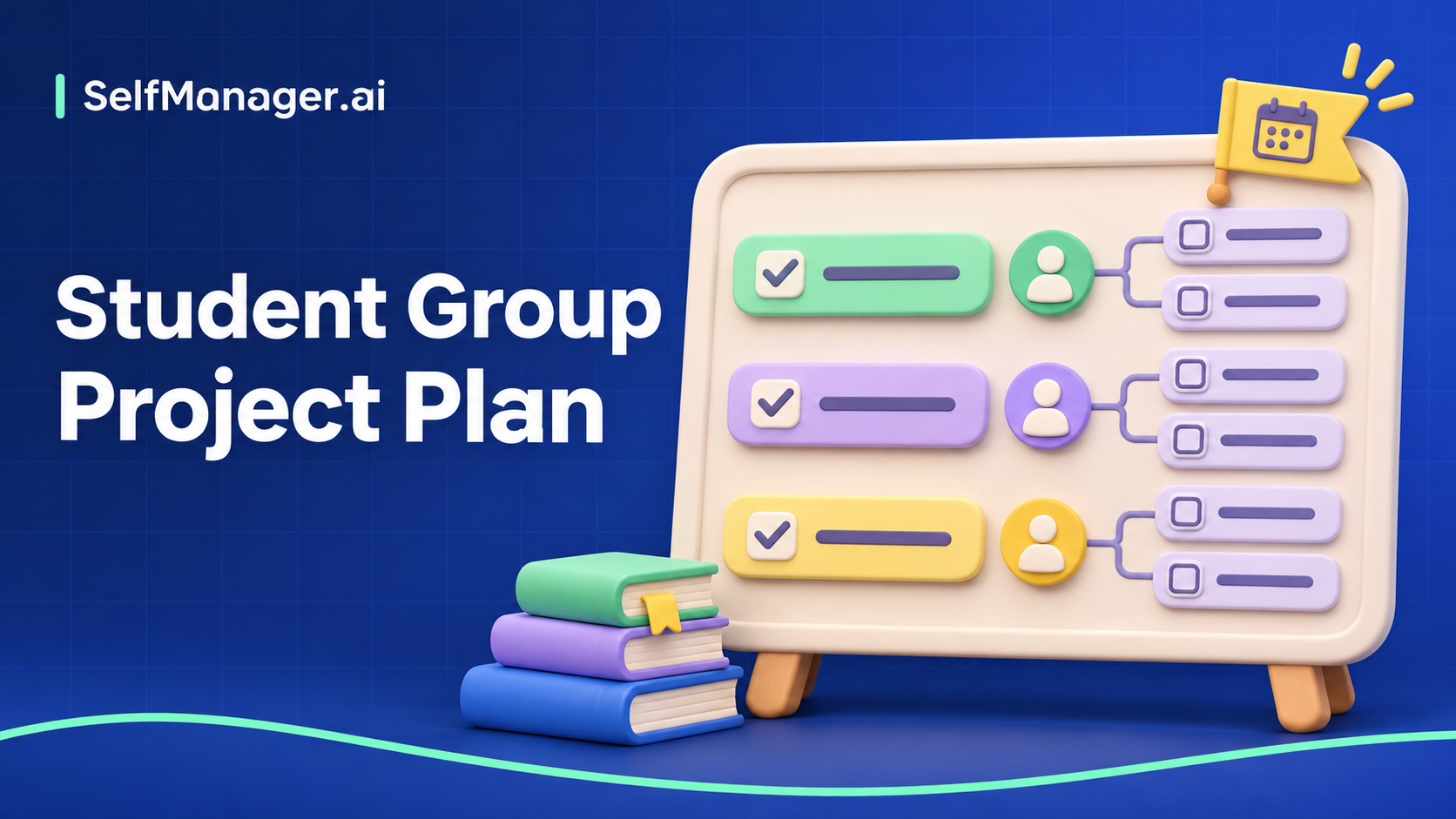
A useful student group project plan makes four things visible: what the group must submit, who owns each part, when the pieces must come together, and how the group will check the finished work. Dividing the essay into equal sections is only a starting point. Someone still needs to combine the sections, resolve contradictions, check the rubric, and submit the correct file.
Use the template below for a shared report, presentation, research poster, or assessed project. It focuses on one group deliverable. If you need to track several individual assignments across modules, use the assignment tracker template alongside it.
Start with the submission contract
Before assigning tasks, agree on the actual deliverable. Copy this block into the top of your project notes:
Project and module:
Deliverable: file type, length, presentation format, or other requirements
Official deadline: date, time, and time zone
Submission location:
Rubric and instructions: link
Working document: link
Final file owner:
Person responsible for submitting:
Backup submitter:
What the group must approve before submission:
Read the module's rules about collaboration, attribution, and permitted AI use together. A shared planner helps coordinate the work; your assessment instructions determine what work each person may contribute and how it must be acknowledged.
Keep one working document as the reference version. A folder containing five files named “final” creates a version problem that extra reminders will not solve.
Copy this group project task table
The dates and people below are a fictional example for a report due on Friday. Replace them with your own schedule and leave enough review time for your project size.
| Task | Owner | Ready for review | Evidence of completion |
|---|---|---|---|
| Turn the rubric into a report outline | Maya | Monday | Headings mapped to assessment criteria |
| Gather and check the evidence | Leo | Tuesday | Source list with notes on relevance |
| Draft the analysis | Noor | Wednesday | Analysis in the shared working document |
| Combine the report into one argument | Maya | Thursday morning | One coherent draft with consistent terms |
| Review claims, references, and rubric coverage | Leo | Thursday afternoon | Review comments resolved or assigned |
| Check formatting and final file | Noor | Friday morning | Opened, readable submission file |
| Submit and record the receipt | Maya | Before the official deadline | Confirmation saved in project notes |
An owner is the person responsible for moving the task forward. Other students can help, but “everyone” should not be the only name next to a critical task. Add a reviewer when a piece needs a second pair of eyes.
Separate the internal review date from the official submission deadline. Finishing your section at the exact submission time leaves no space to assemble the group output.
Break the risky work into subtasks
Use subtasks when a task contains several visible steps. For “Gather and check the evidence,” the breakdown might be:
- Find candidate sources relevant to the agreed question.
- Check that each source supports the claim attached to it.
- Add citation details to the shared reference list.
- Flag gaps that need a group decision.
Keep this breakdown shallow enough to scan. A subtask should produce something another student can recognize, such as a checked source list. “Work on research” provides little useful evidence.
Do not assume that ticking every subtask proves the parent deliverable is acceptable. The owner still checks that the whole task meets its completion condition.
Run a short check-in around blockers
At each check-in, open the plan rather than asking everyone to reconstruct their week from memory. Use this agenda:
1. What is ready for someone else to use?
2. What is blocked, and what specific decision or input is needed?
3. What changed in the requirements or available time?
4. Which task needs a new owner or review date?
5. What must be ready before the next check-in?
A useful blocker message names the missing input: “I need the agreed sample definition before I can write the methods section.” It also names who can resolve it and the date by which the answer matters.
When someone falls behind, revise the remaining work together. Record the change so the original owner and the person helping have the same understanding. If contribution problems persist, follow your course's escalation process and retain an accurate record of work completed.
Use SelfManager for ownership and discussion
In SelfManager.ai, create a shared table for the project and put the submission requirements in its notes. Add the deliverables as tasks, break larger pieces into one level of subtasks, and assign work to eligible participants on the table. Enable task comments when the discussion belongs beside a particular deliverable; comments remain on the parent task rather than its subtasks. These features are described in the latest product updates.
Set the table deadline to the shared submission deadline. Use task deadlines for intermediate review points. Keep the submission receipt with the project so the record covers the final handoff as well as the drafting.
For your individual class schedule, keep using the student timetable guide. The group plan should answer a different question: what does this team need to deliver next, and who will move it forward?
What should happen before the group marks the project complete?
Check the actual submitted file, confirm that it opens, compare it with the rubric, and save the submission confirmation. A completed writing task and a successful submission are separate events. Give both a visible place in the plan.
Date-based AI Task Manager
Plan smarter, execute faster, achieve more
Create tasks in seconds, generate AI-powered plans, and review progress with intelligent summaries. Perfect for individuals and teams who want to stay organized without complexity.
Get started with your preferred account