
The Productivity Budget (2026): Spend Money to Buy Back Focus
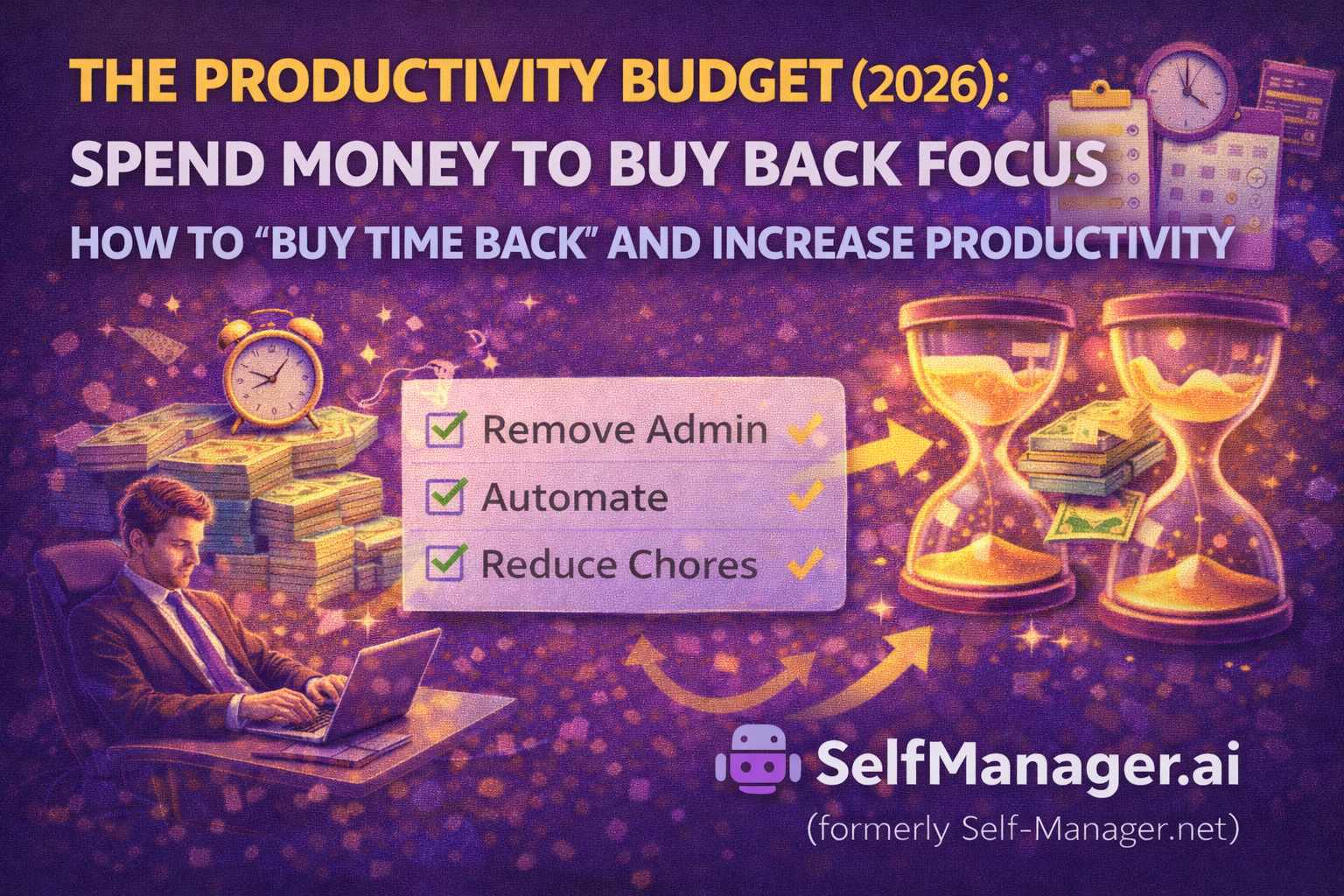
How to "buy time back" without wasting money (and why it's a productivity superpower)
Most people treat productivity like a time-management problem.
But in 2026, a lot of productivity is actually a money-management problem.
Because the real productivity question isn't:
"How do I do more?"
It's:
"What should I stop doing myself?"
That's what a productivity budget is for.
A productivity budget is a deliberate amount of money you spend each month to:
- reduce admin work
- reduce decision fatigue
- remove distractions
- protect deep work
- buy back hours that you can reinvest into high-impact work
It's not luxury.
It's leverage.
What "buy time back" actually means
Buying time back doesn't mean paying for convenience because you're lazy.
It means you understand a simple truth:
Your time and attention are your highest-value assets.
So instead of doing everything yourself, you pay to remove low-value tasks that steal focus.
And then you use that regained time for:
- deep work
- skills
- health
- building assets
- meaningful projects
- family
- rest
The productivity budget formula (simple and practical)
Here's the core idea:
Productivity Budget = 1%–5% of your monthly income
Start small. Increase only when it clearly pays back.
Example:
- income: €4,000/month
- productivity budget (3%): €120/month
That €120 should buy back real hours, not just nice feelings.
The "ROI rule": if it doesn't buy time or focus, it doesn't count
A productivity budget is not:
- random gadgets
- trendy subscriptions
- apps you don't use
- "feels productive" purchases
It should create one of these outcomes:
- ✅ More deep work hours
- ✅ Less mental load
- ✅ Fewer context switches
- ✅ More consistent execution
- ✅ Less admin work
- ✅ More energy
If it doesn't do that, it's not a productivity budget — it's consumption.
The 5 categories that buy back focus (ranked by ROI)
1) Buy back admin time (highest ROI)
Admin tasks kill focus because they're small, constant, and annoying.
Examples:
- bookkeeping help (even a few hours/month)
- invoice automation tools
- recurring bill automation
- tax prep assistance
- a virtual assistant for scheduling
If you regain 4–8 hours/month here, the ROI is huge.
2) Buy back chores (focus protection)
Chores are not hard — they're distracting.
They create:
- task switching
- low-grade stress
- constant "I still need to…"
Examples:
- cleaning help once per month
- grocery delivery
- meal prep services
- laundry service
This is not about being fancy.
It's about removing friction that constantly pulls you out of your work rhythm.
3) Buy back decision-making (reduce decision fatigue)
Decision fatigue is real. Tiny decisions drain the brain.
Examples:
- simplify wardrobe (buy multiples of basics)
- recurring meal plan
- standing shopping list
- set "default" routines
- subscriptions that reduce repeated choices
This category costs little but can save a surprising amount of attention.
4) Buy back focus (environment + tools)
Your environment determines your output more than motivation.
Examples:
- noise-cancelling headphones
- better chair / desk setup
- second monitor (if it truly speeds up work)
- coworking day pass once/week if home is noisy
Focus tools should remove friction from deep work — not just look cool.
5) Buy back mistakes (systems that prevent chaos)
A huge hidden cost is rework and forgetfulness.
Examples:
- password manager
- backup solution
- automated reminders and recurring tasks
- a task/project management system that prevents dropped commitments
This is where a productivity system pays off long-term.
The Productivity Budget checklist (copy/paste)
Before you spend money, ask:
- What will this remove from my week?
- How many hours will it buy back per month?
- Will it reduce stress or decision fatigue?
- Will it increase deep work or execution quality?
- Is there a cheaper version that gives 80% of the benefit?
If you can't answer #1 and #2, it's not a productivity investment.
The "two lists" method: what to outsource first
Make two lists:
List A: Low-value tasks that drain you
- repetitive admin
- scheduling
- cleaning
- errands
- small fixes
- follow-ups
- booking things
List B: High-value tasks that move your life forward
- building projects
- writing content
- learning valuable skills
- high-leverage business work
- health and energy
Then you move items from A → outsourced/automated
So you can spend more time on B.
That's buying time back.
Common mistakes (so you don't waste money)
Mistake 1: Spending on tools instead of removing tasks
Most people buy apps.
Few people remove the real drains.
Start with chores/admin first.
Mistake 2: Over-subscription
Too many tools becomes more cognitive load.
One system that you actually use beats 10 apps.
Mistake 3: Buying motivation instead of building structure
A new gadget feels motivating for 3 days.
A weekly review habit stays forever.
Where a task/project manager fits into a productivity budget
A productivity budget works best when you reinvest the time you buy back.
If you buy back 5 hours/month but you don't plan well, the hours disappear into:
- scrolling
- random tasks
- more meetings
That's why you need a system.
A task/project manager helps you convert time into output by:
- making priorities visible
- connecting tasks to projects
- planning your week (not just your day)
- reviewing what actually got done
Why SelfManager.ai fits this "buy time back" philosophy
SelfManager.ai (formerly Self-Manager.net) is aligned with the productivity budget mindset because it's built around:
- weekly/monthly planning
- review loops that turn chaos into strategy
- projects + outcomes, not endless tasks
- optional AI summaries that reduce review friction
In other words, it helps ensure the time you buy back turns into:
real progress.
A realistic starter productivity budget (example)
If you're starting from zero, here's a simple plan:
€50–€150/month starter budget
- 1 small chore removal (cleaning once/month OR grocery delivery)
- 1 admin automation (invoicing / bills / calendar automation)
- 1 focus investment (headphones OR desk improvement)
- 1 system investment (a task manager you actually use)
You don't need to spend big.
You need to spend smart.
Final thought
The productivity budget is not about spending more.
It's about spending deliberately to protect your most valuable assets:
- attention
- deep work
- mental energy
- time
In 2026, the people who win aren't the ones who hustle harder.
They're the ones who buy back focus — and then use it well.
Date-based AI Task Manager
Plan smarter, execute faster, achieve more
Create tasks in seconds, generate AI-powered plans, and review progress with intelligent summaries. Perfect for individuals and teams who want to stay organized without complexity.
Get started with your preferred account