
5, 6, 7, and 8 Figures: What Each Income Level Actually Does Differently
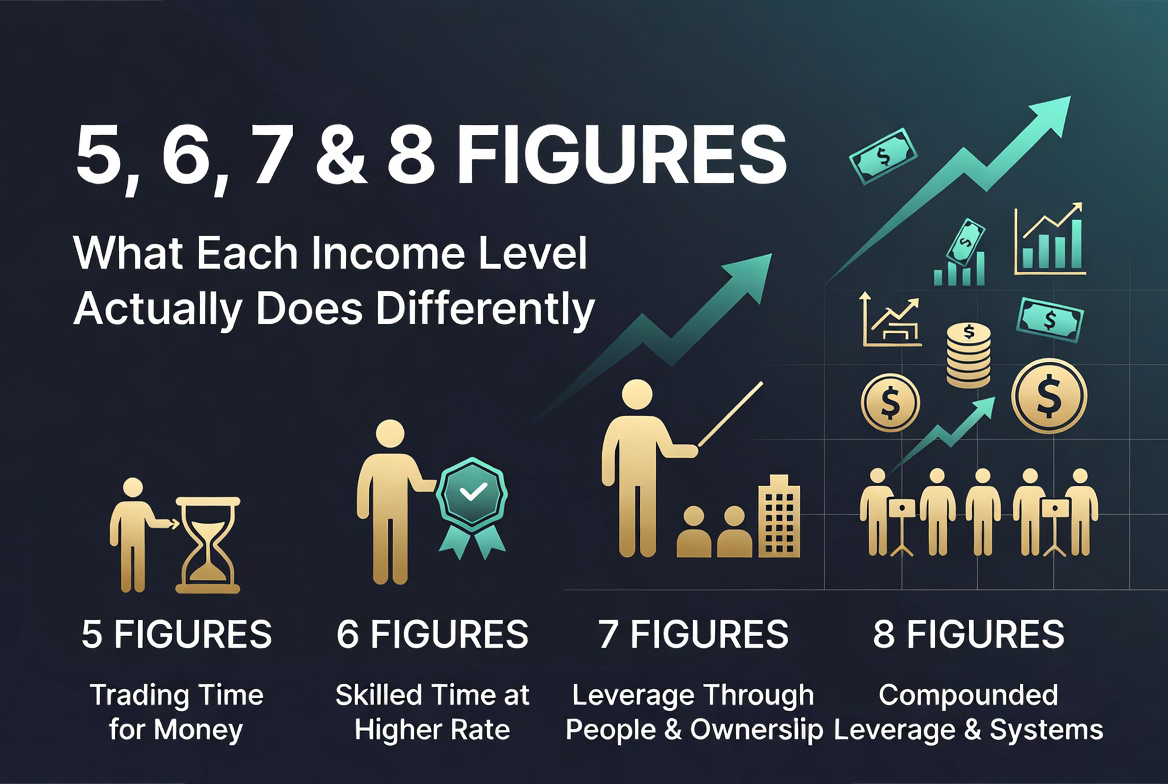
There is a popular genre of content that promises if you copy the morning routine of an eight-figure earner, you will become one. It is appealing and almost entirely wrong. The uncomfortable truth is that a person earning five figures and a person earning eight figures can have nearly identical personal habits. They can both wake early, plan their days, and work with discipline. The habits are not what separate them.
What separates them is leverage. The jump from one income level to the next is not mainly a story about productivity hacks. It is a story about how income is generated, and specifically about how tightly your earnings are tied to your own hours. At the bottom, you trade time directly for money, and time is strictly limited. At the top, income is decoupled from hours entirely, multiplied through other people, capital, and things that work while you sleep. Understanding this is the difference between chasing the wrong things and chasing the right ones.
This article walks through each level in turn, five figures to eight, and looks at two things at each step: what is structurally different about how income is made, and what actually changes in how people at that level spend their time and attention. Productivity still matters at every tier. But it matters in service of leverage, not as a substitute for it. Let me start at the bottom and work up.
A note on what these numbers mean
Quick clarification, because the terms get used loosely. Five figures means roughly ten thousand to ninety-nine thousand in a year. Six figures is one hundred thousand to just under a million. Seven figures is one million to just under ten million. Eight figures is ten million to just under a hundred million. These are annual figures here, not net worth, since income and accumulated wealth are different things.
The other thing to hold in mind is that these are not a straight ladder you climb with effort alone. Each jump tends to require a change in the kind of work you do and the leverage it sits on, not just more of the same work done harder. That is the through-line of everything below, and it is also the most honest and useful framing, because it points you at what actually moves the needle rather than at routines that do not.
The five-figure level: trading time for money
At the five-figure level, the defining structural fact is simple. Income is tied directly to hours worked, usually as an hourly wage or an entry-level salary. You get paid for showing up and putting in time, and the ceiling is hard, because there are only so many hours in a week and your rate per hour is set by someone else.
This is the purest form of trading time for money, and it is why effort alone cannot break you out of it. You can be the most productive person in the building, and it changes very little, because the structure caps what your time is worth regardless of how well you use it. The person beside you doing the same job for the same wage takes home the same amount whether they are brilliant or average at it. Productivity at this level mostly affects whether you keep the job and whether you get noticed, not how much you earn per hour.
What people who climb out of this level do differently is rarely about working harder at the job itself. It is about using their non-work hours to build something that is not paid by the hour. They develop a skill that commands a higher rate, or they start something on the side that has its own earning potential. The actionable move here is to stop trying to win purely on effort inside an hourly structure and start investing time into a skill or asset that can eventually be paid for in a way that is not capped by your personal hours. The most valuable productivity at this level is not doing your job faster. It is protecting and using the time outside it to build a way out.
The six-figure level: skilled time, priced higher
At six figures, the structure shifts, but often less than people think. Most six-figure earners are still fundamentally trading time for money. The difference is that their time is now worth a lot more per hour, because they have a skill, a credential, or a position that commands it. A senior specialist, an experienced professional, a skilled freelancer, a manager. The hourly trade is still there. The hourly rate is just much higher.
This is a crucial and underappreciated point. Six figures usually represents the ceiling of being very good at trading your time. You have climbed by becoming valuable enough that your hours are expensive, and that can take you a long way. But the same fundamental limit still applies, just at a higher altitude. There are only so many hours, and even at an excellent rate, multiplying limited hours by a high number eventually caps out. Many people spend years grinding to push their rate up, not realizing they are optimizing within a structure that has a built-in lid.
Here, productivity genuinely starts to matter more, because the work is more complex and the demands on focus and prioritization are higher. People at this level who do well tend to be sharp about protecting deep focus, managing competing priorities, and being effective rather than merely busy. But the people who go further do something structural. They begin to decouple their income from their hours. They start managing other people whose work they benefit from, or building a product or a piece of equity that earns independently of their time. The actionable shift at six figures is to recognize that you may be near the top of what skilled hourly work can pay, and to start deliberately building leverage that is not your own time, because that, not a higher rate, is what opens the next level.
The seven-figure level: leverage through people and ownership
At seven figures, the structure changes fundamentally, and this is the real break point. You essentially cannot reach seven figures a year by trading your own time, no matter how skilled or productive you are. The math does not work. Reaching this level almost always requires leverage, which means your income is now multiplied through things beyond your personal hours: a team of people, a business you own, products that sell at scale, or capital that earns on its own.
This is the leap that the productivity-hack content completely misses. The seven-figure earner is not just a more disciplined version of the six-figure earner. They are operating on a different model. Their income comes from owning or building something that produces value beyond what they personally do hour to hour. A business with employees, where the team's combined output far exceeds the founder's own hours. A product that sells thousands of times from work done once. Equity in something that grows. The common thread is ownership and the multiplication of effort through other people or systems.
This changes what productivity even means at this level. The seven-figure operator's personal time is no longer the engine. Their job has shifted from doing the work to directing it, which means their highest-value activities are choosing what to build, hiring and leading the people who execute, making the few decisions that only they can make, and removing themselves from the daily tasks so they can focus on direction. The most productive thing they do is often to not do something themselves, and instead build the person or system that does it repeatedly. The actionable lesson is that climbing here requires letting go of being the one who does the work and becoming the one who builds the leverage, which is a genuinely hard psychological shift for people who got to six figures precisely by being excellent at doing the work themselves.
The eight-figure level: leverage on top of leverage
At eight figures, the structure is leverage compounded. Income at this level comes not from a single business or a single source, but from systems and assets that multiply on top of each other, often largely independent of the person's daily involvement. A company that scales far beyond its founder, significant equity in growing enterprises, capital deployed across investments, and frequently several of these at once, reinforcing one another.
The defining feature here is that the person's personal time has almost no direct relationship to their income anymore. An eight-figure earner could take a month off and their income would barely register the absence, because it is generated by businesses, teams, products, and investments that run without them moment to moment. This is the full decoupling of income from hours, taken to its logical end. The work that produced the income was largely done in the past, by building the systems and making the bets, and it now compounds. This is also why so few people reach this level. It requires not just leverage but leverage that has been built, layered, and given time to compound, and it depends heavily on factors beyond any habit, including timing, capital, market, and luck.
What people at this level do differently with their time is almost entirely high-level allocation. Their scarce resource is not hours but judgment and attention, and they spend it on a tiny number of enormously consequential decisions: where to deploy capital, which businesses to back or build, who to put in charge of what, and which few opportunities are worth their involvement at all. The day-to-day execution is many layers removed from them. The actionable insight, even for someone nowhere near this level, is that this is what the top of the leverage curve looks like, and it clarifies the direction of travel: from doing the work, to leading the people who do the work, to allocating resources across systems that do the work. Each level up is a step further from your own hands and further into leverage.
What actually changes as you go up
Step back from the individual tiers and a few clear patterns run through the whole progression. These are the real differences, and they are worth naming directly because they tell you what to focus on regardless of where you currently are.
The relationship between time and money inverts
At the bottom, income is almost perfectly tied to hours. As you climb, that link weakens, until at the top it is nearly severed. The single most important variable across all four levels is how decoupled your income is from your personal time. Every meaningful jump involves loosening that link. If you want to understand why you are stuck at a given level, look honestly at how tightly your earnings depend on your own hours, because that, more than your habits, is usually the constraint.
The job changes from doing to building to allocating
A five or six-figure earner is mainly doing work. A seven-figure earner is mainly building and leading the things and people that do the work. An eight-figure earner is mainly allocating resources across systems that do the work. The nature of the work itself transforms at each level, and people who get stuck often do so because they keep doing the same kind of work harder instead of changing what kind of work they do. The actionable version is to keep asking whether your time is going into doing, building, or allocating, and to deliberately push up that chain.
Leverage matters more than effort
This is the heart of it. At every level, the people who advance are not primarily the ones working the most hours. They are the ones who attach their effort to a source of leverage, whether that is people, capital, products, or media that scales. Effort is necessary throughout, but effort without leverage hits a ceiling fast, and the ceiling gets higher only when leverage is added. Two people can work equally hard and end up tiers apart purely because one built leverage and the other did not.
What you do with your time changes accordingly
Productivity habits do matter at every level, but the highest-value use of time changes as you climb. At the bottom, the best use of time is building a skill or an asset that escapes the hourly trade. In the middle, it is protecting deep focus and starting to build leverage through people or products. Near the top, it is making a small number of high-stakes decisions exceptionally well and staying out of everything else. The same eight hours are spent on completely different kinds of activity, and matching your time to the right kind for your level and ambition is where productivity genuinely pays off.
The honest caveat
It would be dishonest to present this as a guaranteed ladder you climb by following steps. It is not. The higher tiers depend heavily on things no habit controls: capital you may not have, timing you cannot manufacture, markets that cooperate or do not, networks, starting position, and a real amount of luck. Plenty of people do everything in this article and never reach seven or eight figures, because those outcomes are not available to effort alone. Most people who build leverage still do not reach the top tiers, and that is not a personal failing. It is the nature of how those outcomes are distributed.
So the value of understanding these differences is not a promise. It is direction. It tells you that if you want to move up, the lever is rarely working more hours at the same kind of work, and almost always changing the structure of how your income is generated. It tells you to look at your relationship between time and money and to build leverage deliberately rather than grinding inside a capped structure. Whether that takes you one tier up or several depends on much that is outside your control. But pointing your effort at leverage rather than at raw hours is the one part that is genuinely in your hands, and it is the part that the morning-routine content never mentions.
Takeaways
The real difference between 5, 6, 7, and 8-figure earners is leverage and income structure, not personal productivity habits. People at very different levels often have similar routines. What differs is how their income is generated.
At five figures, income is tied directly to hours. At six figures, it is still mostly hourly but at a much higher rate, which has its own ceiling. At seven figures, income is decoupled from personal hours through ownership and leverage over people and products. At eight figures, leverage is compounded across multiple systems and assets that run largely without the person's daily time.
Across the whole progression, the time-money link weakens, the job shifts from doing to building to allocating, leverage matters more than effort, and the highest-value use of your time changes at each level.
The honest caveat is that the higher tiers depend heavily on capital, timing, markets, and luck, not just effort. The useful takeaway is directional: to move up, change the structure of how you earn and build leverage deliberately, rather than working more hours inside a capped model.
FAQ
What is the real difference between five, six, seven, and eight-figure earners?
It is primarily leverage and how income is generated, not who has better habits. Five-figure earners trade hours directly for money. Six-figure earners usually still trade time but at a much higher rate. Seven-figure earners decouple income from their own hours through ownership and leverage over people and products. Eight-figure earners compound leverage across multiple businesses, assets, and investments that run largely without their daily involvement.
Can I reach seven or eight figures just by being more productive?
No. Personal productivity has a hard ceiling because there are only so many hours in a week. Reaching seven or eight figures almost always requires leverage, meaning income multiplied through other people, businesses, products, or capital rather than your own time. Productivity helps you execute well within whatever structure you are in, but it cannot by itself break the link between hours and income that caps the lower levels.
Why do people get stuck at six figures?
Because six figures usually represents the ceiling of trading time for money, even at an excellent rate. Many people respond by trying to push their hourly rate or workload higher, which optimizes within a structure that has a built-in lid. Moving beyond it requires a structural change: building leverage through a team, a product, or equity that earns independently of your personal hours, rather than continuing to sell your time at a premium.
What does leverage mean in the context of income?
Leverage is anything that multiplies the output of your effort beyond your own hours. The main forms are other people, whose combined work exceeds your own; capital, which earns on its own; and products, code, or media, which can be created once and sell or scale many times. The defining feature of higher income levels is that earnings are driven by these forms of leverage rather than by the person's direct hourly work.
Does this mean habits and productivity do not matter?
They matter, but as a supporting layer rather than the engine. Productivity habits help you execute well at every level, and the highest-value use of your time changes as you climb, from building an escape from hourly work, to protecting focus and building leverage, to making a few high-stakes decisions well. But habits operate within a given structure. Changing the structure of how you earn is what actually moves you between levels.
Is moving up the income levels just a matter of following the right steps?
No, and it would be misleading to suggest otherwise. The higher tiers depend heavily on factors outside any habit, including access to capital, timing, market conditions, networks, starting position, and luck. Many people do everything right and never reach the top levels, because those outcomes are not available through effort alone. Understanding the differences gives you direction about where to aim, not a guarantee of the result.
What is the single most useful thing to focus on if I want to earn more?
Look honestly at how tightly your income is tied to your own hours, and work to loosen that link. At lower levels, that means building a skill or asset that is not paid purely by the hour. Higher up, it means building leverage through people, products, or capital. The consistent lesson across all levels is that raw effort inside an hourly structure hits a ceiling fast, while attaching your effort to leverage is what raises it.
Date-based AI Task Manager
Plan smarter, execute faster, achieve more
Create tasks in seconds, generate AI-powered plans, and review progress with intelligent summaries. Perfect for individuals and teams who want to stay organized without complexity.
Get started with your preferred account