
How Controlled Isolation From Society’s Noise Can Help You Build a Business or Learn a Mentally Tough Skill Faster
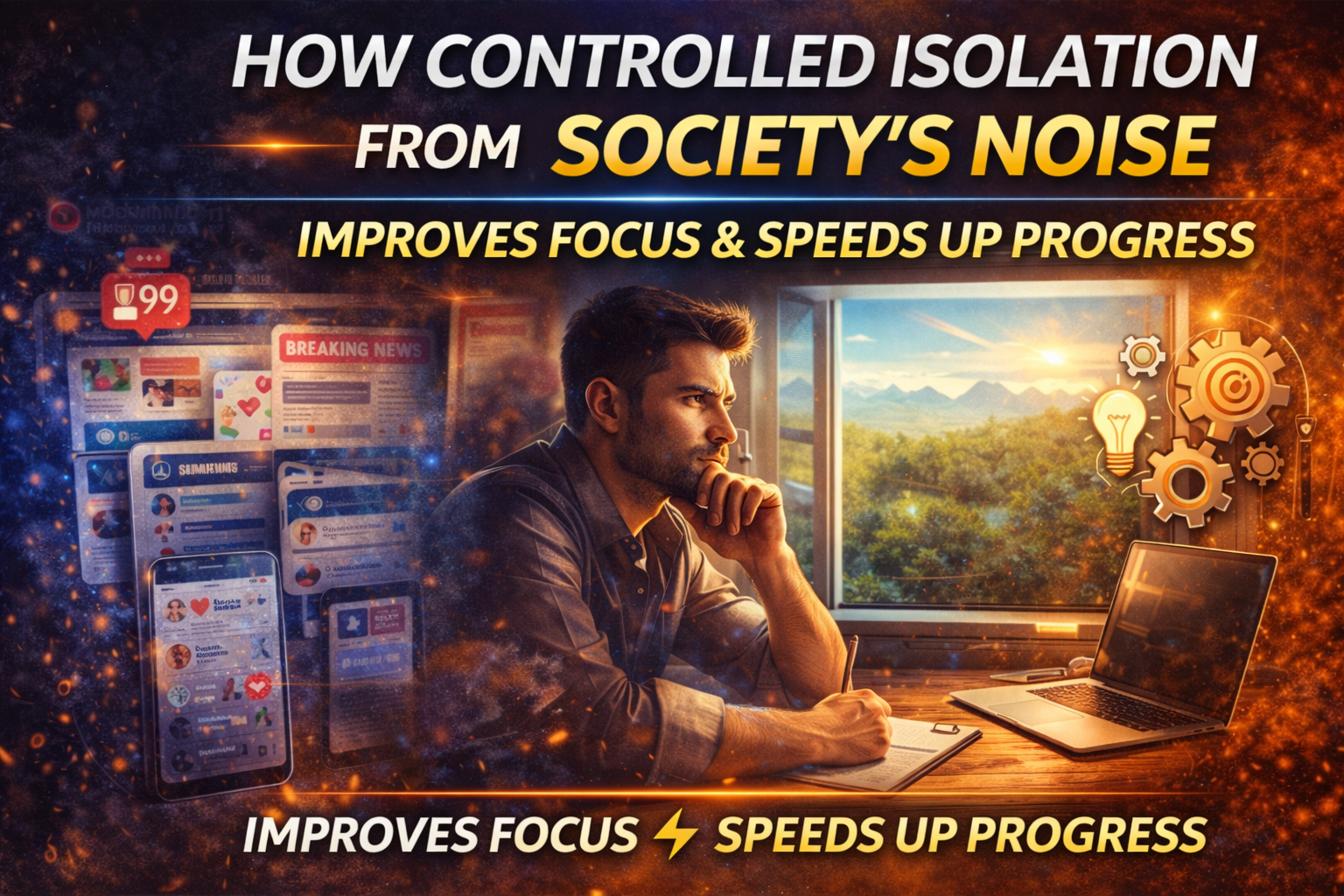
There are periods in life when progress does not come from doing more.
It comes from hearing less.
A lot of people who want to build a business, learn a difficult skill, or create something meaningful make the same mistake.
They stay too connected to the noise of the world while trying to do deep work.
They keep one eye on trends.
One eye on what other people are doing.
One eye on social media.
One eye on the news cycle.
One eye on opinions, drama, and endless commentary.
And then they wonder why progress feels slow.
The answer is often simple.
Their attention is too divided.
That is why controlled isolation can be so powerful.
Not extreme isolation.
Not unhealthy disconnection.
Not cutting yourself off from everyone.
But a deliberate period of reduced exposure to society’s noise, trends, distractions, and mental clutter.
That kind of temporary distance can be one of the fastest ways to improve focus and make stronger progress.
Especially if you are trying to build a business or develop a mentally tough skill.
What controlled isolation actually means
Controlled isolation does not mean disappearing from life.
It means becoming more selective about what enters your mind.
It means reducing exposure to:
- social media trends
- online drama
- nonstop news
- random opinions
- comparison with others
- low-value conversations
- distraction-heavy environments
- content that pulls attention away from your real work
This kind of isolation is controlled because it is intentional.
You are not escaping life.
You are protecting the conditions needed for serious progress.
That is an important difference.
Why society’s noise slows people down
Modern life creates a constant stream of input.
Even when you are technically “working,” your mind may still be carrying:
- ideas from people online
- emotional reactions to trends
- comparison with other founders or creators
- fear of missing out
- pressure to respond to everything
- attention residue from endless content
This noise is expensive.
It reduces mental clarity.
It weakens sustained focus.
It increases emotional distraction.
And it makes it harder to stay with one meaningful path long enough to see results.
A person trying to build something difficult needs more than motivation.
They need protected attention.
And society’s noise often destroys that attention quietly.
Controlled isolation helps you focus on what actually matters
When you reduce the amount of outside noise entering your life, something important happens.
Your own priorities become easier to hear.
You stop reacting so much.
You stop comparing so much.
You stop absorbing random agendas from other people.
And when that happens, your work becomes more direct.
You can ask simpler and better questions:
- What matters most today?
- What is the real next step?
- What skill actually needs improvement?
- What is helping progress?
- What is just noise?
This is one of the biggest benefits of controlled isolation.
It removes unnecessary mental competition.
That allows your real priorities to become stronger.
It helps you build momentum faster
One of the biggest enemies of progress is interruption.
Not only physical interruption.
Mental interruption too.
Every trend, controversy, interesting post, random video, or outside opinion can pull your brain slightly away from the path you were trying to stay on.
One interruption may not look serious.
But hundreds of them over weeks and months become expensive.
Controlled isolation helps because it creates longer uninterrupted stretches of focus.
And long stretches of focus create momentum.
That matters in business.
It matters in skill-building.
It matters in writing, coding, sales, design, strategy, and almost everything that requires mental depth.
Momentum is easier to build when your mind is not constantly being pulled sideways.
Business often grows faster when you stop consuming so much noise
A lot of people who want to build a business spend too much time watching other people talk about building businesses.
That may sound harsh, but it is true.
They consume advice, hot takes, threads, podcasts, trends, and startup opinions all day.
Some of that can help.
Too much of it becomes a substitute for execution.
Instead of building, they are watching.
Instead of testing, they are comparing.
Instead of selling, they are analyzing what everyone else is saying.
Controlled isolation helps break that cycle.
It moves you away from business entertainment and closer to business action.
That can speed things up a lot.
Because businesses usually grow from doing the fundamentals well, not from endlessly tracking what the internet is talking about this week.
Mentally tough skills improve faster in quieter conditions
This is also true for difficult skills.
Some skills require emotional resilience, patience, and a lot of repetition.
That includes things like:
- programming
- writing
- design
- trading discipline
- public speaking
- sales
- studying
- deep problem-solving
- focused reading
- learning a language
- building emotional control
These skills often improve best in quieter conditions.
Why?
Because mentally tough skills require friction tolerance.
You need to stay with boredom.
Stay with confusion.
Stay with repetition.
Stay with slow improvement.
Society’s noise makes that harder.
It trains the brain to seek novelty, stimulation, comparison, and quick emotional reward.
Controlled isolation trains the opposite.
It strengthens patience.
And patience is a huge advantage in mentally demanding work.
Less comparison means better self-direction
One of the hidden costs of constant connection is comparison.
You see other people’s wins.
Other people’s numbers.
Other people’s output.
Other people’s speed.
Even if you do not consciously care that much, it still affects you.
Comparison can make you:
- question your path too often
- change direction too quickly
- feel behind when you are not
- underestimate steady progress
- chase trends instead of building something real
Controlled isolation reduces that effect.
It gives you more room to judge your progress by your own standards and your own path.
That is extremely valuable.
Because real progress often looks slow from the inside.
If you are comparing yourself every day to the visible highlights of others, you may abandon the work too early.
Isolation can improve emotional stability
Society’s noise is not only informational.
It is emotional.
Trends, outrage, arguments, bad news, and online comparison all influence mood.
That can create a subtle but constant inner disturbance.
You may feel:
- more restless
- more reactive
- less patient
- less satisfied
- more mentally crowded
- more easily discouraged
Controlled isolation often improves emotional stability because it lowers unnecessary emotional input.
That makes it easier to think clearly.
And clearer thinking usually leads to better work.
This is especially important when building a business, because businesses already create enough emotional pressure on their own.
You do not need extra chaos entering your nervous system every hour.
It helps you develop a stronger inner world
A person who is constantly filled by outside input often has less space to develop inner strength.
Controlled isolation creates that space.
It gives you more room for:
- reflection
- original thought
- deeper concentration
- honest self-assessment
- long-term thinking
- stronger personal standards
This matters because business and difficult skills both require an internal backbone.
You need the ability to continue when results are slow.
You need the ability to think for yourself.
You need the ability to stay loyal to a process that is not yet visible to others.
That becomes easier when your mind is not constantly crowded by the outside world.
Boredom becomes useful again
One of the biggest modern problems is that people no longer tolerate boredom well.
The second there is silence, they reach for stimulation.
But boredom is often the doorway to deeper work.
Boredom is where your brain stops expecting constant reward.
It is where patience grows.
It is where your mind starts settling enough to do serious things.
Controlled isolation helps reintroduce boredom in a useful way.
That does not mean suffering.
It means becoming less dependent on constant stimulation.
And that is a huge edge.
A person who can tolerate quiet and stay with meaningful work without needing endless novelty has a strong advantage over time.
The real benefit is speed through simplification
At first, isolation sounds like slowing down.
In practice, it often speeds things up.
Why?
Because it removes friction.
Less noise means fewer emotional detours.
Less distraction means more meaningful hours.
Less comparison means better consistency.
Less trend-chasing means stronger long-term direction.
In other words, controlled isolation speeds progress not by adding more energy, but by removing what leaks it away.
That is often the smarter path.
This should be controlled, not extreme
This part matters.
The goal is not total withdrawal.
You still need healthy relationships, real life, useful feedback, and some level of connection.
The goal is simply to reduce unnecessary noise while protecting serious work.
So controlled isolation should look more like:
- less social media
- fewer random opinions
- less news consumption
- more quiet work blocks
- more time offline
- more intentional environments
- more attention protection
- more direct focus on your craft or business
That is healthy.
It is strategic.
And for many people, it is exactly what they need.
Practical ways to do it
You do not need a dramatic life change to get the benefit.
A few practical moves can help a lot:
1) Reduce social media for a period
Even 2 to 4 weeks of lower exposure can change your attention noticeably.
2) Stop consuming trend content every day
Most trends are less important than your real work.
3) Create long quiet work sessions
Protect blocks of time with no outside input.
4) Limit how often you check messages and news
Do not let the outside world interrupt your mind all day.
5) Spend more time alone with your work
Especially when learning something hard or building something important.
6) Use weekends to reset your mind
Walk, reflect, plan, and reduce digital noise.
7) Let your own goals become louder than other people’s opinions
That is one of the biggest shifts.
Why this matters for long-term productivity
Long-term productivity is not only about systems and tools.
It is also about what kind of mental environment you live in.
If your attention is constantly fragmented by society’s noise, then even the best tools will not fully save you.
But if you create a quieter environment, your focus improves naturally.
That leads to:
- better concentration
- faster progress
- stronger consistency
- more original thinking
- better emotional control
- less distraction
- deeper skill development
That is why controlled isolation can be so powerful.
It does not give you magic.
It gives you better conditions.
And better conditions often create much better results.
Final thought
If you are trying to build a business or develop a mentally tough skill, one of the smartest things you can do is temporarily reduce your exposure to society’s noise.
Not forever.
Not in an unhealthy way.
But in a controlled, intentional way that protects your focus.
Because attention is one of the most valuable assets you have.
And in a world full of trends, opinions, distractions, and nonstop stimulation, the person who can protect their mind often moves faster than the person who is connected to everything.
Sometimes progress does not require more information.
It requires less noise.
Date-based AI Task Manager
Plan smarter, execute faster, achieve more
Create tasks in seconds, generate AI-powered plans, and review progress with intelligent summaries. Perfect for individuals and teams who want to stay organized without complexity.
Get started with your preferred account