
What Is a Good Work Routine for a Self-Employed Knowledge Worker? Benefits of Having a Routine
A lot of self-employed knowledge workers want freedom.
That is one of the main reasons they chose this kind of work in the first place.
They want flexibility.
They want autonomy.
They want control over their time.
They want to work without someone constantly telling them what to do.
That freedom is real.
But it also comes with a hidden challenge:
When nobody structures your day for you, you have to build that structure yourself.
That is where routine starts to matter.
For a self-employed knowledge worker, a good work routine is not about becoming robotic or making every day identical. It is about creating enough structure to protect focus, maintain momentum, and reduce the mental friction of deciding everything from scratch every morning.
A strong routine can make self-employment feel calmer, clearer, and much more sustainable.
What is a self-employed knowledge worker?
A self-employed knowledge worker is someone who mainly earns through thinking, creating, solving, communicating, planning, or producing intellectual work rather than physical labor.
This can include:
- freelancers
- consultants
- designers
- developers
- writers
- marketers
- coaches
- researchers
- agency owners
- solo founders
- other people whose work depends heavily on focus and mental output
This kind of work usually depends on:
- concentration
- problem-solving
- communication
- decision-making
- managing priorities
- handling information well
That is why routine matters so much here.
When your work depends on the quality of your attention, how you structure the day has a direct effect on your results.
Why routine matters more when you work for yourself
In a traditional job, some structure is already built in.
There are meetings.
Office hours.
Managers.
Deadlines set by other people.
A general rhythm to the workday.
When you are self-employed, much of that structure disappears.
At first, that can feel great.
But over time, it can also create problems like:
- inconsistent focus
- delayed starts
- reactive workdays
- unfinished priorities
- too much context switching
- blurred boundaries between work and life
- guilt during rest
- burnout from constantly thinking about work
Without a routine, every day requires too many decisions.
When should I start?
What should I work on first?
Should I answer messages now?
Should I do deep work or admin?
Should I take a break?
Am I doing enough?
Should I keep going?
That decision load becomes exhausting.
A good routine reduces that.
It gives the day shape.
What makes a good work routine?
A good work routine for a self-employed knowledge worker is not one fixed formula.
It depends on the person, the type of work, and the stage of life or business.
But a good routine usually has these qualities:
- it is realistic
- it supports focus
- it reduces decision fatigue
- it creates consistency
- it protects energy
- it leaves room for real life
- it helps separate important work from shallow work
- it can be repeated without feeling oppressive
The goal is not perfection.
The goal is to create a structure that makes good work easier to repeat.
A good work routine usually includes these parts
1. A clear start to the workday
One of the most important parts of a routine is having a reliable way to begin.
Without that, the day can drift.
A clear start might include:
- opening your planning system
- reviewing priorities
- checking today's appointments
- deciding the top 1 to 3 important tasks
- avoiding messages for the first part of the day
- starting with a focused block of work
This matters because the first hour often sets the tone for everything after it.
If the day starts in reaction mode, it is much easier to stay reactive.
If the day starts with clarity, it is easier to stay intentional.
2. Dedicated deep work time
Knowledge work often depends on uninterrupted thinking.
That means a good routine should include protected time for real concentration.
This may be:
- coding
- writing
- designing
- strategic planning
- research
- client problem-solving
- building something important
This kind of work usually creates the highest-value outcomes.
But it is also the easiest to destroy with constant switching.
That is why a strong routine usually protects deep work early in the day or during the hours when your mind is strongest.
3. A separate place for admin and communication
A lot of self-employed people lose good working hours to low-value activity.
Emails.
Messages.
Small edits.
Tiny requests.
Checking things too often.
Administrative cleanup.
These things do matter, but they should not consume the best part of the day by default.
A good routine often works better when communication and admin are grouped into specific times rather than allowed to take over the whole day.
This helps preserve focus for more meaningful work.
4. Breaks that actually protect energy
Some self-employed people make the mistake of thinking that working without breaks means working seriously.
Usually the opposite happens.
The mind becomes dull.
Attention weakens.
Work quality drops.
The day starts feeling heavy.
A good routine includes breaks not as laziness, but as part of maintaining useful energy.
That can mean:
- standing up
- walking briefly
- stepping away from the screen
- eating properly
- resetting mentally before returning
Knowledge work depends on cognitive quality, not just hours logged.
5. A clear end to the workday
This is one of the most overlooked parts of routine.
Many self-employed people never really stop.
They just slowly blur from work into evening while still thinking about unfinished tasks.
That creates low-quality rest and ongoing mental tension.
A better routine includes some kind of shutdown moment:
- review what got done
- carry unfinished important items forward
- note tomorrow's priorities
- close the work system
- allow yourself to be off
This matters because rest works better when the mind feels that work has been held somewhere reliable.
Benefits of having a routine as a self-employed knowledge worker
1. It reduces decision fatigue
Routine removes many small unnecessary choices.
Instead of deciding every day how to begin, where to look, or what order to follow, the structure already exists.
This saves mental energy for real work.
2. It improves focus
Routine creates rhythm.
When deep work, admin, planning, and breaks have some structure, it becomes easier to focus because the day does not feel like random motion.
3. It helps you start faster
A lot of productivity is lost in slow starts.
Routine shortens that startup friction.
You do not need to invent the day each morning.
You begin from a known pattern.
4. It lowers stress
Stress often comes from vagueness.
Too many undefined tasks.
Too many mental open loops.
Too much uncertainty about whether you are doing the right thing.
Routine reduces that by creating a clearer flow.
5. It supports consistency
Self-employment rewards consistency more than occasional heroic effort.
Routine helps you show up regularly, make steady progress, and avoid relying only on mood or motivation.
6. It creates better work-life boundaries
When work has no structure, it expands everywhere.
A good routine gives work a more defined shape, which makes personal time easier to protect.
7. It makes productivity more sustainable
A routine that works well is not only about doing more today.
It is about being able to work well next week, next month, and next year without burning out.
That long-term sustainability matters a lot.
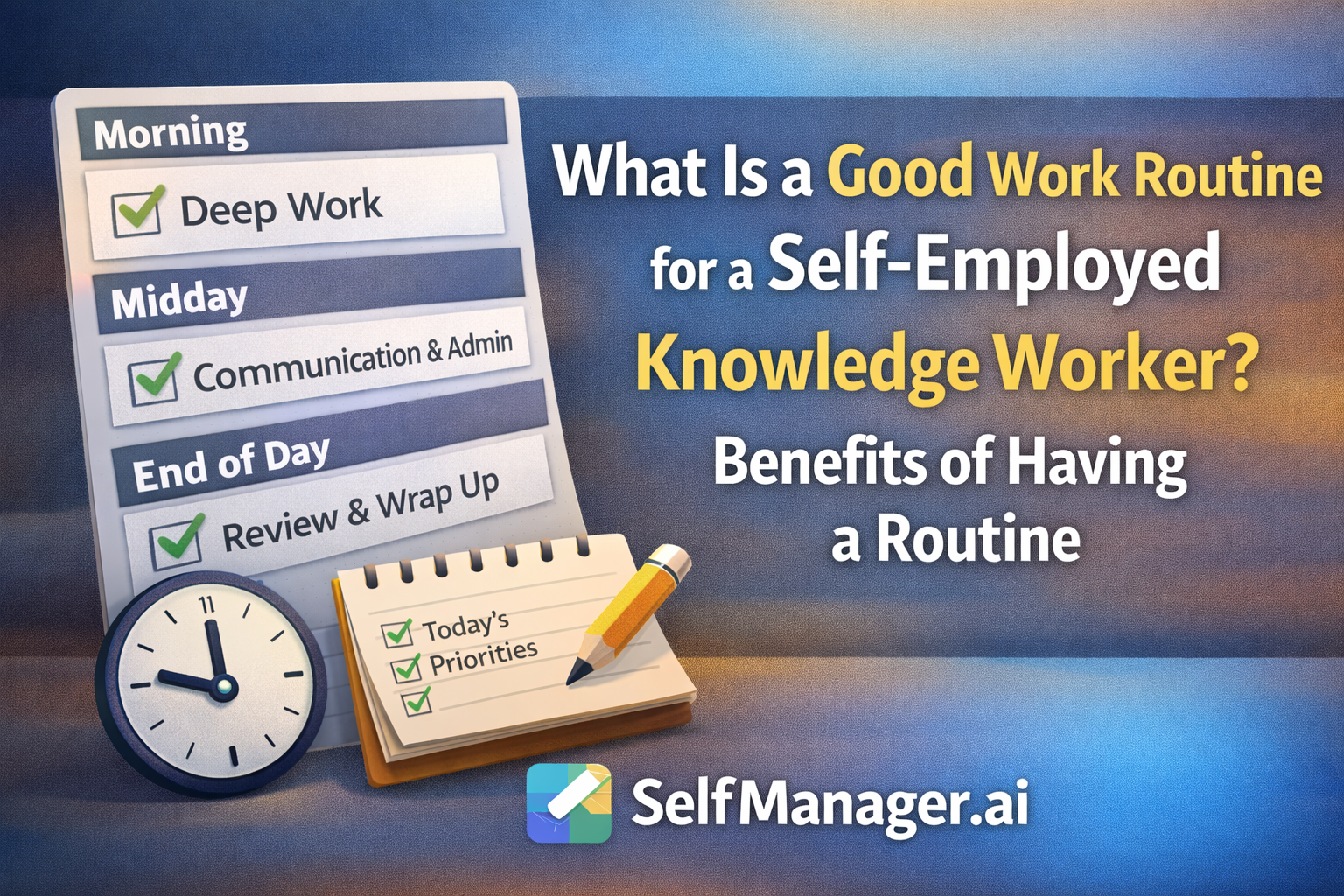
A simple example of a good work routine
A good routine could look something like this:
Morning
- review the day
- look at appointments
- choose top priorities
- begin with deep work before messages
Midday
- handle communication and lighter admin
- take a proper break
- reset the plan if needed
Afternoon
- continue important work
- finish secondary tasks
- complete follow-ups
End of day
- review progress
- move unfinished important items forward
- note tomorrow's priorities
- stop work clearly
The exact timing does not matter as much as the pattern.
What matters is having a repeatable structure that protects focus and reduces chaos.
Common mistakes self-employed people make with routine
1. Making the routine too rigid
A routine should support you, not control you excessively.
If it is too strict, it can become frustrating and unsustainable.
2. Letting communication dominate the day
Starting with email or messages often turns the day reactive.
3. Mixing all work types together
Deep work, shallow work, admin, and planning all require different mental states. A better routine respects that.
4. Never reviewing the day
Without review, the routine becomes mechanical and less useful. Reflection helps improvement.
5. Expecting perfect adherence
Routine is meant to guide the day, not create guilt every time reality changes.
What a good routine should feel like
A good routine should feel:
- clear
- supportive
- repeatable
- grounded in real life
- flexible enough to adapt
- strong enough to protect important work
It should not feel like a prison.
It should feel like useful structure.
That is the difference.
Why SelfManager.ai fits this especially well
SelfManager.ai is a strong fit for self-employed knowledge workers because it supports the kind of day-based structure that routine depends on.
A self-employed person usually needs more than a task list.
They need one place where they can see:
- today's priorities
- notes
- work categories
- personal items that affect the day
- ongoing progress
- review flow across days, weeks, and months
That is where SelfManager.ai stands out.
Instead of only acting as a traditional task manager, it helps turn the day itself into a practical workspace. That makes it easier to build and maintain a routine that actually reflects real life.
For self-employed people, this matters a lot.
Because when you run your own work, your routine is not just a productivity trick.
It is part of your operating system.
Final thought
A good work routine for a self-employed knowledge worker is not about removing freedom.
It is about making freedom usable.
It gives structure to independence.
It protects focus.
It lowers stress.
It improves consistency.
And it makes productive work more sustainable over time.
That is why routine matters so much.
Not because every day should look identical.
But because a reliable structure helps you do better work with less chaos.
And that is exactly the kind of daily clarity SelfManager.ai is designed to support.
Date-based AI Task Manager
Plan smarter, execute faster, achieve more
Create tasks in seconds, generate AI-powered plans, and review progress with intelligent summaries. Perfect for individuals and teams who want to stay organized without complexity.
Get started with your preferred account