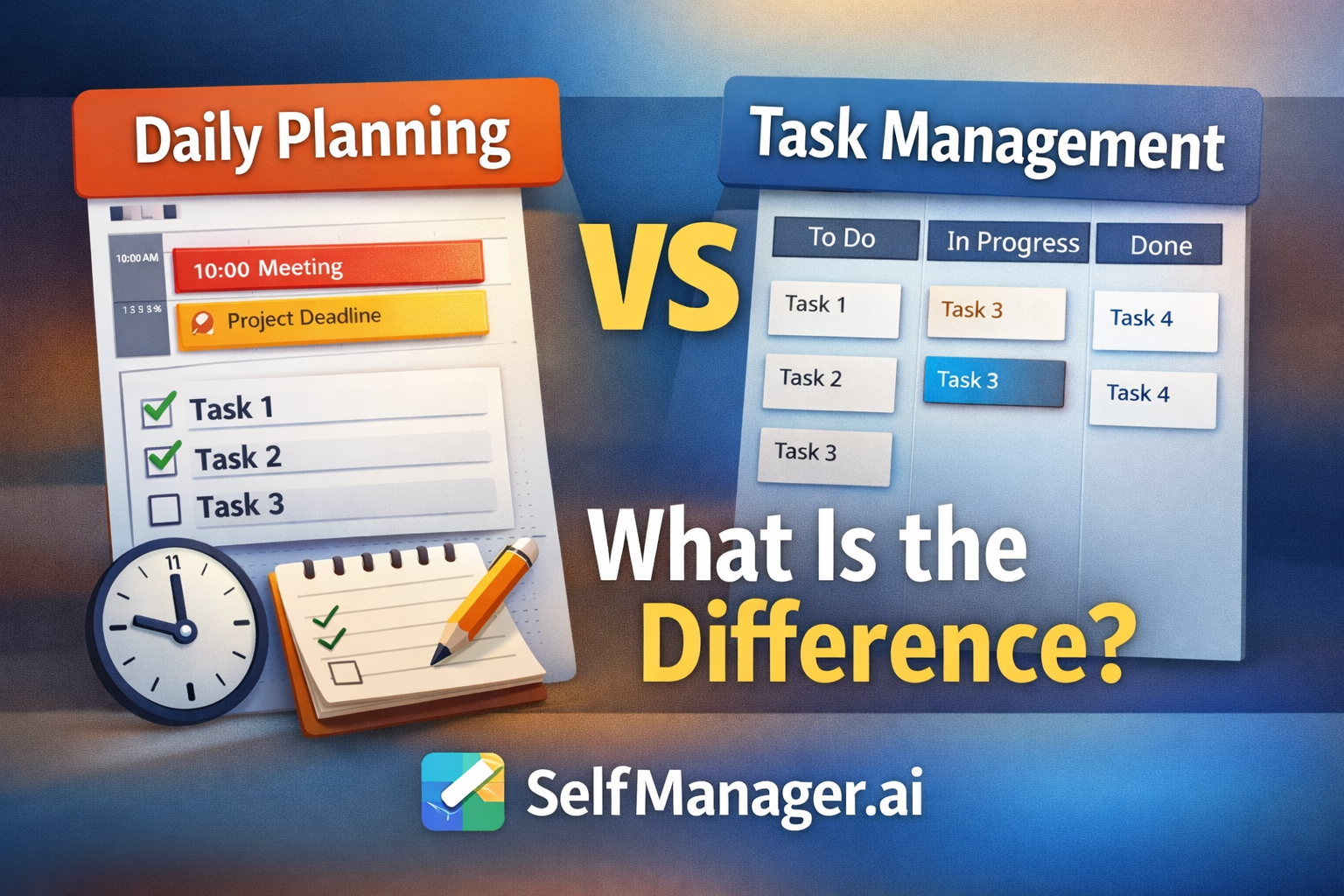
Daily Planning vs Task Management - What Is the Difference?
A lot of people use the terms daily planning and task management as if they mean the same thing.
They are connected, but they are not the same.
That difference matters more than it may seem.
Because many people do not actually have a productivity problem caused by laziness, lack of ambition, or lack of tools. They have a structure problem. They use task management tools for something those tools were not really designed to solve, then wonder why they still feel scattered during the day.
Task management helps you organize what exists.
Daily planning helps you decide how to live the day.
A good productivity system usually needs both. But if you understand the difference clearly, it becomes much easier to choose the right tool and build a system that actually works in real life.
What is task management?
Task management is the process of capturing, organizing, tracking, and completing tasks.
It usually focuses on questions like:
- What needs to be done?
- Which project does it belong to?
- What is the deadline?
- What is the status?
- Who is responsible for it?
- What should happen next?
Task management is mostly about structure.
It helps turn obligations into organized units. That can include personal tasks, team tasks, recurring work, deadlines, project workflows, and long lists of future responsibilities.
This is why many task management tools are built around:
- projects
- boards
- lists
- priorities
- due dates
- statuses
- tags
- assignees
That approach is useful. In many cases, it is necessary.
If you are working with a lot of tasks across multiple projects, task management gives you control and visibility.
But it still does not automatically tell you how to approach today.
What is daily planning?
Daily planning is the process of shaping the current day into something clear, realistic, and actionable.
It usually focuses on questions like:
- What matters most today?
- What can realistically fit into this day?
- What should I focus on first?
- What appointments, notes, responsibilities, and context belong to today?
- How do I move through today with less mental friction?
- How does today connect to the week, month, and bigger goals?
Daily planning is less about storing everything and more about creating a usable direction for the current day.
It is not just a database of tasks.
It is a working view of life as it is happening now.
That is why daily planning often needs more than tasks alone. It also needs:
- context
- notes
- priorities
- calendar awareness
- flexibility
- room for adjustment
- reflection
Task management can tell you everything you owe.
Daily planning helps you decide what today should actually look like.
The simplest difference
If you want the shortest explanation, it is this:
Task management is about organizing tasks.
Daily planning is about organizing the day.
That is the core difference.
And once you see that clearly, a lot of modern productivity frustration starts to make sense.
Many people are using tools that are very good at task storage and project organization, but not as strong at helping them run the day itself.
That is why a person can have a beautifully organized system and still wake up feeling mentally overloaded.
They have task structure.
But they do not have day clarity.
Why people confuse the two
People confuse daily planning and task management because they overlap.
Of course tasks are part of a day.
And of course a day contains tasks.
But that does not make the two concepts identical.
A task manager often becomes the default productivity tool because it is the easiest category to recognize. People add tasks, create lists, maybe build a few projects, and assume they now have a full planning system.
Sometimes that works for a while.
But eventually many people notice problems like:
- too many tasks, but no clear focus
- too many projects, but no realistic day plan
- tasks separated from notes and real-life context
- planning that feels abstract instead of practical
- a constant feeling of being behind
- lots of organization, but weak execution
That usually means the system is task-heavy and day-light.
What task management does well
Task management is extremely useful when you need to:
- keep track of many responsibilities
- manage projects with multiple steps
- store future work
- organize tasks by category or project
- assign ownership
- monitor status and deadlines
- avoid forgetting things
This is why task management tools are so popular.
They are excellent for capturing obligations and keeping work visible.
If you run a team, manage client work, or handle many moving parts, task management is an important layer.
It creates order.
It reduces the chance that important work gets lost.
It gives structure to complexity.
That is valuable.
But even the best task manager can still leave you wondering:
What should I actually do with this day?
What daily planning does well
Daily planning is useful when you need to:
- decide what matters today
- reduce overwhelm
- balance work and personal life in one practical view
- connect appointments, notes, and tasks
- build a realistic daily rhythm
- adjust when life changes
- stay focused on execution instead of just organization
A good daily planning system turns a pile of responsibilities into a workable day.
That is a very different kind of value.
It is closer to operational clarity than storage.
It is the difference between having a map of everything and knowing where to walk next.
Why classic project-board apps often feel incomplete for daily life
Classic project-board apps can be great for workflow visibility.
They are often useful for:
- team collaboration
- project pipelines
- status tracking
- moving work between stages
- seeing progress at a high level
But many of them are built around boards, projects, and workflow states first.
That means the main question becomes:
- what stage is this task in?
- which board is it on?
- which project does it belong to?
Those are valid questions.
They are just not always the most important questions for a person trying to get through a real day.
Real life is usually not experienced as a board.
It is experienced as:
- today's priorities
- today's meetings
- today's notes
- today's unfinished work
- today's interruptions
- today's decisions
- today's energy and limits
That is why many people eventually feel friction with project-board apps for personal productivity. The tool may be logically organized, but still not feel close enough to how the day actually unfolds.
Where SelfManager.ai is different
This is exactly where SelfManager.ai has a stronger angle.
Instead of treating productivity mainly as a set of project containers, SelfManager.ai treats the day itself as the practical workspace.
That changes a lot.
In SelfManager.ai, the goal is not only to store tasks somewhere cleanly. The goal is to make each day usable.
That means bringing together things that often get separated in traditional systems:
- tasks
- notes
- events
- categories of life and work
- priorities
- review flow
- time awareness
This makes SelfManager.ai feel closer to daily planning than to a classic board-based task manager.
And that is an important distinction.
Because many people are not looking for another place to store tasks.
They are looking for a better way to operate day by day.
Task management without daily planning can create hidden stress
One of the biggest problems with task-heavy systems is that they often grow faster than they guide.
You keep adding tasks.
You keep organizing them.
You keep improving the system.
But the day itself still feels foggy.
This creates a hidden kind of stress.
You know your obligations are somewhere in the system, but you still do not feel grounded. You still need to mentally reconstruct what matters today. You still have to pull context from different places. You still switch between tasks, notes, calendar, reminders, and projects.
That is why people can have a very organized task system and still feel mentally crowded.
The issue is not organization alone.
It is lack of day-level integration.
Daily planning without task management also has limits
The opposite problem exists too.
If someone only plans day by day without a larger task management structure, they may feel clear in the moment but lose control over the bigger picture.
Important things can get forgotten.
Future work can disappear.
Projects can become messy.
Priorities can drift.
Longer timelines can weaken.
That is why the best systems usually combine both ideas.
You need task management for continuity.
You need daily planning for clarity.
The real goal is not to choose one and reject the other.
The goal is to make them work together.
The best productivity systems connect both
A strong productivity system should help you do two things at once:
First, it should help you manage the full universe of responsibilities.
Second, it should help you reduce that universe into a clear and realistic day.
That is where many tools only solve half the problem.
Some are good at total task organization.
Others are better at immediate planning flow.
The most useful system is one that connects the two.
That is one of the biggest reasons SelfManager.ai makes sense for people who want more than a traditional task manager. It supports the ongoing structure of work while also giving each day its own operational space.
That makes it easier to move from:
everything I need to do
to
what I am actually doing today
That transition is where a lot of productivity systems break.
Signs you need more daily planning, not just more task management
If any of these sound familiar, you may not need a more advanced task manager. You may need stronger daily planning:
- You have too many tasks but do not know what to focus on today
- Your tasks are organized, but your day still feels chaotic
- You keep switching between calendar, notes, and task apps
- You feel productive on paper, but not in lived experience
- Your system stores work, but does not guide execution well
- You start the day without a clear plan
- You end the day unsure what really moved forward
These are usually signs that your system is not close enough to the day itself.
Signs you need stronger task management too
On the other hand, these signs usually mean you also need stronger task management:
- You forget important tasks
- You do not have a trusted place to store future work
- Projects become vague or incomplete
- Responsibilities are spread across too many random notes
- You lose track of deadlines
- You do not have enough structure to review ongoing commitments
A real productivity system needs both memory and direction.
Task management is the memory layer.
Daily planning is the direction layer.
So which one matters more?
For most people, daily planning matters more in the lived moment.
Because the day is where life is actually happening.
You do not experience your productivity system as a concept.
You experience it as today.
But task management still matters because it supports everything behind the scenes.
So the better answer is not that one replaces the other.
It is that daily planning should be the visible layer, while task management should support it in the background.
That is a much healthier model for real life.
Instead of forcing people to work directly from giant lists, scattered projects, or board columns all day, the system should reduce complexity into a clearer daily workspace.
That is where SelfManager.ai is especially strong.
Why SelfManager.ai fits this model well
SelfManager.ai is a strong fit for people who want more than classic task storage.
It is built around the idea that a day should have its own workspace, where the most important parts of life and work can come together in a practical way.
That includes:
- tasks that belong to the day
- notes connected to the day
- structure across different categories like work, personal, client, or content
- a better sense of what matters now
- review flow that helps connect today with larger progress
This approach gives users something many traditional tools do not:
A way to manage tasks without losing the human experience of the day.
That is a major difference.
And for many people, it is the difference that makes the system finally feel usable.
Final thought
Daily planning and task management are partners, but they are not the same thing.
Task management helps organize what exists.
Daily planning helps turn that into a clear day.
If your current system stores a lot but still leaves you mentally overloaded, the problem may not be that you need more features.
You may simply need a system that is built closer to how real life actually works.
That is why the difference matters.
And that is why SelfManager.ai stands out.
It is not just trying to help you manage tasks.
It is trying to help you run the day.
Date-based AI Task Manager
Plan smarter, execute faster, achieve more
Create tasks in seconds, generate AI-powered plans, and review progress with intelligent summaries. Perfect for individuals and teams who want to stay organized without complexity.
Get started with your preferred account