
Being Busy Is Not the Same as Being Productive (2026)
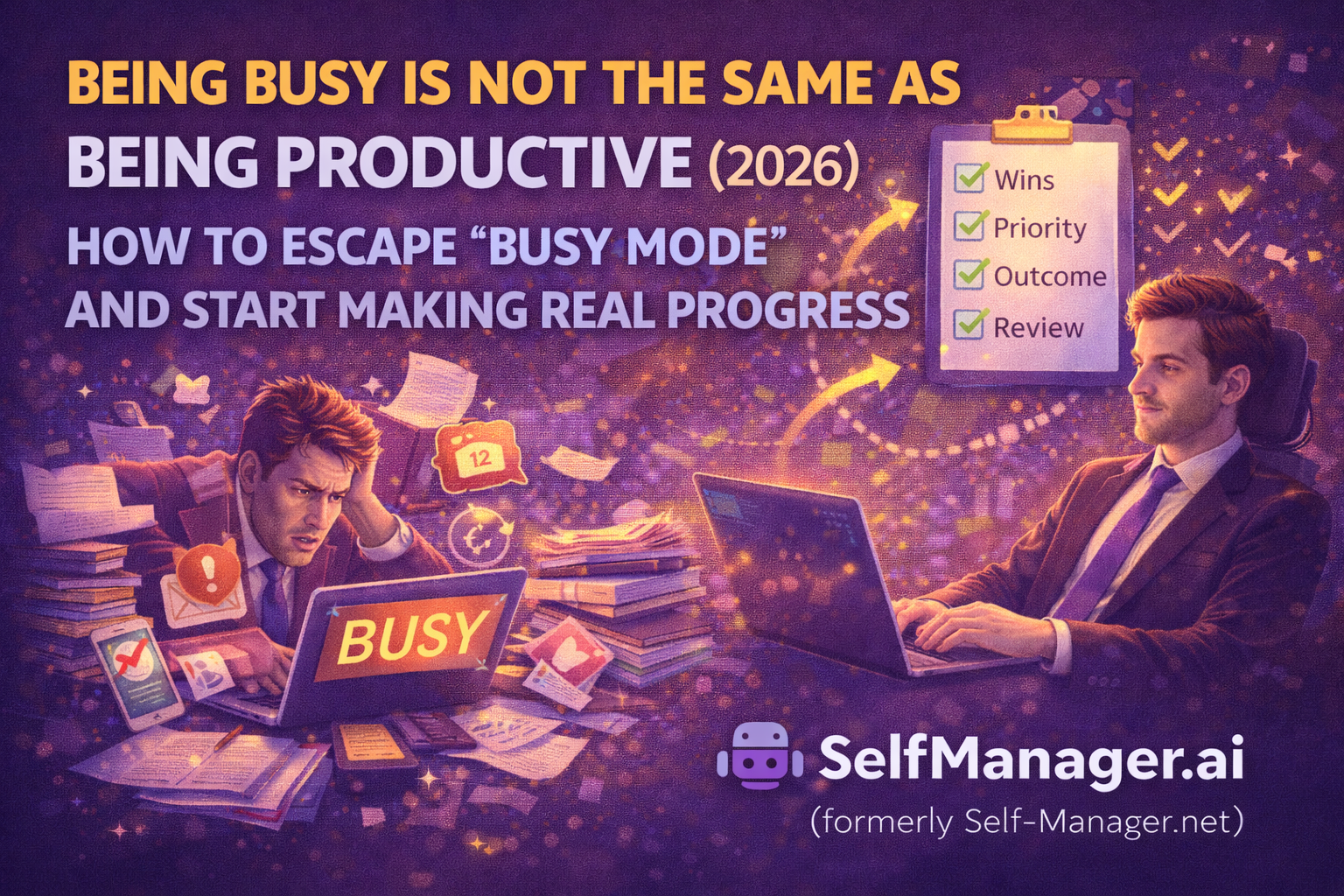
How to Escape "Busy Mode" and Start Making Real Progress
Most people don't have a productivity problem.
They have a busyness problem.
They spend the whole day doing things, switching between tasks, answering messages, reacting to requests…
…and still feel like nothing important moved forward.
That's the trap of 2026:
You can be busy all day and still make zero meaningful progress.
This article explains the difference, why "busy mode" is so addictive, and a simple system to shift from activity to outcomes — using a task + project manager (and why SelfManager.ai, previously Self-Manager.net, is built for this loop).
Busy vs Productive (the real difference)
Busy = high activity
- lots of small tasks
- many interruptions
- constant context switching
- fast dopamine from "checking things off"
- mostly reactive work
Productive = high impact
- clear priorities
- fewer tasks, but better tasks
- planned execution
- progress on important projects
- consistent review and adjustment
Busy feels productive because it looks like movement.
But movement isn't progress.
Why people get stuck in "busy mode"
1) Busy gives instant feedback
Answering emails gives quick closure.
A deep project gives delayed reward.
So the brain chooses the easy win.
2) Busy avoids discomfort
The important tasks usually contain discomfort:
- uncertainty
- learning
- risk
- responsibility
- possible failure
Busy mode is a safe escape.
3) Busy looks responsible
You feel like you're "working."
Even when the work doesn't matter.
4) Busy is socially rewarded
People respond to fast replies.
Nobody rewards your deep work until it ships.
So busy wins… unless you build a system.
The "activity trap": what busy mode looks like in real life
If this is your day, you're in busy mode:
- you start with email/messages
- you do 20 small tasks
- you jump between apps constantly
- you avoid the hardest thing
- you feel tired but unclear
- you end the day thinking "tomorrow I'll do the real work"
Then tomorrow repeats.
The productivity shift: measure outputs, not effort
The simplest fix is a mindset shift:
Stop asking: "Was I busy?"
Start asking: "What did I produce?"
Output examples:
- wrote a draft
- shipped a feature
- finished a proposal
- made a real decision
- moved one project forward
Effort can be high with no output.
Productivity is output.
The 3-question daily filter (kills 80% of busy work)
Before you start the day, ask:
- What is the one outcome that makes today a win?
- What are the 2 smaller outcomes that support it?
- What will I ignore today (on purpose)?
If you don't choose what to ignore, your day chooses for you.
The "Top 3 Outcomes" system (simple and powerful)
Busy mode happens when your task list is flat.
Everything looks equal.
Fix it by separating:
- Outcomes (results)
- Tasks (actions)
Each day:
Pick 3 outcomes.
Not 12.
Three.
Examples:
- Draft article outline
- Fix onboarding bug
- 5 follow-ups that unlock revenue
Then choose tasks that support those outcomes.
This is how you run a day like a CEO.
How a task + project manager helps you escape busy mode
A proper system helps because it gives you:
- priorities that stay visible
- projects that don't get forgotten
- a place to capture distractions (so they stop hijacking your focus)
- weekly reviews that expose what you're actually doing
Busy mode thrives on chaos.
A task manager creates structure.
Why weekly reviews are the real "busy mode killer"
Without weekly reviews, you can be busy forever and never notice.
A weekly review forces the truth:
- what moved forward
- what didn't
- what got avoided
- what kept repeating
- what needs to change next week
That reflection is the difference between:
busyness and improvement.
How SelfManager.ai fits (and why it's built for outcomes + reviews)
Most apps are great at storing tasks.
But escaping busy mode requires:
- planning by week/month
- tracking progress across projects
- review loops
- visibility into outcomes
That's where SelfManager.ai (formerly Self-Manager.net) is intentionally strong:
- date-centric planning (daily/weekly/monthly)
- support for review habits
- optional AI summaries to speed up reflection
It's not just "more tasks."
It's a system to move the right things forward.
Practical: the 10-minute weekly reset (copy/paste)
If you do nothing else, do this every week:
WINS
- What were my 3 biggest wins?
REALITY
- What didn't happen?
- Why?
BUSY TRAPS
- What did I spend time on that didn't matter?
NEXT WEEK
Top 3 outcomes next week:
Common signs you're productive (not just busy)
You're productive when:
- you can name your top priorities clearly
- your week has a few big outcomes, not 50 small tasks
- you ship something consistently
- you have fewer, better tasks
- you review and adjust weekly
- you feel calm even when you're working hard
Busy mode feels chaotic.
Productivity feels controlled.
Final thought
Busy is easy.
You can always find something to do.
Productivity is harder, because it requires choosing what matters — and ignoring the rest.
But once you build a system around outcomes and reviews, you stop living in reaction.
You start building real progress.
Date-based AI Task Manager
Plan smarter, execute faster, achieve more
Create tasks in seconds, generate AI-powered plans, and review progress with intelligent summaries. Perfect for individuals and teams who want to stay organized without complexity.
Get started with your preferred account