
How to Avoid Stress and Stay Productive: A Simple System for Busy Digital Life
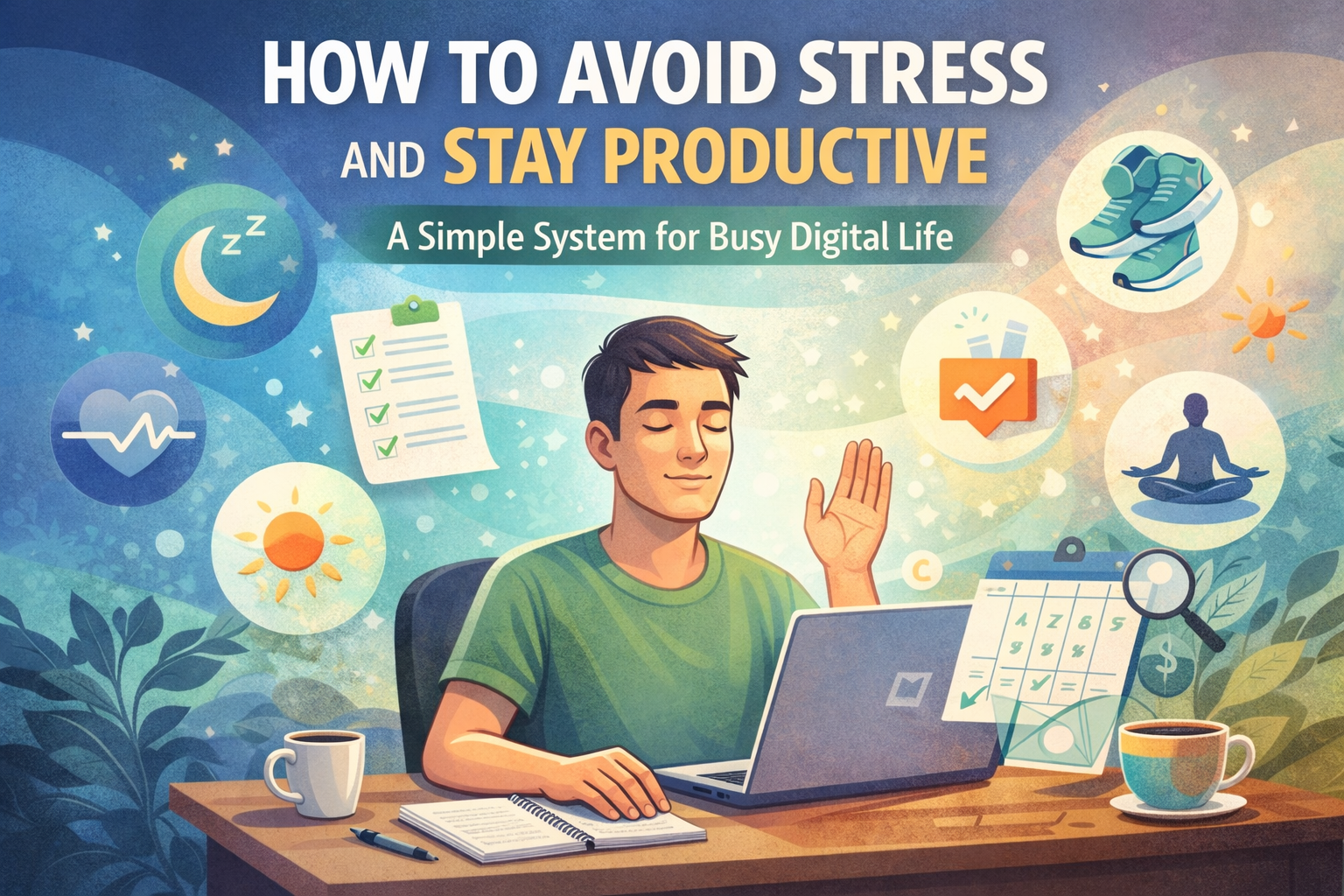
Stress kills focus, and "productivity hacks" don't help when your nervous system is overloaded. Here's a practical system to reduce stress, protect your energy, and stay productive—without working longer hours.
Most people don't lose productivity because they "lack discipline." They lose it because they're running on stress: poor sleep, constant notifications, too many open loops, and no real recovery. When stress is high, your brain defaults to short-term relief (scrolling, procrastination, sugar, random busywork) instead of meaningful progress.
This article is a practical system you can implement in days.
1. Understand the real problem: stress creates fake urgency
When you're stressed, everything feels urgent. You start reacting instead of choosing. Your day becomes: messages → interruptions → context switching → more stress → less progress.
The goal isn't "zero stress." The goal is to reduce chronic stress, so you can use your attention on what matters.
2. The 5 root causes of modern stress (and what to do about each)
A. Lack of sleep (you can't out-hack it)
Sleep loss makes everything harder: focus, patience, decision-making, emotional control. Start here.
Baseline target: adults generally need at least 7 hours of sleep per night.
What to do:
- Pick a consistent wake time (even weekends if possible)
- Stop "stealing" sleep to finish work; it usually backfires the next day
B. No movement (stress gets stuck in the body)
Movement is one of the most reliable stress reducers because it changes your physiology. Health guidelines commonly recommend at least 150 minutes/week of moderate activity (and strength training too).
What to do:
- Minimum: 20–30 minutes walk most days
- If busy: 3 x 10-minute walks still counts as real progress
C. No breaks (you try to brute-force focus)
Breaks are not laziness. Evidence suggests micro-breaks improve well-being (feeling more energetic / less fatigued) and can support performance, especially when fatigue is building.
What to do:
- Add micro-breaks: 1–3 minutes to stand, stretch, breathe, refill water
- Add one real break: 10–20 minutes away from screens
D. Information overload (news + social + notifications)
Constant negative information can keep your stress response "on." Public health guidance explicitly recommends taking breaks from news and social media when it becomes overwhelming.
What to do:
- Check news/social in one planned window, not all day
- Turn off all non-human notifications (apps should not be allowed to "summon" you)
E. No system (your brain holds everything)
When tasks, ideas, worries, and obligations are floating in your head, you feel pressure even when nothing is happening. You need an external system.
What to do:
- Capture everything into one place
- Decide once per day what matters
- Review once per week to close loops
3. A daily "anti-stress productivity" routine (15 minutes total)
Morning (5 minutes): Set the day
- Pick "Top 3 outcomes" (not 20 tasks)
- Time-block one deep-work window (even 45 minutes)
Midday (2 minutes): Reset your nervous system
Try a short breathing practice. Mindfulness-style breathing is commonly recommended as an easy way to reduce stress in the moment.
Example: breathe in slowly, pause briefly, exhale longer than you inhale. Repeat 5 times.
End of day (8 minutes): Shutdown ritual
- Write what's done (small wins count)
- Decide tomorrow's Top 3
- Park open loops (so your brain stops reloading them at night)
4. Weekly review: the stress-killer most people skip
Stress often comes from uncertainty + too many open loops. A weekly review turns "vague anxiety" into clear decisions.
Once per week:
- What are the 3–5 most important outcomes next week?
- What can be deleted or delayed?
- What's causing recurring stress (and what boundary fixes it)?
5. How to set this up inside Self-Manager (simple, effective)
Create these 4 recurring tables:
- Today: Top 3 outcomes + must-do admin
- Stress inbox: dump worries, tasks, "I should…" thoughts (process later)
- Routines: sleep, movement, breaks (recurring tasks)
- Weekly review: prompts + decisions + next week plan
Optional: use your AI summaries to turn messy weeks into clear next steps (less rumination, fewer repeated decisions).
6. A 7-day challenge (easy version)
- Day 1: Turn off non-human notifications
- Day 2: 7+ hours sleep target
- Day 3: 20–30 minute walk
- Day 4: Add micro-breaks (3 per day)
- Day 5: Top 3 outcomes every morning
- Day 6: Shutdown ritual at night
- Day 7: Weekly review + delete 10% of commitments
Small disclaimer
If stress feels constant, overwhelming, or starts affecting your health, relationships, or sleep long-term, consider speaking with a qualified professional.
Why this works
This isn't about "hustling harder" or adding more tasks. It's about designing your day to protect your nervous system.
When stress is low, you:
- Think more clearly
- Make better decisions
- Stay focused longer
- Recover faster
- Actually enjoy the work
The system above (sleep + movement + breaks + boundaries + weekly review) creates the conditions for real productivity—not the fake "busy all day but accomplished nothing" version.
How Self-Manager supports this approach
Self-Manager is built to reduce stress, not add to it:
- Date-centric design: Tasks are tied to dates, reducing "when should I do this?" anxiety
- Weekly reviews: Close open loops once per week, not constantly
- AI summaries: Get insights without spending mental energy analyzing
- Simple structure: No endless folders, tags, or categories to maintain
- Repeating tasks: Set up routines once (sleep, movement, breaks), never rethink them
The tool doesn't demand your attention—it supports your system.
Final thoughts
Productivity without stress management is just slow burnout.
The real unlock isn't working more hours—it's protecting your energy so the hours you do work actually count.
Start with one change:
- Fix your sleep
- Turn off notifications
- Add one 20-minute walk per day
- Do a 5-minute shutdown ritual tonight
Small, consistent changes compound faster than you think.
Date-based AI Task Manager
Plan smarter, execute faster, achieve more
Create tasks in seconds, generate AI-powered plans, and review progress with intelligent summaries. Perfect for individuals and teams who want to stay organized without complexity.
Get started with your preferred account