
How Marian Sorca Created a Date-Based System to Understand His Work, Life, and Progress
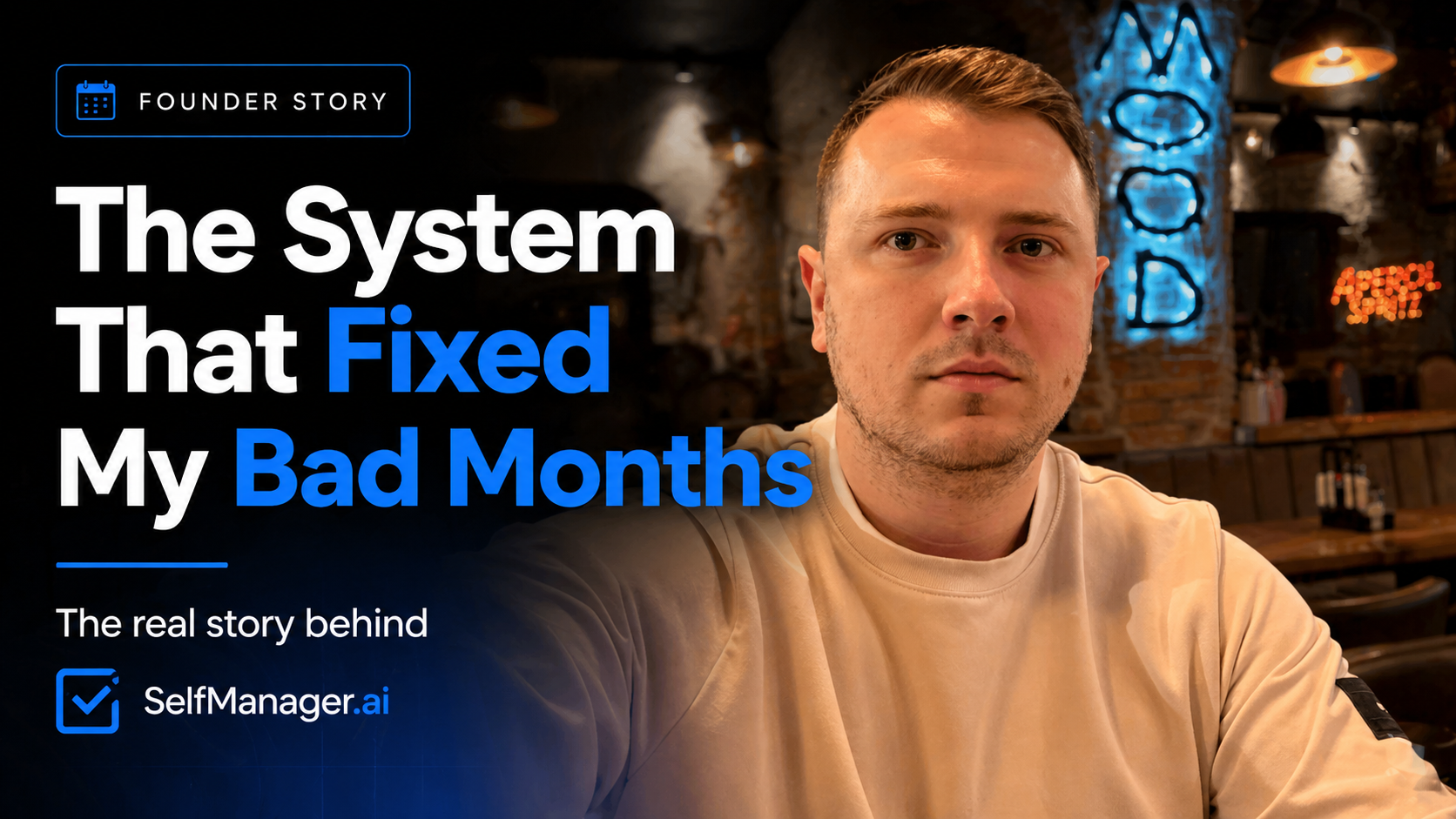
Most productivity stories start with someone who wanted to do more.
Mine didn't.
It started with a young freelancer who didn't think he needed a productivity system at all - and who only built one because, on the other side of a few hard months, he realized he had no way to understand what had happened to him.
That insight is the real origin of SelfManager.ai. Not the code. Not the launch. The moment I sat with old notes and saw a pattern I didn't expect.
The years before the system
In my early freelancing years, I thought to-do lists were for people who didn't have real work to do.
I had work. I had clients. I was busy. The idea of writing down tasks felt like overhead I didn't need. Sometimes I'd make a list anyway, mostly when something forced me to. Then I'd drop the habit a few days later.
I went on like that for a while. Some months were great. Some months were rough. I didn't think much about why.
The accidental review
Bad periods are good teachers, but only if you have something to look at.
When one of those rough stretches hit, I started flipping back through the few pages of notes and to-do lists I'd kept. Not looking for tasks - I was looking for an explanation. Why did this month feel off? Why did the previous one go so well?
The pattern was almost embarrassing in how clear it was.
The good periods were the ones where I had written things down.
Not because the lists made me magically more productive. Because writing things down meant I could see what had actually happened. The bad periods were invisible to me. The good ones had a record.
That was the moment the system started.
Adding dates to everything
The fix was small, almost stupid in its simplicity.
I started adding a date to every page. Every list, every note, every quick capture. The date became the anchor. Not because deadlines mattered more, but because dates gave me something to look back on.
A list without a date is just a list. A list with a date is a record. That difference is the whole thing.
Once dates were on everything, reviews became possible without effort. I could open the agenda, flip a few pages back, and actually see the shape of a week. I could compare a good month to a bad one and notice what was different - the kind of work, the energy, the people I was around, even the social media accounts I was following.
The system wasn't really about tasks. It was about being able to see myself clearly enough to learn from what I'd done.
Small additions that made the system feel human
Over the next few years, I added small things to the paper system, each one solving a specific problem.
A motivational note at the top of each day, something to set the tone before the work started. Not a quote from a book - usually just a sentence to myself.
Around the same time, I made another change that ended up shaping the app more than I expected. When I got serious about learning programming, I cleaned up who I followed on social media. About 10% close friends, and the other 90% accounts focused on programming, science, technology, business, and motivation. The idea was simple - whatever I saw every day on Facebook, Instagram, and YouTube would slowly shape who I became. So I made sure what I saw matched the direction I wanted to grow in.
That habit changed how I felt every time I picked up my phone. Instead of getting pulled sideways, I was getting nudged forward.
When I started building the digital version of the system, I wanted that same effect inside the app itself. Not as a gimmick - as a real part of the daily view, because the day is where everything starts.
That's where the image and video features in SelfManager.ai came from, and they show up in a few specific places:
Top hero image on the home view. A picture you choose, sitting at the top of your day. It can be a goal, a person you respect, a place you want to go, a quote you needed to hear. It's there every time you open the app, doing the same job that a curated social feed used to do - shaping the headspace you start the day in.
Left sidebar background image. Another personalization layer, always visible while you work. Same idea, different surface. The whole interface starts to feel like yours instead of a generic tool.
Unlimited images, kept in original quality. Throughout the day I take screenshots on desktop and mobile of things that stand out - a professional or personal win, an analytics chart trending up, a design inspiration that I like, something that stands out in that day, usually digitally. I wanted a place to drop all of them without thinking about storage limits or losing detail. So the app supports 100 images per table, with unlimited tables, which adds up to no real ceiling. And the images are kept in original quality and size on purpose. If a screenshot is worth saving, it's worth saving readable. Compressed thumbnails defeat the point.
Embedded playable videos inside comments. I'll often drop a YouTube video into the day I plan to watch it - a talk, a tutorial, something motivational, something connected to a project I'm working on. It plays right inside the app. The video becomes part of that day's record, not a tab I'll lose track of.
A physical calendar for future planning, separate from the daily agenda. Writing down what I wanted done by date X helped my subconscious work on it in the background. That sounds vague until you try it for a few months.
None of these were productivity tricks. They were ways of making the system match how a real day actually feels - not just what got checked off, but what kind of day it was.
Why I built the software version
By the time I'd been using the paper system for a few years, two things were true at once.
The system worked. I was a more focused freelancer, my months were more consistent, and I'd learned how to recover from bad periods because I could actually see them.
And I was becoming a software engineer. I liked building things. I'd never liked the sales side of freelancing, and the idea of building a tool for myself - one that I'd actually use every day - kept sitting at the back of my head.
Late 2016 was when the timing finally lined up. Google had just launched Angular 2, a framework mature enough to build a real web app on. I picked it because I wanted to learn it, and because the project I had in mind was the perfect scope - a digital version of the paper system I'd been refining for years.
I didn't sit down and design a productivity app. I sat down and tried to put my paper system into code.
What stayed and what changed
The structure didn't change. Dates first. Tasks inside days. Notes, context, and references living next to the work they belonged to.
What changed was the things only software can do. Search across years instead of flipping pages. Time tracking attached to real tasks. Images and links stored properly instead of taped into a notebook. Real-time sync so the system worked whether I was at my desk or on the move.
For seven years, it stayed a side project that only I used. No launch. No marketing. Just a tool getting better because I used it daily and fixed whatever annoyed me.
In 2022 I launched it publicly as Self-Manager.net. In 2024 I went all-in after seeing real interest from other people. In 2025 I added AI features and rebranded to SelfManager.ai.
The AI part is worth saying clearly: it only works because the structure underneath it has been date-first since 2016. AI on top of scattered tasks gives you generic summaries. AI on top of real days, with real context attached, can actually tell you what your week was like. That's the difference between a tool that organizes and a tool that helps you understand.
What the system is really for
If I had to summarize what this system does, it wouldn't be "manage your tasks."
It's about making your life better, becoming more efficient, reaching the goals you actually care about, and being able to look back and learn from what you did. All of it organized by date, because time is the real unit. It moves forward whether we like it or not - none of us get to vote on that. So the system runs on the one thing we can't stop.
The idea is simple. Combine the best of what humans do with the best of what software does, and let the result push you toward becoming an outstanding version of yourself in the areas you care about.
What software is good at
Humans are bad at remembering small details. You probably can't tell me what time you finished a particular task last Tuesday, or even what you worked on that morning. Software doesn't have that problem.
SelfManager.ai stores everything cleanly: every table has a log, and every task records when it was created, when it was started, when it was completed, and when it was last edited. Nothing gets lost.
On top of that, the small things that make daily work easier are all there:
- Search that actually finds anything across your years of data
- Linked tables you can open with one click, so related work stays connected
- Pinned tables for the things you check every morning
- AI on demand, available 24/7, ready to summarize a week, review a quarter, or help you reflect on what you did
What humans are good at
Deciding what matters. Knowing why a project felt heavy. Remembering the conversation behind a decision. Choosing the goal in the first place.
The system doesn't try to replace any of that. It just makes sure the data, the time, and the context are all in one place, so when you do sit down to think clearly, you have something real to work with.
What that looks like day to day
You can go back to any day in the past and see where your time went. You can read a comment where you journaled about an event and remember why you made the call you made. You can scroll forward and see what you want accomplished by a future date - the deadlines, the goals, the projects waiting for their turn.
You can review a week, a month, or a quarter and see whether you're actually on track for the year you said you wanted.
That's the loop. Plan, do, review, learn, plan again. With time as the spine and software handling the storage, search, and intelligence so you can focus on the parts only you can do.
And now: planning, not just reviewing
For the last year, the AI in SelfManager.ai has been excellent at one thing - helping you understand what you already did. Weekly reviews, monthly summaries, quarterly reflections, and chat on your real data.
Two days ago I shipped AI Plan, the 11th AI feature, which closes the other half of the loop. You describe what you want to achieve, optionally let it look at your last few months of real work, and it generates a complete dated plan - one table per day, with prioritized tasks, ready to edit and commit straight into your account.
Reviewing the past was already there. Now planning the future is too. Same structure, same dates, same system you already use.
I use it daily. I rely on it. I'm a power user of my own product, and I've been one for nine years.
Takeaways
- Productivity systems aren't only for doing more. They're for understanding what you've done.
- The simplest difference between a list and a record is a date. That one detail is what makes review possible.
- Bad periods are useful only if you can look back at them. A date-based system makes that automatic.
- Context matters. Tasks alone don't tell the story - notes, references, screenshots, and the feel of a day all belong with the work.
- Time is the real unit. It moves whether we choose it to or not, so building the system around it makes everything else easier.
- AI is only as good as the structure underneath it. Date-first data turns AI from a guess generator into a real review and planning partner.
- The best tool is usually the one you'd build for yourself. SelfManager.ai started that way and stayed that way.
Date-based AI Task Manager
Plan smarter, execute faster, achieve more
Create tasks in seconds, generate AI-powered plans, and review progress with intelligent summaries. Perfect for individuals and teams who want to stay organized without complexity.
Get started with your preferred account