
An Idiot With a Plan Can Beat a Genius Without a Plan
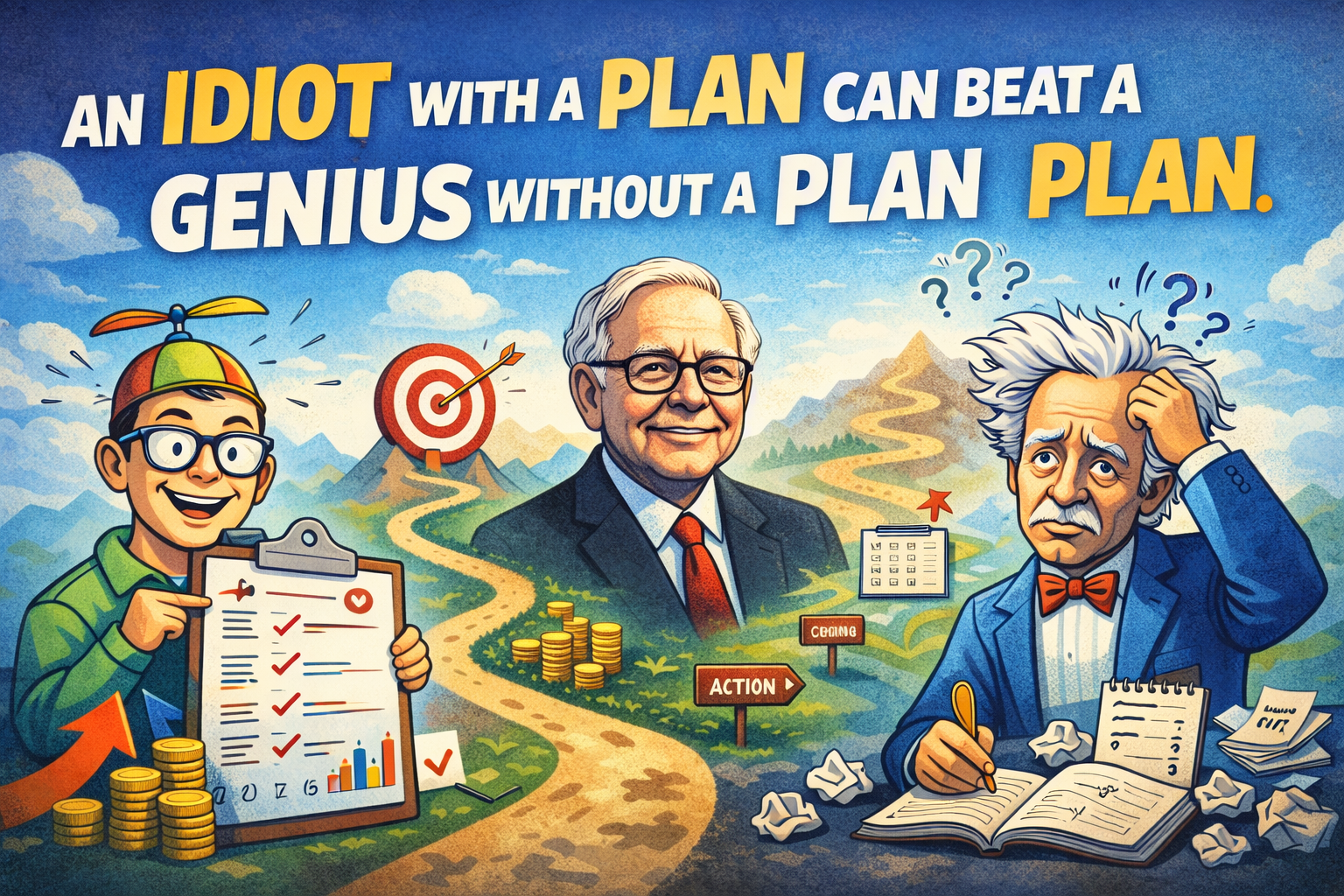
(Often attributed to Warren Buffett — and even if the exact source is hard to verify, the idea is brutally true.)
If you've ever watched a year disappear, you already know how this happens:
- you start with good intentions
- you stay busy
- you solve a lot of "urgent" things
- and somehow the big goals barely moved
That's the "genius without a plan" problem.
You can be talented, smart, fast, creative… and still lose to someone average who simply shows up with a clear plan and executes it consistently.
Why the quote hits so hard
Because it's not really about idiots vs geniuses.
It's about direction vs drift.
A plan does three things that raw intelligence doesn't automatically do:
- It converts intention into action
- It protects your time from randomness
- It creates feedback loops (so you can adjust early)
And those three things compound.
The real advantage of having a plan: fewer bad decisions
Most "failed years" aren't caused by one huge mistake.
They're caused by thousands of tiny decisions like:
- "Sure, I'll take that extra project."
- "I'll start this side thing too."
- "I'll do the important stuff next week."
- "This feels urgent, so I'll handle it now."
A plan gives you a simple filter:
Does this move my year forward?
If not, it's easier to say no—without guilt.
Plans beat motivation (because motivation is unstable)
Motivation is a nice spark, but it's not a system.
What actually works is making your plan specific and behavioral, not inspirational.
There's strong evidence in psychology that turning goals into concrete "if–then" plans (implementation intentions) improves follow-through because it pre-decides what you'll do when the moment arrives.
Example:
- Goal: "Get in shape"
- Plan: "If it's Monday/Wednesday/Friday at 18:30, then I train for 45 minutes."
Now your brain doesn't have to negotiate every time. It just runs the script.
The mistake most people make: they set goals, not a plan
Goals are outcomes. Plans are behaviors.
A goal without a plan is basically a wish with a deadline.
A good yearly plan includes:
- a target (what "success" means)
- a weekly system (what you do consistently)
- obstacle plans (what you do when life gets messy)
Because life will get messy.
A simple "non-genius" yearly plan that works
You don't need 20 goals. You need a few that matter.
1) Pick 3–5 goals for the year
Think in categories:
- Health / energy
- Relationships
- Money
- Business / career
- Learning
Write each as a measurable outcome.
2) Define the weekly system for each goal
Ask: What would this goal look like on a normal week?
- "Save €10,000" → "Save €200/week automatically"
- "Build an audience" → "Publish 2 posts/week"
- "Ship the product" → "3 focused build sessions/week"
3) Add "if–then" rules for obstacles
This is the part most people skip.
- "If I miss a workout, then I do a 15-minute minimum version the next day."
- "If I'm slammed with client work, then I do maintenance mode this week (not 'quit')."
How to run this inside Self-Manager
If you want Self-Manager to actually help you win the year (not just store tasks), set it up like this:
1) Create a pinned table: "Year Plan"
Columns:
- Goal
- Why it matters
- Success metric
- Weekly system
- Obstacles + if–then rule
- Next action
2) Use Quarterly Reviews to stay on track
A plan is useless if you never look at it again.
Quarterly reviews are the perfect rhythm:
- long enough for progress
- short enough to correct course
Review:
- What moved?
- What didn't?
- What should you stop doing?
3) Translate goals into weekly commitments
Each week, pick 3 "must-win" items that serve the year.
Not 30 tasks. Three meaningful outcomes.
4) Keep daily work small, visible, and repeatable
The winning strategy is boring:
small actions, repeated, tracked.
That's the entire game.
Final thought
The "idiot with a plan" wins because they don't rely on brilliance.
They rely on:
- direction
- consistency
- review
- adjustment
That's not motivational. That's mechanical.
And that's exactly why it works.
Date-based AI Task Manager
Plan smarter, execute faster, achieve more
Create tasks in seconds, generate AI-powered plans, and review progress with intelligent summaries. Perfect for individuals and teams who want to stay organized without complexity.
Get started with your preferred account