
Most Popular Task & Project Management Apps in 2025 (Ranked by Traffic)
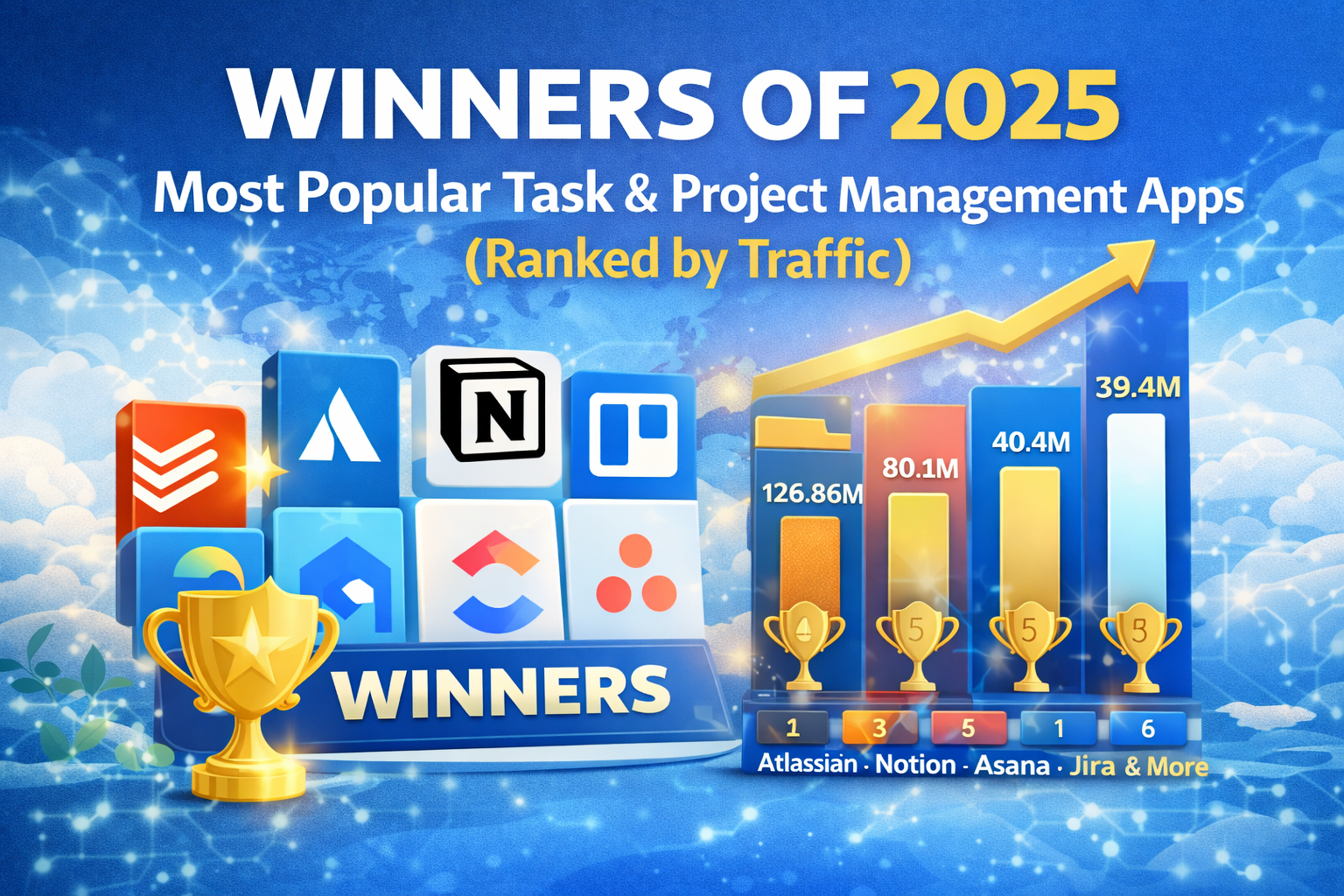
If you ask 10 people what the "most popular" task manager is, you'll get 10 opinions.
So in this article, I'm using a simple proxy for popularity: estimated website traffic. It's not perfect (apps have mobile users, desktop apps, and multiple domains), but it's a practical way to compare the "gravity" of each product in 2025.
How this ranking was built
- Ranking metric: estimated monthly website visits (November 2025 snapshot).
- Data source: Semrush traffic estimates for each domain.
- Important caveat: traffic ≠ active users. Some tools are used mostly inside logged-in workspaces, on mobile, or via desktop apps. Also, some products (like Notion) use multiple domains, so choosing the right domain matters.
Top apps in 2025 ranked by estimated web traffic
(Estimated monthly visits, November 2025)
| Rank | App (domain used) | Est. monthly visits (Nov 2025) | Notes on scale (publicly stated) |
|---|---|---|---|
| 1 | Atlassian Cloud (atlassian.net – Jira/Confluence, etc.) | 140.28M | Atlassian reports 300,000+ customers overall. |
| 2 | Notion (notion.so) | 126.86M | Notion announced it passed 100M users. |
| 3 | Trello (trello.com) | 80.1M | Trello publicly celebrated 50M registered users (milestone announced earlier, but shows scale). |
| 4 | ClickUp (clickup.com) | 40.04M | ClickUp says it's trusted by 10M+ users and has referenced 2M teams. |
| 5 | Asana (asana.com) | 39.4M | Asana has disclosed 3M+ paid users and 150,000+ paying customers (in filings/earnings context). |
| 6 | monday.com (monday.com) | 37.62M | monday.com investor materials cite ~245,000 customers (as of June 30, 2025). |
| 7 | Airtable (airtable.com) | 25.84M | Airtable's "organizations" counts are often reported by third parties (commonly cited around 450k orgs), but not always consistently sourced. |
| 8 | Smartsheet (smartsheet.com) | 16.79M | Enterprise-heavy adoption; popularity isn't just web traffic. |
| 9 | Todoist (todoist.com) | 9.45M | Strong consumer/prosumer footprint; simpler than "work management suites." |
| 10 | Teamwork (teamwork.com) | 3.5M | Often positioned for client services/agencies; narrower audience than the giants. |
Quick notes on what "made them popular" in 2025
1) Atlassian Cloud (Jira / Confluence)
Jira remains a default choice for engineering-led teams because it's deeply integrated into dev workflows (tickets, sprints, releases), and Atlassian's ecosystem is huge. Atlassian also reports very large customer scale overall.
2) Notion
Notion's popularity comes from being flexible: notes, docs, databases, lightweight project tracking, and templates. In 2024 it announced passing 100M users, and that momentum carried through 2025.
3) Trello
Trello stayed popular because it's easy to adopt: boards, lists, cards, and quick collaboration. It's often the "first real project tool" teams try before moving to heavier systems.
4–6) ClickUp, Asana, monday.com
These three are the modern "work hubs" for many teams:
- ClickUp pushes an all-in-one story (docs, tasks, dashboards, AI features).
- Asana is known for structured task/project execution and cross-team coordination, with large paying-customer scale.
- monday.com grew into a broad platform (projects + CRM + ops workflows), and publicly cites ~245k customers.
7–8) Airtable and Smartsheet
These sit in the "work management + structured data" space:
- Airtable is popular for teams that want database-like power without building custom software.
- Smartsheet is very enterprise-friendly and spreadsheet-native, which keeps it sticky in operations-heavy orgs.
9–10) Todoist and Teamwork
- Todoist is a strong personal/prosumer task manager (simple, fast, habit-forming).
- Teamwork tends to win in agency/client work where projects need clear client visibility and accountability.
A note on "ranking by users" vs "ranking by traffic"
If you rank by publicly stated users/customers, the order can look different because:
- Some companies publish user counts (Notion, ClickUp), others publish customer counts (monday.com, Atlassian), and some publish "paid users" metrics (Asana).
- "Customer" can mean an organization; "user" can mean an individual; "paid user" is another category entirely.
That's why traffic is useful as a single consistent yardstick, even if imperfect.
An app worth watching: SelfManager.ai
Most popular tools in 2025 still revolve around boards, projects, and workspaces.
SelfManager.ai is worth watching because it approaches personal project management differently: date-based organization (so your work lives on actual days/weeks/months), plus AI-powered summaries/reviews that make weekly and monthly reflection much easier—especially if your goal is consistency over the whole year rather than random bursts of productivity.
If 2026 becomes the year more people treat their personal goals like a system (not a mood), tools built around reviews + time context will stand out.
Date-based AI Task Manager
Plan smarter, execute faster, achieve more
Create tasks in seconds, generate AI-powered plans, and review progress with intelligent summaries. Perfect for individuals and teams who want to stay organized without complexity.
Get started with your preferred account